

A cruise insurance pre existing condition waiver can protect more than the fare, but only when the actual insurance policy includes the waiver and every eligibility condition is met. The first cruise deposit can start a short purchase clock. Later flights, hotels, excursions, and final payment can create reporting duties. A cruise line’s separate cancellation fee waiver may not be insurance at all.
This U.S.-focused guide follows the booking from initial deposit through a possible claim. It is educational, not medical, insurance, or legal advice. State forms and cruise protection packages vary, so use the documents issued for the traveler’s residence and booking.
Key takeaways
- Identify whether the product is insurance, assistance, a cancellation fee waiver, or a bundle.
- Count the time-sensitive period from the policy’s defined initial trip payment, not automatically from final payment.
- Insure and update every required prepaid nonrefundable trip cost.
- Check how the form treats traveling companions and non-traveling relatives.
- Shipboard treatment, shore evacuation, trip interruption, and cancellation use different benefits.
Reviewed August 16, 2026. Purchase windows, state forms, waiver requirements, trip-cost rules, people, and benefit limits vary. The issued policy, schedule, declarations, endorsements, and non-insurance terms control.
First separate two kinds of “waiver”
A pre-existing-medical-condition exclusion waiver is an insurance provision that can remove a stated exclusion from applicable benefits when the policy conditions are satisfied. A cancellation fee waiver is an agreement by a travel supplier to waive some or all cancellation fees under its own terms.
The NAIC Travel Insurance Model Act defines a cancellation fee waiver as a contractual agreement with a travel supplier and says it is not insurance. The NAIC’s travel-insurance topic page also distinguishes insurance from non-insurance cancellation waivers and assistance services.
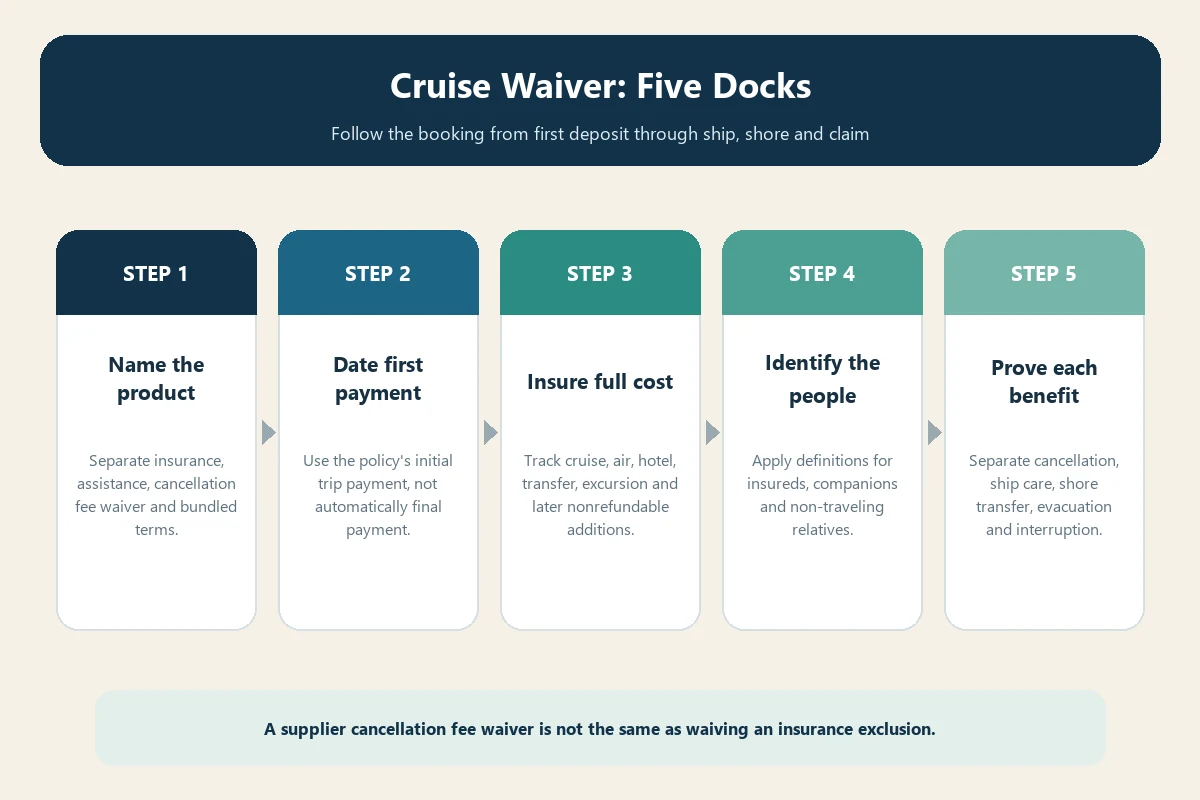
Dock one: identify every protection component
Download the cruise line’s plan description, insurance policy or certificate, schedule of benefits, declarations, endorsements, assistance terms, and any cancellation waiver. Record the insurer, plan administrator, cruise line, policy form, state, and effective dates.
The cruise insurance clauses guide explains how medical, evacuation, missed connection, interruption, and itinerary-change terms differ. A one-price package can contain several legal products.
Cruise-line plan versus independent policy
A cruise-line package may focus on the cruise booking and offer a supplier cancellation feature. An independent comprehensive plan may allow the traveler to insure the wider trip, including separately booked airfare and lodging. Either type can have useful or limited terms.
Do not choose by channel alone. Compare the actual pre-existing exclusion, waiver conditions, medical and evacuation limits, trip-cost definition, covered suppliers, payment rules, and state form.
Dock two: find the initial trip payment
The first refundable cruise deposit can still be the policy’s “initial trip payment” if the definition uses the first payment toward the trip. Waiting until final payment may miss a 14-, 15-, or 21-day purchase window.
Travel Guard’s current cruise plan guidance describes early-purchase benefits during the first 15 days after the initial trip payment. That is a carrier example; the traveler must use the number in the issued policy.
Build a cruise payment timeline
List the booking date, initial deposit, insurance purchase, airfare, hotel, transfer, final cruise payment, excursion, dining package, tour, and every later addition. Save itemized invoices and card statements.
The waiver purchase-deadline guide explains how to identify day zero and count calendar days. Never rely on “coverage was bought before sailing” when the policy counts from the first payment.
Dock three: insure the required trip cost
A waiver may require the insured amount to equal all prepaid nonrefundable trip costs or all cancellation penalties up to a stated maximum. The initial deposit is only the beginning; final payment and added arrangements can increase the amount at risk.
A state-specific Travel Guard Cruise Protection Plan policy example requires purchase within its time-sensitive period, medical ability to travel, and coverage equaling all cancellation penalties, with later arrangements updated within 21 days. Other plans and states can differ.
What counts as cruise trip cost?
Read the definition rather than assuming. The cruise fare, taxes, nonrefundable air, pre-cruise hotel, transfers, excursions, tours, and post-cruise arrangements may be treated differently. Refundable amounts and loyalty points can have special rules.
Create a ledger with supplier, purchase date, gross cost, refundable amount, nonrefundable amount, insured update date, and proof. If the policy permits zero trip cost for medical-only coverage, confirm whether doing so forfeits the waiver or cancellation benefit.
Final payment is a checkpoint, not necessarily the deadline
At final payment, reconcile the insured amount with the cruise line’s cancellation schedule. Report required increases inside the policy’s update window. Do the same for a later flight change, cabin upgrade, or excursion.
A final-payment reminder is useful operationally, but it cannot reopen a time-sensitive waiver window that already closed. Ask the insurer to confirm the updated insured cost in writing.
Dock four: identify whose condition can cause the loss
The relevant person may be the insured traveler, a traveling companion, a family member, a business partner, or a host. Each policy defines these terms. A parent at home can trigger a cancellation analysis even though the parent is not sailing.
Use the non-traveling family-member guide and the traveling companion guide to keep definitions, medical history, and relationship proof separate.
The waiver may require all insured travelers to be able to travel
Some plans require the insured traveler or all insured travelers to be medically able to travel when the plan is purchased. A clinician can document health facts and restrictions, but the insurer applies the policy standard.
The medically-able-to-travel guide explains which dated records can support the application. Do not postpone necessary care or change medication to preserve an insurance argument.
Dock five: match the event to the right benefit
A condition can cause pre-departure cancellation, shipboard treatment, transfer ashore, emergency evacuation, trip interruption, or extra return costs. The waiver may remove an exclusion from applicable coverages, but each benefit retains its own trigger, limit, and proof.
The cruise pre-existing-condition overview covers the general relationship. For a claim, make a separate worksheet for every benefit rather than one undifferentiated “medical claim.”
Shipboard care can be only the first expense
The onboard medical center may charge the traveler directly. A more serious event can require disembarkation, local hospitalization, shore ambulance, an escort, hotel, or a new return itinerary. Medical expense, evacuation, delay, and interruption can all become relevant.
Obtain the ship medical record, itemized bill, payment receipt, incident report, disembarkation instruction, port-agent contacts, and local facility record. Keep expenses separated by date and purpose.
Evacuation does not automatically mean transport home
An evacuation benefit may authorize movement from the ship or port to an appropriate facility able to treat the patient. Repatriation home may require stabilization, medical necessity, separate approval, or different wording.
The medical evacuation limits guide explains destination control and authorization. Contact the assistance team as soon as practical and do not independently book nonurgent air transport without understanding the policy.
Excursions create their own evidence trail
Confirm whether an excursion is part of the insured trip and whether the activity itself is covered. A cruise-line excursion, independent tour, scuba dive, scooter rental, or remote hike can have different supplier terms and activity exclusions.
Save the excursion receipt, operator terms, activity description, waiver forms, local incident report, witness information, and medical record. A pre-existing-condition waiver does not remove an adventure-activity or intoxication exclusion.
Missed port and itinerary change are not the same as cancellation
A changed port, shortened call, or revised itinerary may not trigger trip cancellation coverage. Read itinerary-change, missed-connection, delay, and inconvenience benefits separately, including whether a flat payment or documented loss is required.
Do not attribute an operational itinerary change to a medical condition unless the facts support it. Supplier credits and refunds must be deducted according to the policy.
Keep medical history accurate
The insurer may request records from the look-back period for the traveler or relative whose condition caused the loss. Preserve symptoms, visits, tests, treatment, recommendations, and medication changes with dates.
The pre-existing-condition claim documents guide organizes policy, medical, trip-cost, causation, and financial proof without asking a clinician to make a coverage conclusion.
Claim workflow after a cruise medical event
- Seek appropriate care and follow ship and port emergency instructions.
- Notify the assistance administrator as soon as practical.
- Ask which transfers or return arrangements require approval.
- Collect ship, shore, transport, and physician records before leaving.
- Request refunds or credits from the cruise line and other suppliers.
- Submit the waiver timeline, full trip-cost ledger, and benefit-specific proof.
- Keep copies, delivery confirmations, and responses from other insurance.
Questions to ask before final payment
- Is this product insurance, a cancellation fee waiver, assistance, or a bundle?
- Does the exact state policy waive the pre-existing-condition exclusion?
- What date starts the time-sensitive period?
- Which trip costs must be insured and when must additions be reported?
- Which people and benefits receive the waiver?
- Are ship medical care and shore evacuation covered, and at what limits?
- Who authorizes evacuation and what destination is permitted?
- Does renewal, rebooking, or moving the sailing require an update?
Bottom line
A cruise insurance pre existing condition waiver requires more than buying protection before departure. Separate insurance from a supplier cancellation waiver, preserve the initial-payment clock, update the full required trip cost, identify every relevant person, and match each event to the proper benefit. On a cruise, the strongest file connects the booking ledger, waiver conditions, ship and shore medical records, assistance authorization, and net financial loss.
