

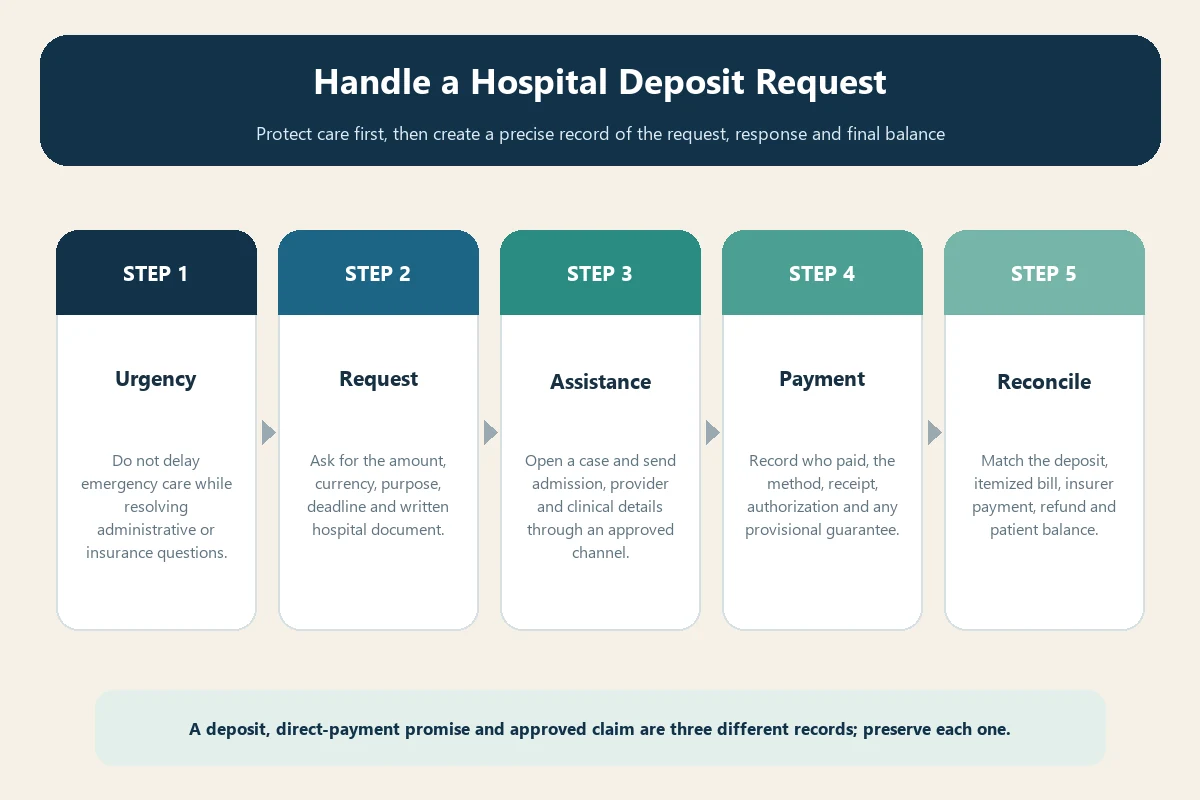
A travel medical insurance hospital deposit is an upfront payment request from a provider, not proof that the expense is covered or denied. The hospital may need money or a payment commitment before admission, while the assistance team is still confirming identity, clinical facts and policy details. Protect urgent care first, then create a precise record of the request, response, payment and final balance.
Key takeaways
- Ask the hospital to state the amount, currency, purpose and deadline in writing.
- Open an assistance case promptly without treating the case number as claim approval.
- Keep deposits, provisional guarantees, insurer payments and refunds as separate records.
- Request an itemized final bill and reconcile it against every payment.
- Do not delay emergency treatment solely to complete an administrative step.
Planning information reviewed August 16, 2026. Hospital payment practices and insurance procedures differ by country, facility and certificate. In an emergency, seek care first and contact assistance as soon as practical.
Separate the hospital’s request from the policy decision
A deposit answers the hospital’s question: what financial assurance is required before care or admission proceeds? Coverage answers a different question: which expenses meet the certificate after exclusions, limits, cost sharing and evidence are applied. Both processes can run at the same time.
The travel medical direct billing guide distinguishes provider acceptance, an assistance case, a provisional payment guarantee and final claim adjudication. Use those labels in every message.
Protect urgent care before paperwork
If the patient has a life-threatening or rapidly worsening condition, follow local emergency instructions. Do not wait for an insurer callback before calling emergency services or beginning medically necessary stabilization.
Ask a companion, hospital employee or clinician to contact assistance while care proceeds. Record why prior authorization or payment coordination could not be completed first. The timeline can matter when the policy contains an emergency exception.
Get the deposit request in writing
Ask for the amount, currency, payment deadline, reason, refundable status, patient name, hospital name and department. Determine whether the money is a general admission deposit, estimated patient share, advance for a specific procedure or security against the entire projected bill.
A card terminal amount or handwritten figure without context is weak evidence. Request an official receipt or invoice number. Photograph the document and preserve the original.
Ask what happens if the estimate changes
A hospital can request an additional deposit when the stay, procedure or clinical plan changes. Ask how often the estimate is reviewed, who authorizes increases and whether unused funds are automatically returned.
Record each demand as a new row rather than replacing the earlier amount. A chronological ledger prevents a later insurer payment or hospital refund from being matched to the wrong deposit.
Open the assistance case promptly
Provide the policy or certificate number, patient identity, location, hospital contact, diagnosis or presenting problem, admission status, treating clinician and written deposit request. Use only the communication channel stated in the issued documents.
The assistance and claims guide explains why coordination does not establish payment. Save the case number, time, representative and exact next step.
Confirm what the hospital will accept
Some facilities accept a card, cash, bank transfer, insurer payment guarantee or direct payment. Others require the patient to pay and file for reimbursement. Ask the admissions office which forms are accepted and whether treatment can begin while financial verification continues.
Do not send sensitive medical or payment information to an address supplied only through an unsolicited message. Confirm the hospital and assistance contact through official channels.
Understand a provisional payment guarantee
A guarantee of payment can be conditional, limited to a stated amount or service, and subject to later claim review. It may help a hospital proceed without the full patient deposit while leaving deductibles, excluded services or nonpayable balances unresolved.
Ask for the guarantee amount, dates, services, exclusions and recipient in writing. Determine whether the hospital released the patient’s deposit after receiving it or kept both forms of security.
Do not confuse preauthorization with eligibility
Preauthorization can confirm that a proposed service passed a procedural review. It does not necessarily prove the illness is covered, all charges are reasonable, the provider meets definitions or no exclusion applies.
The travel medical benefits guide maps event, service, cost sharing and evidence. Apply every layer even when assistance arranged the hospital contact.
Prepare to pay when coordination is unavailable
The U.S. Department of State states in its current medicine and health guidance that payment or a deposit is required before services in many locations. Travelers should plan a lawful, secure way to access emergency funds.
If payment is required, obtain the strongest possible record. Do not rely on a card statement alone. Ask for an itemized receipt tied to the patient, date, purpose and hospital account.
Create a payment ledger immediately
For each transaction, record date, local amount, currency, payer, payment method, hospital receipt number, stated purpose and refundable status. Add insurer payments, other-plan payments, provider adjustments and refunds as separate negative or positive rows.
Keep the original currency throughout the ledger. Add the card exchange rate and fee only when the claim instructions request them. Do not invent a conversion from a search result.
Request an itemized running bill
A deposit receipt shows money transferred, not the services delivered. Ask for a running account that lists room, clinician, tests, medicine, procedures, supplies and transport. Review it during a longer admission rather than waiting until discharge.
For cash payments, use the cash receipt checklist and fictional reconciliation example to keep the deposit, final bill and any refund separate.
The hospitalized abroad guide provides a record checklist for clinical summaries and bills. Pair financial records with the treatment timeline.
Apply the deductible and cost share after eligibility
A hospital can estimate a deposit without knowing the policy deductible, coinsurance or allowed charge. The traveler’s final responsibility may therefore differ from the requested amount even when the underlying treatment is eligible.
Use the travel medical deductible guide to identify the reset unit. Add service limits, provider-network rules and other insurance before calculating the payable amount.
Coordinate a domestic health plan
A U.S. health plan may cover some overseas emergency care or require notice. A travel policy can operate as primary or secondary according to its wording. Ask both plans what evidence they require and which decision must occur first.
The primary versus secondary guide explains the payer sequence. A hospital deposit still belongs in the ledger even if another plan ultimately pays part of the bill.
Track treatment that the deposit does not cover
A deposit may be applied only to hospital charges, while outside specialists, ambulance providers, pharmacies or laboratories bill separately. Ask which providers are part of the hospital account and which will issue their own invoices.
Do not submit one deposit receipt as proof of every service. Obtain supporting bills from each provider and match them to the clinical record.
Reconcile the account before discharge
Request a statement showing total charges, adjustments, insurer or guarantor payments, deposits applied, refunds due and patient balance. Confirm where any refund will be sent and how long the hospital expects processing to take.
If the final bill is unavailable, obtain an interim statement and a named billing contact. Keep proof that the traveler requested the final documents before leaving the country.
Preserve evidence after a hospital refund
A refund does not erase the original deposit. Keep the receipt, account statement, refund notice and bank or card proof. The claim must show the net amount that remained paid by the traveler.
If the insurer reimbursed before the hospital refund arrived, notify the claims administrator. A duplicate recovery can create an overpayment that must be corrected.
Build the claim packet in chronological order
Include the incident statement, assistance case, deposit request, admission note, clinical records, authorization or guarantee, deposit receipt, itemized bill, discharge summary, all payments, refunds and other-payer decisions. Add a one-page ledger at the front.
The travel claim documentation guide explains how to preserve originals and submit the unreimbursed balance. A clean sequence reduces questions about who paid what.
Read the certificate for payment-process terms
Search for deposit, advance, guarantee, direct payment, direct billing, preauthorization, notification, emergency, proof of claim, other insurance, reasonable charge and reimbursement. Follow each definition and exception.
The policy reading guide helps trace cross-references. Record page numbers and ask the insurer to confirm how the terms apply to an admission-deposit scenario.
Use official guidance as the planning baseline
The CDC Yellow Book’s international insurance chapter says travelers may need to pay out of pocket, sometimes before care, and later submit bills and invoices. The U.S. Department of State’s insurance guidance also notes that some policies can make direct hospital payments.
These sources establish the risk, not the terms of a particular claim. The issued certificate and actual hospital record remain controlling evidence.
Test a deposit scenario before travel
Assume a hospital requests an admission deposit after an emergency evaluation. Ask: who contacts assistance, what document is sent, how long the facility will wait, what payment method is available, whether a guarantee can replace the deposit and how unused money is returned.
NAIC’s current consumer guidance advises travelers to ask whether insurer approval is needed before care. Scenario testing turns that question into an operational plan.
Make the final hospital deposit plan
A reliable plan includes the local emergency pathway, assistance contacts, policy documents, a secure payment method, a companion communication role, a hospital-document checklist and a reconciliation ledger. It assumes that coverage and cash flow are related but not identical.
The best response to a travel medical insurance hospital deposit is calm separation of records. Protect care, document the hospital’s demand, activate assistance, preserve every payment and reconcile the final account before claiming only the remaining eligible amount.
Document check and editorial update
October 7, 2026: Linked the receipt checklist and clarified the relationship between a hospital deposit, the final bill and any refund.
This update is editorial document research; no licensed insurance professional review is claimed. The issued policy, schedule and endorsements determine coverage. See our editorial policy.
