

Travel medical insurance benefits are the specific services and expenses a policy may pay after an eligible illness or injury abroad—not a promise that every medical bill will be reimbursed. A useful comparison follows each benefit from its trigger through exclusions, cost sharing, authorization, payment and claim evidence.
Key takeaways
- Separate emergency treatment, evacuation, assistance and trip protection; they solve different problems.
- Check definitions, exclusions and sublimits before comparing headline maximums.
- Ask whether the insurer pays the provider, reimburses the traveler or coordinates another payer.
- Test planned activities, pre-existing-condition wording and prescription rules.
- Build a claim file while care is being delivered, not after returning home.
Planning information reviewed August 16, 2026. Benefits, exclusions, provider arrangements and government guidance change. The issued certificate and schedule of benefits control each claim.
Start with the three insurance layers
The CDC’s current travel insurance guidance separates trip cancellation or disruption insurance, travel health insurance and medical evacuation insurance. One product can bundle them, but the benefits still have different triggers, limits and evidence.
Trip cancellation protects eligible prepaid trip cost. Travel medical coverage addresses eligible care after an unexpected illness or injury. Evacuation addresses authorized transport to appropriate care. Do not assume a large trip-cancellation benefit creates strong medical protection.
Emergency outpatient treatment
This benefit may include an eligible physician visit, urgent care, diagnostic test, minor procedure or medically necessary supply. Check how the policy defines an emergency, sickness, injury, covered expense and usual or reasonable charge. Routine and preventive services may be excluded.
Ask whether a deductible, copayment or coinsurance applies and whether a provider network changes the recognized amount. Save the clinical note, diagnosis, itemized invoice, payment proof and test result. A card receipt without medical detail is rarely a complete record.
Hospitalization and inpatient care
Inpatient benefits can cover eligible room, nursing, physician, surgery, anesthesia, imaging, laboratory and medicine charges. Each may have a separate sublimit or eligibility rule. Confirm whether private-room charges, intensive care and specialist fees are handled differently.
Ask assistance whether it can contact the hospital or issue a payment guarantee. The CDC notes that travelers may need to pay out of pocket abroad and suggests looking for a policy able to pay hospitals directly. Direct payment remains subject to provider acceptance and policy review.
Local ambulance and emergency transport
A ground ambulance benefit is not automatically the same as medical evacuation. Check whether the policy recognizes transport from the incident site to a hospital, between local facilities and from a clinic to an airport. Ask what “medically necessary” and “appropriate facility” mean.
Collect the dispatch record, route, clinical reason, invoice and receiving-facility note. If a hotel or companion arranged a taxi because no ambulance was available, document the circumstances and ask the insurer whether that cost can qualify.
Medical evacuation
Evacuation may pay authorized transport when suitable care is unavailable locally. It can involve ground transport, a commercial flight with medical support or a specialized aircraft. It does not automatically mean return to a hospital near home.
The medical evacuation limits guide explains receiving-facility, escort and approval wording. Ask who determines necessity, selects the destination and arranges the transport. A high maximum cannot create an aircraft, safe weather or an accepting hospital.
Repatriation after stabilization
Some certificates distinguish emergency evacuation from a later transfer home after the traveler is stable. Review the medical-repatriation, return-of-patient and continuation-of-treatment language. Ask whether economy airfare, an upgraded seat, escort or stretcher requires prior authorization.
Preserve the treating clinician’s fitness-to-fly opinion and the assistance team’s plan. Buying an expensive replacement flight independently can make medical necessity and reimbursement harder to prove.
Repatriation of remains
This separate benefit may coordinate preparation and transport after a covered death. It usually does not replace life insurance and can contain specific documentation or destination rules. A local burial option may be treated differently.
The repatriation of remains guide outlines consular, funeral-home and carrier documents. Families should contact assistance and the nearest U.S. embassy or consulate before making nonemergency arrangements.
Prescription medicine benefits
A policy may cover medicine prescribed for an eligible new illness or injury but exclude routine refills, preventive drugs or losses caused by leaving medicine behind. Check generic substitution, quantity, pharmacy and replacement rules.
Carry lawful medicine in original packaging with the prescription. After treatment, keep the prescription, pharmacy itemization, payment proof and clinical diagnosis. An over-the-counter purchase without a clinician’s recommendation may not meet the benefit definition.
Emergency dental care
Dental benefits often have a smaller sublimit than the overall medical maximum and may distinguish accidental injury from sudden pain. Check whether repair, extraction, temporary treatment and follow-up are eligible. Cosmetic and routine treatment are commonly outside the benefit.
Ask for a tooth-specific diagnosis, procedure code or detailed description, radiograph when available and itemized charge. Do not compare policies using the medical headline alone when dental exposure matters.
Companion and family travel
Some plans may pay defined lodging, local transport, economy airfare or bedside-visit costs when a covered hospitalization or evacuation meets stated conditions. These are not automatic extensions of the patient’s medical benefit.
Check who qualifies as a companion or family member, the minimum hospitalization period, approval requirements and daily or total caps. Record why the companion remained, the assistance instruction and every supplier refund.
Assistance services are not insurance payment
A 24-hour assistance team may locate a facility, contact a provider, arrange translation, coordinate transport or open a case. The claims team later applies the contract. A referral does not guarantee provider quality, admission or reimbursement.
The assistance versus claims guide shows how to record case numbers, instructions and approvals. Ask which services are coordination only and which expenses sit under an insured benefit.
Primary and secondary payment
A primary travel medical policy may process an eligible claim without first requiring another insurer’s decision. A secondary plan can require the traveler to submit to the domestic health plan or another payer first. Provider payment timing can still differ from this label.
Use the primary versus secondary guide to map notices and explanation-of-benefits records. Never claim the same expense twice. Reconcile all insurer, card, public-system and provider adjustments.
Check existing U.S. coverage
The U.S. Department of State’s insurance checklist recommends asking whether a U.S. plan covers emergency and routine care abroad. It also tells travelers to review destinations, trip length, current conditions, activities and medical transportation.
Medicare’s official travel coverage page says it usually does not cover care outside the United States, apart from limited exceptions. The health insurance abroad guide provides a written call checklist for any U.S. plan.
Pre-existing conditions and stability
Benefits for a new emergency can still be affected by pre-existing-condition definitions, look-back periods, stability requirements or a time-sensitive waiver. Disclose requested information accurately and preserve the first trip payment and policy purchase dates.
The pre-existing conditions guide separates waiver eligibility from general coverage. A waiver does not turn preventive, expected or excluded care into an eligible expense.
Activity-related medical treatment
Medical care after scuba diving, climbing, skiing, racing or motorcycling can depend on the activity wording. Check certification, depth, altitude, equipment, guide, competition and professional-participation exclusions. “Emergency medical” does not override an activity exclusion.
Use the activity exclusions guide and give the insurer the operator’s exact itinerary. Ask separately about initial rescue, medical treatment and evacuation.
Run one benefit-by-benefit scenario
Compare plans with the same hypothetical event: unexpected abdominal pain, outpatient assessment, diagnostic imaging, hospital admission, prescription medicine and a medically authorized transfer because suitable treatment is unavailable.
- Which services are eligible expenses?
- What deductible and coinsurance apply?
- Does any service have a sublimit?
- Who authorizes the transfer?
- Can assistance arrange provider payment?
- Which other payer must decide first?
Record each answer with the policy section. Do not infer one benefit from the name of another.
Build the claim file during treatment
Create folders for assistance contacts, clinical records, provider invoices, transport, prescriptions and other payer decisions. Label each record with the traveler, date, currency and service. Keep original documents and translate only what the insurer requests.
The claim documentation guide helps reconcile itemized charges, card settlements, refunds and explanations of benefits. Submit the final eligible unreimbursed amount.
Know what is commonly outside the benefit
Routine care, preventive exams, expected treatment, elective procedures, excluded activities, unlawful acts and expenses outside the coverage dates may not qualify. Each policy differs. Read the full exclusion and definition sections rather than a marketing summary.
The HealthCare.gov definition of out-of-pocket costs includes deductibles, coinsurance, copayments and noncovered services. Travel medical certificates may structure these differently, so verify whether they promise an out-of-pocket maximum at all.
Review currencies and provider deposits
Record the original invoice currency, payment date, card settlement and any later provider refund. Do not replace every transaction with a single online exchange rate. The insurer may use its own documented conversion method under the certificate.
Label a hospital deposit separately from the final itemized account. Reconcile the deposit against final charges and obtain written confirmation of any balance returned. A temporary authorization or security hold is not automatically a medical expense.
Bottom line
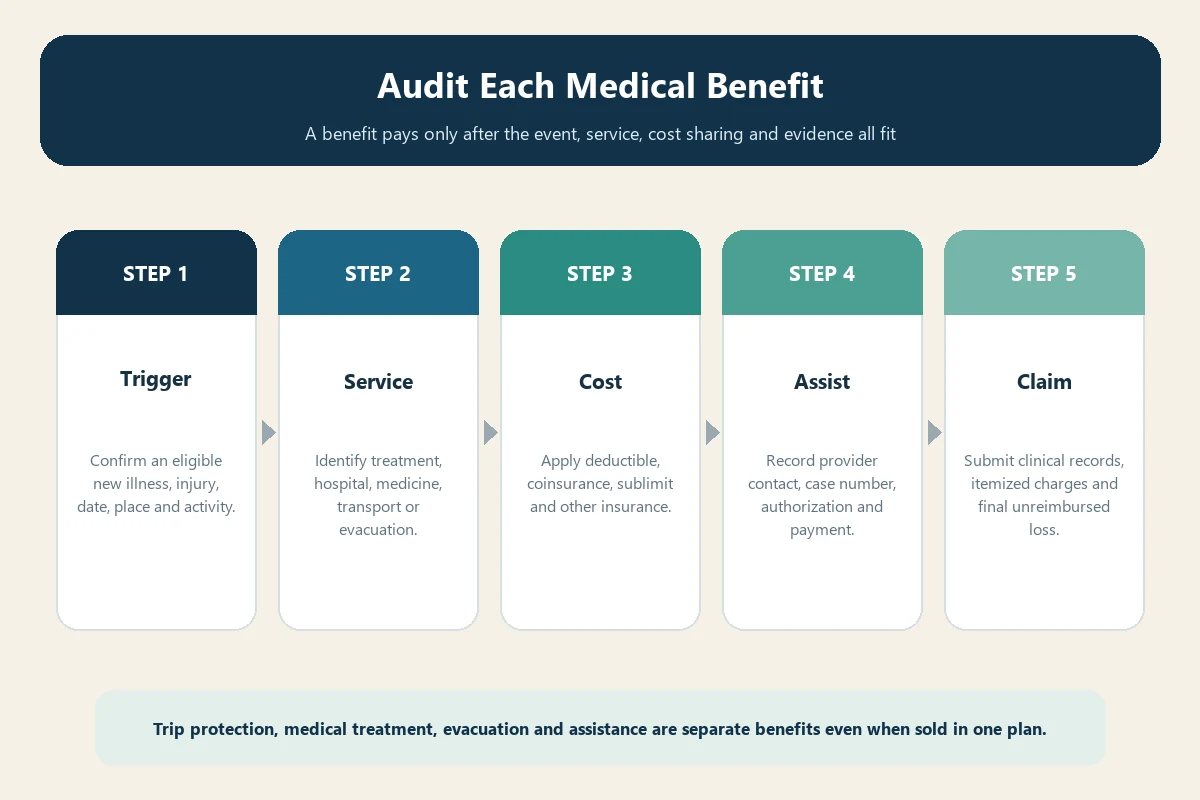
A strong comparison treats travel medical insurance as a group of separate benefits. Confirm the covered event, eligible service, cost sharing, sublimit, authorization and payer sequence for each one. Then make sure the traveler can contact assistance, fund any required upfront payment and produce the evidence the claim needs.
A large medical maximum can still contain smaller ceilings. Use the travel medical insurance sublimits guide to check room, dental, medicine, therapy and transport caps before comparing plans.
Not every visit to a general doctor is routine care. Use the travel medical insurance primary care guide to separate planned checkups from medically necessary visits for a new illness or injury abroad.
A new prescription, a routine refill and medicine lost with baggage follow different rules. Use the travel medical insurance prescription medication guide to choose the right benefit and build the required record.
Emergency dental care can have its own trigger, definition and sublimit. Use the travel medical insurance emergency dental guide to test pain relief, accidental damage, payment and claim evidence.
Local ambulance, interfacility transfer and medical evacuation are not interchangeable benefits. Use the travel medical insurance ambulance coverage guide to classify the route before applying limits and approval rules.
Later treatment may depend on the original event, location and benefit end date. Use the travel medical insurance follow up care guide to track one episode from first treatment through the return home.
Psychiatric care needs its own wording check. Use the travel medical insurance mental health guide to compare emergency treatment, counseling, medication and evacuation terms.
A virtual visit abroad is both a care-access and insurance question. Use the travel medical insurance telemedicine abroad guide to check licensing, provider access, prescriptions, escalation, payment and claim records.
Medical benefits have their own exclusion logic. Use the travel medical insurance exclusions guide to check general clauses, benefit-specific rules, definitions, medical necessity and assistance requirements.
An emergency family or bedside visit has its own hospitalization, visitor, fare, expense and authorization rules. Use the medical evacuation family-visit guide before booking a relative’s flight or assuming the patient’s evacuation approval pays for it.
A parent’s hospitalization can create a separate child-safeguarding and return-transport problem. Use the dependent-children medical evacuation guide to coordinate benefit triggers, an attendant, custody and consent documents, border clearance, a receiving adult, fares, and claim proof.
A human medical evacuation benefit does not automatically transport or treat a pet. Use the medical evacuation insurance pets guide to separate pet return, veterinary expenses, trip-cancellation triggers, carrier rules, country documents, destination care, and crisis-departure limits.
Local burial or cremation can be a separate, lower-capped alternative to returning mortal remains—not a second funeral budget. Use the local burial travel insurance guide to compare disposition routes, authorization, eligible expenses, exclusions, local law, documents and family responsibilities before committing funds.
