

Travel medical insurance direct billing is a payment arrangement in which an overseas medical provider sends eligible charges to an insurer or assistance partner instead of collecting the entire bill from the traveler first. It can reduce a large cash demand, but it is not automatic proof of coverage. Provider participation, timely coordination, clinical information and the issued certificate all have to align.
Key takeaways
- Direct billing describes a payment path; it does not expand covered benefits.
- A provider directory, assistance referral and guarantee of payment are three different things.
- Hospitals can still request deposits, deductibles or payment for excluded and unapproved charges.
- Emergency treatment should not be delayed while seeking authorization, but assistance should be contacted as soon as practical.
- Reconcile the final provider statement, insurer payment and every traveler refund.
Planning information reviewed August 16, 2026. Provider participation, assistance arrangements and policy terms can change. The issued certificate and the facility’s current payment requirements control the real transaction.
Direct billing does not establish claim approval
A hospital can agree to send a bill directly while the insurer still reviews eligibility, medical necessity, exclusions and cost sharing. Conversely, a claim can be covered even when the provider refuses direct billing and requires the traveler to pay first.
The CDC’s current travel insurance guidance says overseas care may require out-of-pocket payment and suggests looking for a policy that can pay hospitals directly. The word “can” matters. It describes a capability, not a promise for every provider or service.
Know the four parties in the transaction
The traveler receives care. The medical provider sets admission and payment requirements. The assistance team may locate care, exchange medical records and coordinate payment. The insurer or claims administrator decides the contractual amount. Some organizations combine roles, but the decisions remain distinct.
Write down the legal name, email and phone number for each party. Record who said what, when and under which case number. The assistance versus claims guide helps separate operational help from the final coverage decision.
Provider directories are only a starting point
A directory can identify facilities that have worked with a network or administrator. It does not prove current participation, availability, specialty, clinical quality or willingness to accept a payment guarantee for this admission. Always contact the facility.
Ask whether the provider recognizes the exact administrator named on the insurance card, not only the insurer’s brand. Confirm the billing office contact, expected deposit, acceptable currency and documents required before discharge.
What a guarantee of payment means
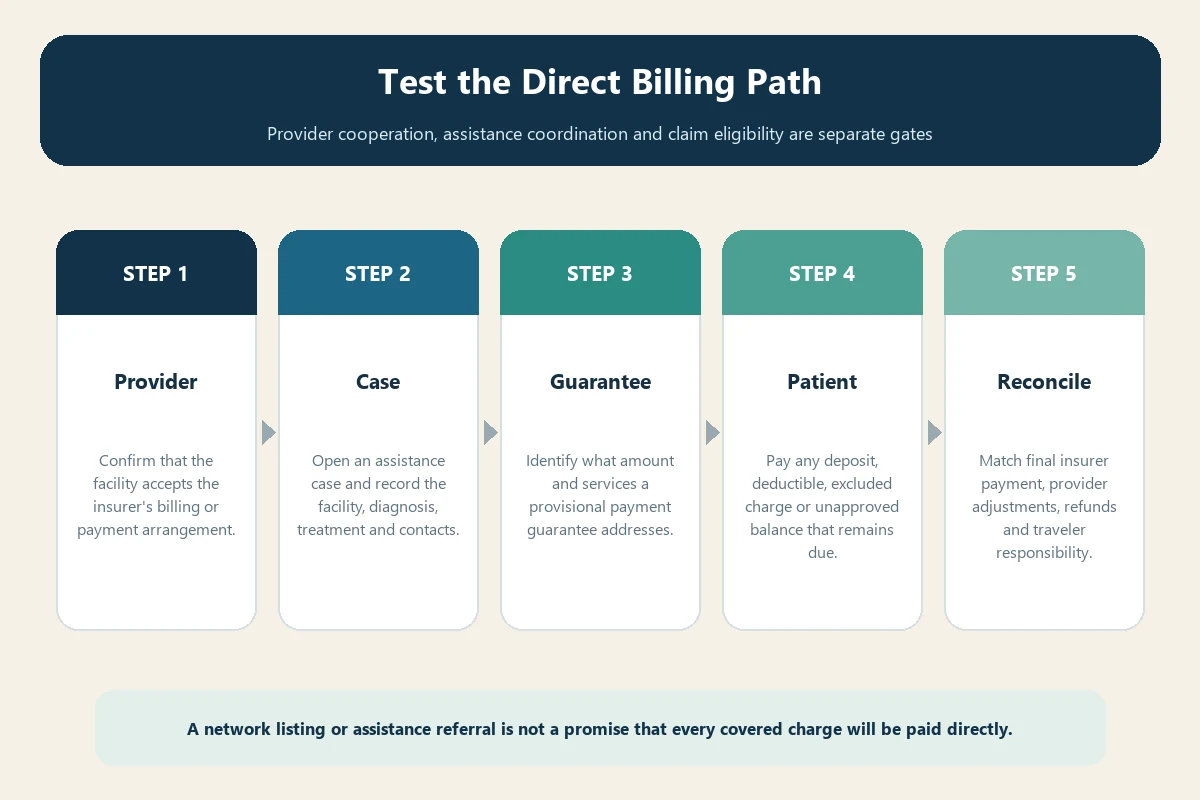
A guarantee of payment is usually a communication to the provider about an amount or set of services the payer is prepared to address, subject to its terms. It can be provisional while records are reviewed. It is not necessarily a final explanation of benefits.
Request a copy or written summary. Identify the traveler, facility, dates, currency, authorized services, amount, expiration and exclusions. Ask whether the hospital treats it as sufficient for admission or only as one part of its credit review.
Why a hospital may still require a deposit
The U.S. Department of State warns that in many locations a payment or deposit may be required before services. A provider can require its own security while waiting for insurer verification, medical records or a formal payment document.
Ask whether the deposit is refundable, which charges it secures and how refunds are issued. Obtain a numbered receipt in the charged currency. Never assume the card authorization will automatically disappear after the insurer pays.
Emergency care versus planned coordination
In a life-threatening emergency, seek appropriate care first. Contact assistance as soon as the situation permits. For a stable outpatient visit, scheduled test, transfer or follow-up, the certificate may require advance contact or approval.
Use the hospitalized abroad checklist to collect the facility contact, diagnosis, treating physician, passport details and policy number. Ask assistance to confirm which next steps require authorization.
Inpatient billing is different from outpatient payment
Direct billing is often easier to coordinate for a substantial inpatient case because a hospital has a billing office and time to exchange records. A small clinic, independent physician, laboratory or pharmacy may require immediate payment and provide documents for reimbursement.
Do not reject appropriate care solely because a provider cannot direct-bill. Ask assistance whether another suitable facility is available and whether changing providers is medically reasonable. Preserve the recommendation and the reason for the final choice.
Pharmacies and separate professionals
A hospital payment arrangement may not include a pharmacy, radiologist, anesthesiologist, ambulance operator or outside laboratory. These providers can issue separate invoices even when treatment occurs under one admission.
Before discharge, request an account list showing which professionals bill independently. Collect each itemized record and proof of payment. One hospital statement may not be the complete claim file.
Authorization is not the same as medical necessity
Assistance can coordinate or authorize under the certificate, while the treating clinician determines the clinical plan. A referral from assistance does not guarantee that every service is medically necessary under the policy. A clinician’s order does not remove an exclusion.
The travel medical benefits guide follows each service through trigger, eligibility, assistance, payment and evidence. Ask for a written answer when the provider proposes a new procedure, transfer or extended stay.
Direct billing does not remove cost sharing
The traveler can still owe a deductible, coinsurance, copayment, service sublimit, unrecognized charge or excluded expense. A provider may collect these amounts before discharge or invoice them after the insurer responds.
Review the travel medical deductible guide and the coinsurance calculation guide. Ask whether the payment guarantee reflects gross charges, an estimated eligible amount or the expected insurer share.
Primary coverage does not promise provider payment
Primary and secondary describe payer order. Direct billing describes who sends money to whom. A primary policy can reimburse the traveler after payment, while a secondary policy may coordinate a hospital bill after another payer has acted.
Use the primary versus secondary coverage guide to determine which insurer must decide first. Ask separately how the provider will be paid during that process.
Run a direct-billing pretrip test
Choose one major destination and one remote stop. Call the assistance number as a prospective traveler and ask how a serious hospital admission would be handled. Record the date and answers without treating them as a permanent provider guarantee.
- Which organization handles assistance and which handles claims?
- Is there a current provider directory?
- Who issues a guarantee of payment?
- Which records must the hospital send?
- How quickly can the team respond around the clock?
- What must the traveler pay at admission or discharge?
- What happens if no suitable participating provider exists?
Follow a six-step workflow during care
- Get medically appropriate care and stabilize the emergency.
- Open an assistance case and record the case number.
- Connect the hospital billing office with the named assistance contact.
- Confirm what information and authorization are still outstanding.
- Pay only documented amounts the provider requires, keeping receipts.
- Before discharge, obtain clinical records and a complete itemized statement.
The Department of State’s insurance guidance notes that some policies make direct payments to hospitals and recommends a 24-hour help line. Verify both capabilities for the issued plan.
If the provider refuses direct billing
Ask for the refusal or payment requirement in writing. Request an estimate and determine whether the provider accepts card, bank transfer or another traceable method. Avoid cash when a traceable option is available; if cash is required, obtain a detailed receipt.
Ask assistance whether it can arrange another medically suitable facility. Do not move an unstable patient for financial convenience. If payment is made, preserve the card settlement, currency conversion and bank fee records for the claim.
If the provider keeps the passport
Medical facilities in some places may request identification or financial security. Ask for a copy or receipt and contact the nearest U.S. embassy or consulate if a passport is being withheld or a dispute creates a serious problem. Assistance cannot replace consular help.
Keep digital copies of identity and insurance documents in a secure location. Give the provider only the information reasonably needed for treatment and billing.
Reconcile currency, discounts and duplicate payments
The provider may issue an estimate, interim invoice and final invoice in local currency. The insurer may apply a different conversion date or negotiated amount. The traveler’s card can add a conversion fee. Record each amount separately.
If the traveler paid a deposit and the insurer later pays the provider, request the provider refund promptly. Do not submit the same unreduced expense to multiple payers. Keep revised statements showing a zero balance or the exact amount still due.
Build the final claim file even with direct billing
Direct billing can still require a claim form, passport copy, itinerary, clinical records, diagnosis, itemized charges and other payer decisions. Confirm submission deadlines and whether the provider sent every record. A payment guarantee does not prove the file is complete.
The claim documentation guide provides a ledger for invoices, insurer payments, provider adjustments and refunds. Submit only the final eligible amount that remains unreimbursed.
Recognize weak direct-billing claims
Be cautious when marketing states “cashless worldwide” without defining the network, assistance contact, provider acceptance or certificate terms. Ask for the issued wording and a written explanation of the coordination process. A logo-filled directory is not a financial guarantee.
NAIC’s current travel insurance consumer guidance advises buyers to ask what the policy covers, which limits apply and whether approval is required before medical care. Those questions are more useful than a cashless label.
Decide whether the payment path is practical
Evaluate the traveler’s ability to fund a deposit, the route’s provider infrastructure, the seriousness of likely events, the assistance team’s availability and the certificate’s actual medical benefits. Direct billing is most valuable when it reduces a large cash barrier without narrowing the choice of appropriate care.
First document the domestic plan using the health insurance abroad guide. Then test the travel plan’s provider path, approval rules, cost sharing and reimbursement fallback. The best answer is not simply “yes, direct billing”; it is a complete plan for who calls, who pays, what remains due and how the account closes.
A hospital deposit is an admission or payment demand, not a final coverage decision. Use the travel medical insurance hospital deposit guide to protect urgent care, contact assistance and document every payment.
A claim decision is only as strong as its policy match and evidence trail. Use how to document currency conversions in a travel insurance claim to organize the relevant records, deadlines and insurer response without submitting unrelated private information.
Claim administration needs a dated record, a policy match and a reconciled amount. Use what to review before directing a travel claim payment to a provider to identify the exact decision, missing evidence or next procedural step before escalating.
