
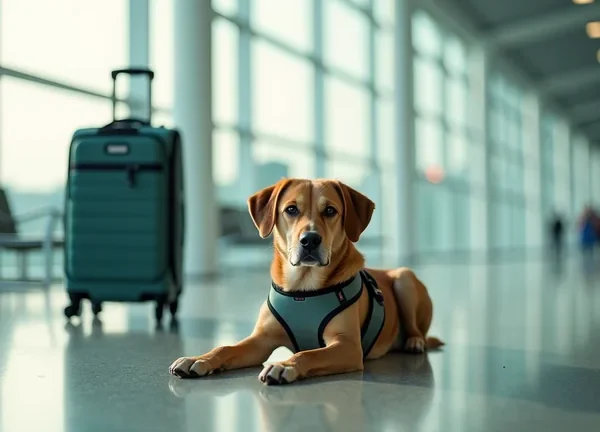
A service animal changes the shape of a trip long before anyone reaches the airport. There is a form to file with the carrier, an import file for the destination, a plan for relief areas during a long connection, and a set of uncomfortable questions about what happens if the animal — or the handler — cannot fly on the day. A travel insurance policy answers a few of those questions and is silent on more of them than most people expect.
Almost every disappointment in this corner of the market comes from one misreading. A travel policy is built around an insured person and an insured trip cost. A service animal is neither of those things unless a specific benefit says so in writing, and most schedules of benefits do not say so.
Traveling with a service animal: where a travel policy helps and where it stops
The policy insures the handler, not the animal
Travel medical benefits pay for the emergency treatment of an insured traveler. Veterinary treatment sits outside that schedule on the large majority of plans, so a dog that is injured on a hiking trail or picks up a tick-borne infection abroad is a cost the handler carries personally. That is not an oversight in the wording — it is the boundary the product was priced against.
The animal can still appear inside a claim, but only indirectly: as the cause of an expense that some other benefit already names. Boarding or kennel costs during a covered delay are the clearest example, and even then they show up as an “additional expense” line rather than as a benefit for the animal itself. Read the definition of additional expense before assuming it stretches that far.
Equipment is treated differently from the animal
Harnesses, mobility aids and the medical equipment a handler travels with are usually property, and property is covered by the baggage benefit with its own sublimits and its own exclusions for wear and tear. That is a materially better position than the animal itself is in, and it is the reason the rules around mobility aids are worth reading separately from the medical section.
The paperwork decides the trip, and then it decides the claim
On flights touching the United States, carriers are permitted to require the Department of Transportation’s service animal air transportation form, submitted in advance, attesting to the animal’s training, health and behavior. Emotional support animals were removed from the federal definition of a service animal for air travel in 2021 and are handled as pets under each carrier’s own policy, which is the single most common source of a denied boarding at the gate.
The destination adds a second file. Import rules for a dog typically involve a microchip recorded before the rabies vaccination, a rabies titer drawn after a waiting period, and a health certificate signed and stamped by a government veterinarian inside a short validity window before departure. Those steps are sequential and some of the waiting periods are measured in months, so a trip booked at short notice can be impossible to document correctly no matter how well the animal is trained.
Why sequence matters to an insurer
An administrative failure is rarely a covered reason. If the animal is refused at the gate because a form was missing, incomplete or filed late, the loss usually falls under the exclusion for documentation, permits and travel authorizations rather than under any cancellation or delay benefit. The standard exclusion list is where that language lives, and it is short enough to read in full.
What tends to fall inside the policy and what does not
| Situation | Usually inside the policy | Usually outside it |
|---|---|---|
| Handler suffers an emergency illness or injury abroad | Travel medical benefit, subject to the limit, deductible and any pre-existing condition terms | Routine or elective care |
| The animal needs veterinary treatment during the trip | Nothing on a standard plan | Vet fees, medication, emergency transport for the animal |
| Carrier refuses the animal at the gate | Only where the refusal is caused by something the wording names as covered | A refusal caused by missing or late documentation |
| The animal falls ill before departure and the handler cancels | Only if the covered-reason list names it, which is uncommon | Cancellation for a reason not on the list |
| Kennel or boarding costs caused by a covered delay | Sometimes, as an additional expense under the delay benefit | Any cost tied to a delay the policy does not cover |
| Harness, mobility aid or medical device damaged in transit | Baggage benefit, within the per-item sublimit | Wear, tear and gradual deterioration |
Cancelling or cutting a trip short because of the animal
Trip cancellation runs on a closed list. The benefit pays when one of the named events occurs, and everything else — however reasonable — is outside it. The named events center on the insured traveler, an insured traveling companion and, on many wordings, a defined class of family member. A service animal does not meet the definition of a traveling companion on the wordings that define the term at all, so its illness or death generally does not open the benefit.
Two routes exist around that. The first is to check whether the plan offers an optional benefit that names the animal explicitly, which a small number do. The second is Cancel For Any Reason, which converts the closed list into a partial reimbursement for any reason at all, at the cost of a higher premium, an early purchase deadline and a reimbursement percentage below the full trip cost. It is worth understanding how the covered-reason list works before deciding whether that trade is worth making.
Delays, re-routing and being turned away at the gate
Refusal at boarding is where handlers most often meet the limits of a policy. Delay benefits generally begin after a waiting period counted in hours and require the delay to arise from a named cause, such as a mechanical failure or severe weather. A refusal that arises from the animal’s paperwork is not one of those causes. Where the refusal comes from the carrier’s own error or an involuntary bump, the position changes, and the mechanics are set out in the guide to denied boarding coverage.
Practically, the strongest protection is not a benefit at all. It is the assistance line, staffed around the clock, that can rebook, locate an accessible hotel or find a veterinarian while the handler is standing at the counter. Confirm before departure that the line handles accessibility requests, and save the number offline.
A short checklist before buying
- Read the definitions section first, specifically “traveling companion”, “additional expense” and “baggage”, and see whether the animal appears anywhere in them.
- Confirm the carrier’s form requirement and file it inside the window the carrier states, not the day before departure.
- Start the destination’s import sequence early enough that the titer waiting period fits, and keep the endorsed certificate with the passport.
- Photograph the harness and any mobility equipment before check-in; a baggage claim without a pre-trip photograph is a slower claim.
- Ask the assistance line, before the trip, what it can arrange if the animal is refused at the gate, and note the answer.
None of this makes traveling with a service animal harder than it already is. It just moves the effort to the point where it is cheap — the weeks before departure, when a form can still be filed and a policy can still be swapped — rather than to the counter at five in the morning, where nothing can be fixed and everything costs money.
