

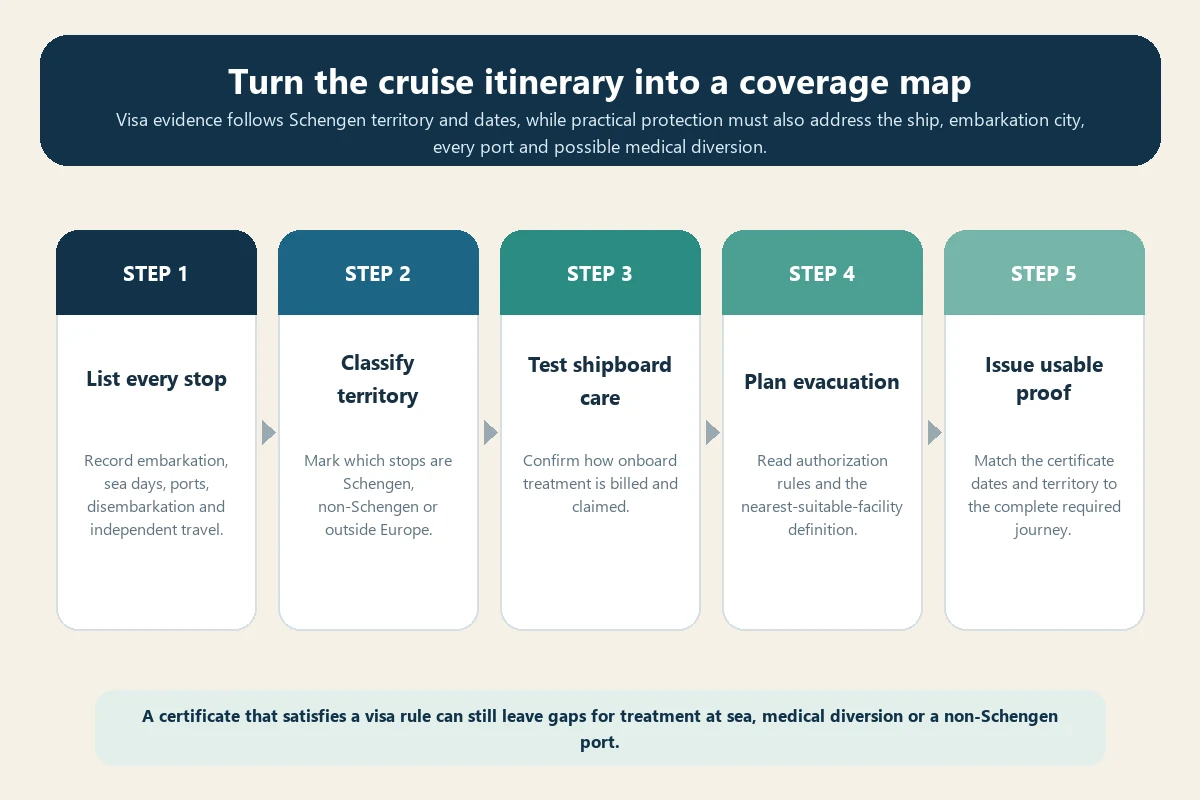
Schengen insurance for cruise passengers should be planned from the complete port itinerary, not from the cruise’s marketing region. A Mediterranean sailing can start in a Schengen country, visit a non-Schengen port, return to Schengen territory and end elsewhere. The visa certificate must match the required dates and territory, while practical coverage should also address shipboard medical bills, evacuation and a possible diversion.
Key takeaways
- List embarkation, every port, sea day, disembarkation and independent land travel.
- A consulate may request the complete day-by-day cruise itinerary.
- Schengen visa proof and cruise-specific medical protection are related but not identical tests.
- Shipboard treatment is usually charged separately from the cruise fare.
- Non-Schengen stops and medical diversions require a broader territory check.
Build the port map before choosing a policy
Copy the itinerary into a simple table. Include the pre-cruise hotel, embarkation city, each sea day, every scheduled port, disembarkation city and post-cruise travel. Add the country and Schengen status beside each stop. Do not assume that every Mediterranean or European port belongs to Schengen.
The Spanish Consulate in Washington Schengen instructions specifically say cruise applicants should provide a booking confirmation with a complete day-by-day itinerary showing ports. The same page requires a medical-insurance certificate with the applicant’s name, dates and minimum coverage.
The correct consulate depends on the main destination, assessed through the purpose and length of stay, or the first entry when stays are equal. A ship’s flag, the cruise line’s headquarters and the embarkation port do not automatically decide jurisdiction. Use the Schengen visa insurance requirements guide with the authority’s current checklist.
Mark Schengen and non-Schengen segments
A cruise can cross immigration areas without the passenger noticing a land border. Mark each country individually. Then ask the insurer whether the policy covers the entire trip, not just the Schengen days. The certificate may say “Schengen area” while the contract uses a broader Europe or worldwide territory. Read both.
Use the Europe country-exclusion guide to check advisories, sanctions and territorial wording. The multi-country Europe insurance guide provides a route-by-route coverage method.
If a port is replaced after purchase, confirm whether the new country remains covered. A geographic extension can require an endorsement. An itinerary change by the cruise line does not automatically create an insurance claim, but it can change where medical protection must work.
Choose certificate dates from the complete required journey
Article 15 of the EU Visa Code requires adequate and valid travel medical insurance throughout the Member States for the complete intended stay or transit. The minimum is €30,000, with the specified medical and repatriation functions.
Do not insure only the nights printed as “cruise duration.” A traveler may enter Schengen for a hotel stay before sailing and remain after disembarkation. Overnight flights, airport transit and re-entry after a non-Schengen port can complicate the date line. Use the Schengen insurance dates guide to count the real period.
For a multiple-entry application, the submitted proof ordinarily focuses on the first intended visit. A cruise that leaves and returns to Schengen can still involve immigration details that should be checked against the itinerary. The multiple-entry insurance guide explains later-trip duties and current certificates.
Shipboard medical care is a separate financial risk
The CDC Yellow Book cruise guidance says medical facilities vary by ship, itinerary and passenger population. Ship medical centers can assess and stabilize patients, but serious illness may require evacuation. The CDC also notes that onboard care is typically not included in the voyage price.
Ask the insurer whether treatment on a foreign-flagged ship is covered and which territory applies while at sea. Confirm whether the traveler pays the ship first and submits a claim later. Read notification and preauthorization rules, but preserve the emergency exception when immediate care is necessary.
A visa certificate can meet the official €30,000 standard while a cruise traveler prefers a higher medical amount based on personal finances and itinerary. Visa acceptance establishes documentary compliance, not that every shipboard expense will be reimbursed.
Evacuation may end at the nearest suitable facility
Medical evacuation can involve transfer from the ship to a port, ground transport to a hospital, or later air transport. The policy usually requires the assistance company to decide medical necessity and arrange the move. The destination is often the nearest suitable facility, not a hospital in the United States.
The CDC’s travel and medical evacuation insurance chapter advises cruise travelers to consider coverage for shipboard services and evacuation. Read the limit, authorization clause and definitions. Our medical evacuation limits guide explains how those parts interact.
A diversion can bring the passenger to an unscheduled country. Ask whether the policy remains valid there and who pays for a companion, hotel, onward transport and return to the ship. Medical evacuation and trip interruption are distinct benefit sections.
Tender ports and cruise-line excursions
Some ships anchor offshore and move passengers to land by tender. Mobility, weather and missed-return risks can differ from a docked call. Check whether a planned activity is operated by the cruise line or an independent vendor, and whether the policy excludes the activity. The cruise line may promise operational assistance for its own excursion, but that promise is not the same as medical or trip-interruption insurance.
Embarkation and missed-connection risks
A Schengen visa policy is primarily medical evidence. It may not cover the cost of missing the ship after a flight delay. When that financial risk matters, read the missed-connection or missed-departure benefit. Check the listed causes, minimum delay, minimum connection time and covered catch-up costs.
Fly to the embarkation city early when practical. An insurer will not reimburse a loss outside the covered reasons merely because the cruise was expensive. The cruise insurance clause guide explains missed departure, skipped ports and trip-cost protection in depth.
Use a two-column policy comparison
| Visa-proof test | Cruise-risk test |
|---|---|
| Applicant correctly named | Traveler eligible for shipboard and foreign care |
| All required Schengen dates | Pre-cruise, sea days, ports and post-cruise dates |
| Valid throughout Schengen | Non-Schengen ports and unscheduled medical diversion |
| At least €30,000 | Chosen medical and evacuation limits match financial risk |
| Required medical and repatriation functions | Onboard billing, assistance, claims and nearest-facility rules |
Passing the left column does not answer every question in the right. Use the Europe policy comparison worksheet to record evidence for both.
Existing conditions and medications at sea
Travelers with chronic conditions should ask the cruise line what the ship can and cannot provide. The CDC recommends advance preparation for travelers with existing conditions or special needs. Carry enough medication, allow for delay and confirm restrictions for every country on the route.
Read the policy’s pre-existing condition definition and any waiver. A compliant certificate may still accompany a policy that excludes claims connected to a known condition. Planned treatment, routine prescriptions and emergency complications can be handled differently.
Keep a concise medical summary and medication list. Store the insurer’s assistance number separately from the main luggage. A companion should know how to find it if the traveler cannot call.
Cruise visa and insurance file checklist
- Complete day-by-day cruise itinerary with all ports.
- Pre-cruise and post-cruise accommodation.
- Flight and surface-transport reservations.
- Insurance certificate with applicant, dates, territory and benefits.
- Full policy wording for shipboard care and evacuation.
- Written confirmation for non-Schengen ports.
- Assistance and claims contacts.
- Operator requirements and medical-access information.
Open every PDF before the appointment. Check that the ship itinerary is current and the certificate is readable. Keep updated copies available during the voyage in case a border officer or medical provider requests them.
Recheck the file after every operator itinerary update.
Common mistakes
- Calling the entire itinerary “Europe” without checking each port’s territory.
- Insuring only sailing nights and omitting hotel or transit days.
- Assuming the cruise fare includes onboard medical treatment.
- Choosing a visa-compliant limit without reviewing evacuation risk.
- Ignoring non-Schengen stops or a possible diversion.
- Expecting insurance to pay whenever the cruise line changes a port.
- Submitting a summary that does not identify the applicant.
Frequently asked questions
Does a Mediterranean cruise always require a Schengen visa?
No. Nationality, residence, ports and itinerary determine entry requirements. Confirm them with the responsible authorities and cruise line.
Should the policy cover non-Schengen ports?
Yes, if protection is needed there. The visa document may focus on Schengen, but the practical policy should cover the actual complete route.
Is the ship’s doctor covered by Schengen insurance?
Only if the underlying policy covers the service, location and event. Ask how shipboard bills are handled and read the contract.
What happens if the ship diverts for a medical emergency?
Coverage depends on assistance authorization, territory, medical necessity and the nearest-suitable-facility clause. Contact assistance as soon as circumstances allow.
Does a missed port create an insurance claim?
Not automatically. Some policies offer a limited missed-port benefit, but normal itinerary changes are often outside cancellation or interruption coverage.
This guide is educational, not legal, medical or insurance advice. Port schedules and entry rules change, so verify the final itinerary and policy before travel.
Low water or a lock closure can replace river sailing with coaches, hotels, another vessel or a new embarkation point without canceling the whole trip. Use the senior river-cruise insurance route matrix to separate operator substitutions, covered benefits, other payers, remaining loss and claim evidence.
