
Travel insurance denied boarding coverage does not turn every refusal at an airport gate into an insured claim. The decisive fact is why the traveler was not allowed to board: an oversold flight, late gate arrival, missing document, aircraft substitution, safety restriction, illness, behavior, or another event.
This U.S. guide separates airline passenger rights from travel-insurance benefits, then shows how to document and calculate the remaining loss. It is educational, not legal or insurance advice.
First identify what “denied boarding” means
In U.S. passenger-rights rules, involuntary denied boarding commonly means the airline requires a passenger with a confirmed reservation to surrender a seat because the flight was oversold. In everyday speech, travelers may use the same phrase when they miss a cutoff, present an unacceptable passport, are medically unable to fly, or are refused for safety or conduct.
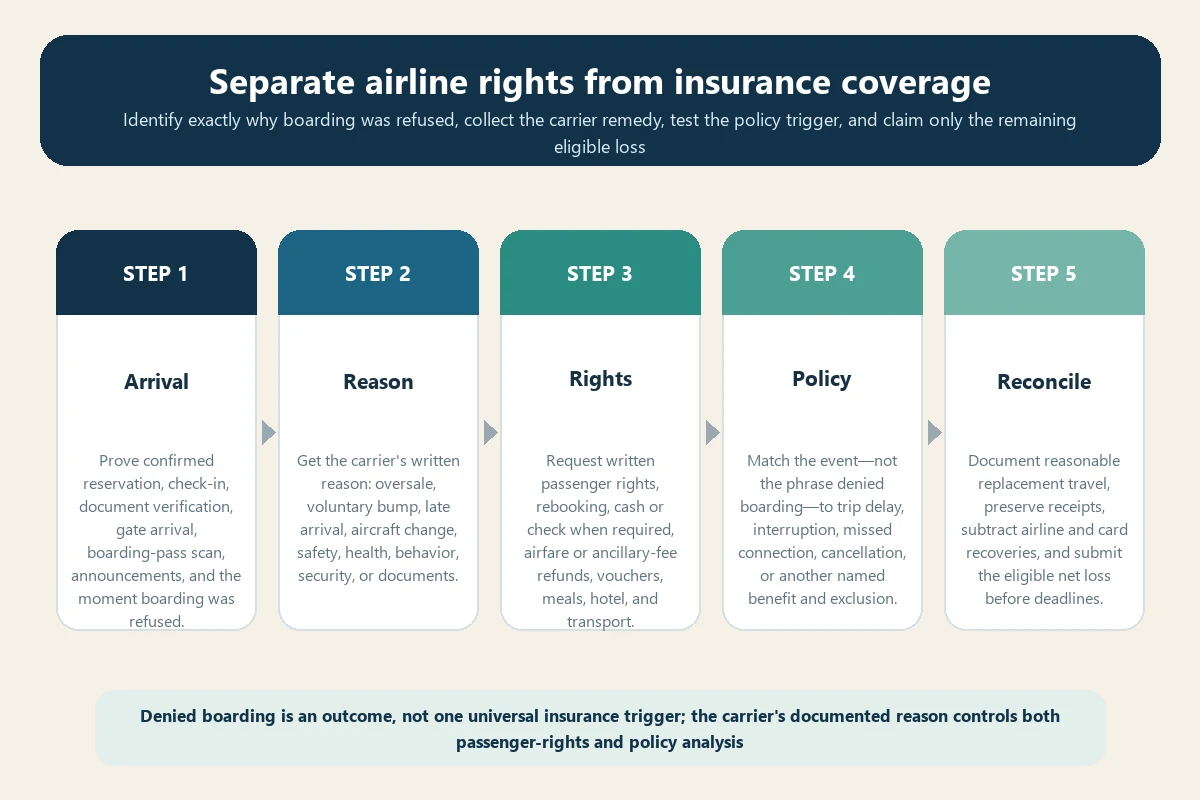
Those events can lead to different airline remedies, exclusions, and insurance benefits. Ask the gate agent to state the precise reason in writing instead of relying on the generic phrase “denied boarding.”
Oversales create airline rights before insurance
The U.S. Department of Transportation’s Bumping & Oversales guide says carriers must seek volunteers before involuntarily bumping passengers from an oversold flight. Qualifying involuntarily bumped passengers may receive denied boarding compensation based on the one-way fare and resulting arrival delay.
Eligibility can depend on departure from a U.S. airport, a confirmed reservation, timely check-in and gate arrival, and the carrier’s inability to deliver the passenger within the applicable time. Current dollar limits can change, so use the DOT table and written notice supplied on the event date rather than an old blog or screenshot.
Ask for the required written notice
DOT says an airline must give an involuntarily bumped passenger a written statement explaining the passenger’s rights and the carrier’s boarding-priority method. Request the notice, the reason code, the proposed alternate itinerary, projected arrival time, and the compensation calculation.
Keep the original boarding pass, confirmation, fare breakdown, check-in proof, gate photographs, app messages, emails, names, and timestamps. If the airline describes the event as voluntary but the traveler did not volunteer, object promptly and preserve the exact words used.
A voluntary bump is a negotiated exchange
A traveler who accepts money, points, a voucher, or another benefit to give up a seat is normally a volunteer, not an involuntarily bumped passenger. Ask whether the replacement seat is confirmed or standby, when it arrives, and whether meals, lodging, transfers, or other expenses are included.
Before accepting a voucher, record its expiration, blackout dates, transferability, route limits, capacity restrictions, and whether accepting it releases other claims. Compare the offer with likely expenses and the statutory compensation disclosed for an involuntary bump. Insurance may treat voluntarily surrendered travel differently from an unavoidable delay.
Late check-in or gate arrival is a different problem
A confirmed ticket does not eliminate airline check-in, baggage, document, security, and gate cutoffs. If the traveler arrives after a deadline, the carrier may cancel the reservation or apply a no-show rule without creating oversales compensation.
Document the published deadline and every timestamp. If an unexpected covered event caused the late arrival, use our missed-departure coverage guide to test that event. Merely calling the outcome denied boarding does not convert traveler lateness into a covered cause.
Aircraft changes can affect compensation
A smaller substitute aircraft may leave fewer seats than the original plane. DOT lists certain aircraft substitutions, operational or safety changes, weight-and-balance restrictions on qualifying small aircraft, charter flights, and small-aircraft operations among circumstances in which standard denied boarding compensation may not apply.
Still ask the airline about rebooking, refunds, downgraded-cabin fare differences, and unused optional services. Insurance analysis should use the documented operational event and resulting delay, not assume that absence of DOT bumping compensation means absence of every remedy.
Safety, security, health, and conduct require exact facts
DOT explains that a carrier may deny boarding or remove a passenger for a safety, security, or health risk, or for obscene, disruptive, or unlawful behavior, even after accepting a boarding pass. These cases are not ordinary oversales.
Request the factual basis without interfering with airport personnel. Preserve medical records, fitness-to-fly communications, accommodation requests, witness details, incident reports, and carrier correspondence. A policy may cover a sudden disabling illness but exclude intoxication, unlawful conduct, known conditions, failure to follow medical advice, or intentional acts.
Passport, visa, and entry failures are usually traveler-document issues
Airlines check whether passengers appear to hold documents required for the destination, transit point, and return journey. An expired passport, missing visa, insufficient validity, name mismatch, absent consent document, or unmet entry condition can result in refusal to transport.
Many policies exclude losses caused by missing or defective travel documents, although narrow exceptions may exist for theft or another named event. Save the official requirement, document presented, carrier message, government communication, and any timely attempt to correct the problem. Do not describe a visa or passport failure as overbooking.
Codeshares require identifying the operating carrier
The airline name on the ticket may be the marketing carrier while another airline operates the aircraft and controls the gate. Record both carriers, flight numbers, ticket stock, booking channel, and who made the boarding decision.
Ask which carrier will rebook, issue compensation, refund optional services, and provide the written explanation. Send the insurer a single chronology that distinguishes each company’s response instead of submitting contradictory accounts.
Airline remedies and insurance benefits are separate layers
The airline may owe rebooking, denied boarding compensation, a refund, a fare-difference refund, amenities promised by its customer-service plan, or repayment of unused optional fees. The policy may separately offer trip delay, trip interruption, missed connection, cancellation, or another benefit if its definitions and covered reasons are met.
Use our delay, interruption, and cancellation comparison to select the right benefit. A later arrival may fit flight-delay coverage; a broken onward itinerary may require missed-connection analysis. The label at the gate does not choose the policy section.
Measure the resulting arrival delay
Record the original scheduled arrival and the arrival offered by the carrier, including all replacement segments. Then record when the traveler actually arrived. The difference can affect DOT compensation and insurance waiting periods, but the two calculations may use different definitions.
If the traveler declines reasonable substitute transport and buys a more expensive flight, explain why. Preserve availability and price screenshots at the decision time, not hours later. Review our flight-change coverage guide when the replacement materially changes airports, dates, or connections.
Claim reasonable additional expenses
Potential expenses include meals, hotel, local transport, communications, and reasonable replacement transportation, subject to the policy’s covered reason, minimum delay, per-day limit, total limit, and exclusions. Keep itemized receipts and proof of payment.
Luxury lodging, premium last-minute transport, alcohol, entertainment, upgrades, and costs incurred after a reasonable alternative was available may be reduced or rejected. Ask the assistance administrator before a major purchase when practical and record the advice.
Request refunds for services never provided
DOT’s airline refund guidance states that consumers are entitled to refunds of fees for ancillary services unavailable through no fault of the consumer, including when a consumer is involuntarily denied boarding. These may include paid seat selection, baggage, upgrade, lounge, or other optional-service fees that were not delivered.
List every fare component and add-on. Request the applicable refund from the airline or ticket agent before presenting the same amount as an insurance loss.
Avoid double recovery
Travel insurance generally reimburses eligible loss, not a windfall. Disclose airline cash, vouchers, refunds, credits, replacement transport, meals, lodging, credit-card benefits, and payments from another insurer. Whether a voucher counts immediately or only when used depends on policy language and claim handling, so disclose it and ask for a written calculation.
Use the method in our supplier-refund and subrogation guide: start with documented eligible cost, subtract refunds and recoveries applied to that same loss, then claim the remaining amount. Do not subtract statutory compensation blindly if it compensates a different harm; let the insurer explain its coordination decision.
Build a minute-by-minute evidence file
Create one chronology covering airport arrival, check-in, baggage acceptance, security, gate arrival, boarding group, scan, refusal, explanation, volunteer request, rebooking offers, purchases, departure, and final arrival. Note local time zones.
Attach the ticket, receipt, reservation, boarding pass, carrier conditions, app notices, written rights statement, compensation offer, refund requests, replacement itinerary, receipts, card statement, photographs, and correspondence. Keep original files and metadata; a polished summary should supplement, not replace, primary evidence.
Use a precise claim narrative
A strong narrative might say: “I checked in at 2:08 p.m., reached Gate 14 at 3:01 p.m. before the 3:15 p.m. cutoff, and the carrier involuntarily denied boarding at 3:22 p.m. because the flight was oversold. It rebooked me to arrive 7 hours 40 minutes late and paid $X. I incurred $Y in eligible meals and ground transport and request review of the documented net amount.”
Do not say only “the airline bumped me.” File through the process in our travel-insurance claim guide, comply with notice and proof deadlines, and answer requests consistently.
If the airline does not honor passenger rights
First send a concise written complaint to the carrier with the itinerary, event date, written notice, requested remedy, and supporting documents. Keep the submission confirmation and response.
If unresolved, the DOT provides an aviation consumer complaint process. A regulatory complaint does not extend an insurance proof-of-loss deadline, so pursue both tracks on time.
A practical denied-boarding checklist
- Confirm the exact carrier reason in writing.
- Preserve proof of reservation, check-in, gate arrival, and boarding scan.
- Distinguish voluntary surrender from involuntary bumping.
- Request written passenger rights and every airline remedy.
- Record original, offered, and actual arrival times.
- Check the policy’s covered event, delay threshold, limits, and exclusions.
- Choose reasonable replacement travel and keep itemized receipts.
- Request refunds for unused fare components and ancillary services.
- Disclose compensation, vouchers, refunds, credits, and other benefits.
- Submit a chronological, documented net-loss claim before deadlines.
Bottom line
Travel insurance denied boarding coverage begins with the carrier’s documented reason, not the traveler’s label. Protect oversales rights first, distinguish voluntary and involuntary decisions, test the actual event against the policy, mitigate reasonably, and reconcile every recovery.
That sequence produces a cleaner passenger-rights request and a more defensible insurance claim for the loss that genuinely remains.
A prolonged wait onboard creates its own evidence timeline. Use this travel insurance tarmac delay coverage guide to track the DOT clock, preserve announcements, test the policy waiting period, document missed connections, and calculate net loss.
