
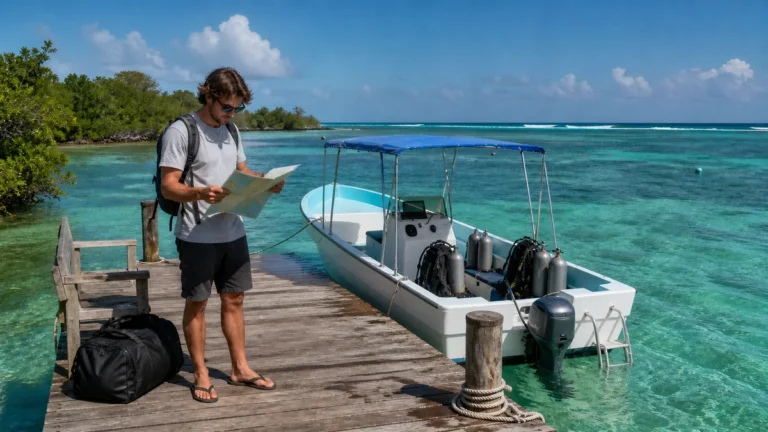
Travel insurance for Belize from USA trips must account for diving, island transfers and the possibility that serious care requires evacuation to another country. A Belize City stop, Ambergris Caye dive week and inland cave tour do not share one transport path. Test the medical and disruption chain from the actual activity location.
Key takeaways
- Check scuba eligibility by certification, depth, supervision and equipment.
- Identify realistic clinics, hospitals and recompression options before diving.
- Separate boat rescue, island transfer, air ambulance and repatriation.
- Audit hurricane timing against the purchase date and named policy triggers.
- Keep dive logs, operator reports, alerts, bills, refunds and authorizations.
Planning information reviewed August 16, 2026. Medical access, marine conditions, storm alerts, operator services and policy wording can change. Verify current official information for the traveler’s islands, districts and dates.
Map Belize by water, road and air
List every airport, water taxi, domestic flight, island, cay, inland lodge, dive site and prepaid activity. Record the scheduled carrier, baggage rules, latest connection, alternative departure and nearest realistic care. Include the first nonrefundable payment date.
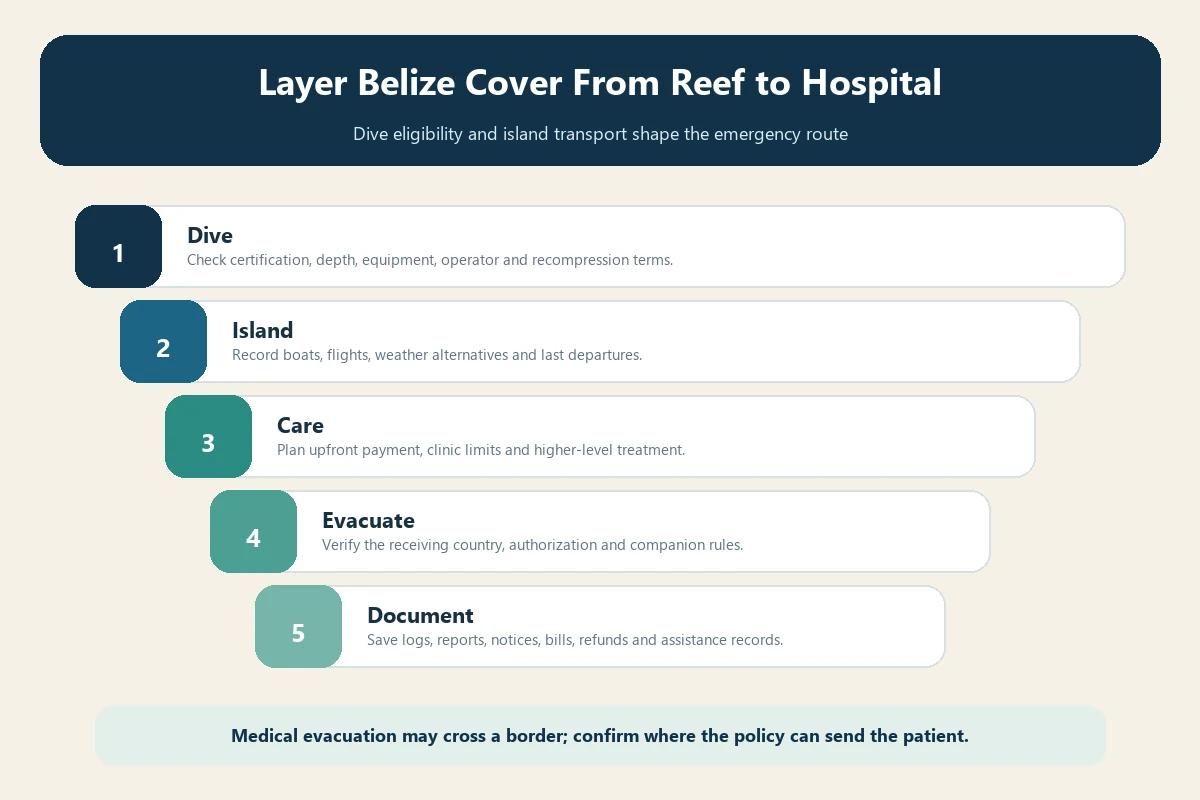
The U.S. Department of State’s current Belize travel information says medical care is limited, with adequate care mainly in Belize City and Belmopan and limited services in rural areas. It notes that serious injuries or illnesses may require medical evacuation to another country and that providers may require upfront payment.
Audit the exact dive profile
Ask whether recreational scuba is covered and under which conditions. Provide the certification level, planned maximum depth, number of dives, supervision, liveaboard use, night or wreck diving and any technical gases. Check whether an optional adventure endorsement is required.
Review exclusions for diving beyond certification, solo diving, instruction, paid work, competition and equipment. A policy may cover medical treatment yet exclude search, rescue or a specialized chamber transfer. The adventure-activity exclusion guide helps turn a general “diving covered” answer into a documented test.
Confirm that every diver follows operator and certifying-agency rules. Insurance is not a reason to exceed training, conditions or a conservative dive plan.
Verify the operator and emergency plan
Record the operator’s legal name, boat, guides, emergency oxygen, communications, passenger count, departure point and cancellation terms. Ask where an injured diver is first landed, which medical service is contacted and how a higher-level transfer is arranged.
Save the booking description, waiver and safety briefing. Note whether the operator uses a small boat from an island, a larger day boat or a liveaboard. Each creates different return times and access constraints.
An operator’s liability coverage, a dive-membership benefit and a travel policy are separate contracts. Identify which one responds to treatment, chamber care, rescue, equipment loss, missed travel and third-party injury.
Locate appropriate care, not just the nearest clinic
The closest clinic may stabilize a patient without providing the specialty care required. Ask the insurer how it defines an appropriate facility and who selects it. Confirm how an island or inland patient reaches Belize City, Belmopan or a provider outside Belize when clinically necessary.
Call the U.S. health plan about foreign providers, payment, claim forms and preauthorization. Then compare the response with the travel medical benefit. The health insurance abroad guide exposes where domestic assumptions stop working.
Carry a medical summary, allergies, prescriptions and emergency contacts offline. A provider may need payment before the traveler can seek reimbursement.
Separate chamber treatment from evacuation
Decompression illness can require oxygen, assessment and recompression, but not every incident follows the same path. Ask whether chamber treatment is part of the medical maximum, subject to a separate sublimit or tied to compliant recreational diving.
Medical evacuation may mean boat or aircraft movement to the nearest appropriate facility. Repatriation to the United States may be considered later. Ask who determines medical necessity, chooses the endpoint and preauthorizes transport. The remote evacuation guide provides a decision-authority checklist.
Do not assume that the most convenient U.S. hospital is the policy’s first destination. Request the exact wording for nearest appropriate care and later return home.
Understand primary and secondary payment
A primary travel medical benefit may accept eligible expenses before another plan, while a secondary benefit can require submission to the U.S. insurer first. Neither label guarantees direct payment to a Belizean provider. Ask whether the assistance company can arrange a guarantee of payment and under what conditions.
The primary versus secondary travel medical guide shows how claim order, provider payment and reimbursement differ. Record the deductible, proof needed and currency conversion method.
Assign island-transfer losses correctly
| Event | Wording to inspect | Evidence to keep |
|---|---|---|
| Water taxi canceled | Common-carrier delay and missed connection | Carrier notice, schedule and refund |
| Small dive boat returns late | Tour delay or policy’s carrier definition | Operator log and actual arrival |
| Medical boat transfer | Ambulance, rescue or evacuation benefit | Clinical need and dispatch record |
| Domestic flight disrupted | Delay, interruption and carrier terms | Airline notice and replacement receipt |
| Unused island hotel | Interruption after a covered cause | Booking, cancellation and refund statement |
A boat can be a scheduled common carrier, a tour vessel or medical transport. Do not assume one benefit applies to every craft. Check the policy definition and the operator’s published schedule.
Plan for tropical weather before it is named
Belize’s National Emergency Management Organization provides official hurricane preparedness information. The U.S. National Hurricane Center also publishes tropical cyclone preparedness guidance and current storm products. Use official notices for safety and save the dated advisory affecting the exact location.
Insurance purchase timing matters. Once a storm is named or otherwise foreseeable under the contract, new coverage may not protect that event. Compare when the first trip payment, policy purchase and first official notice occurred.
The weather-delay coverage guide helps test closure, minimum-delay and common-carrier requirements. Bad weather alone may not be the defined trigger.
Distinguish warning, cancellation and evacuation
A storm watch, water-taxi suspension, operator cancellation, hotel closure and mandatory evacuation are different facts. Record the issuing authority, affected district or cay, start time and supplier response. Ask whether the destination must be inaccessible or uninhabitable and whether evacuation is a listed cause.
Request refunds and credits before claiming the remaining loss. Use the delay, interruption and cancellation guide to classify costs by when the event occurred.
Cover inland activities with the same discipline
Cave tubing, hiking, wildlife excursions, zip lines and remote ruins can add guide, road and rescue questions. Name the activity, location, access road and physical requirements. Ask whether underground, height, motorized or off-trail exclusions apply.
Map how a patient exits the activity site and reaches appropriate care. Confirm whether a local extraction is search and rescue, medical transport or an uncovered operator cost. Never enter a closed site or continue when an official warning or guide instruction says to stop.
Test assistance before relying on it
Give each insurer a realistic case: a certified diver develops symptoms on an island after a compliant recreational dive and needs evaluation, possible chamber treatment and transfer. Ask who answers, contacts the operator, identifies care, approves movement and assists with payment.
Then test a nonmedical case involving a canceled water taxi and missed international flight. The assistance line versus claims guide clarifies what the team coordinates during an incident and what the traveler documents for reimbursement.
Compare policies using one Belize scenario
Use identical ages, trip dates, costs and activities. Include island transfers, recreational diving, one inland tour, serious medical care outside Belize, a storm-related carrier cancellation and unused lodging.
- Is the planned depth and certification explicitly eligible?
- Are oxygen, chamber treatment and rescue addressed?
- Who authorizes boat, ground and air transport?
- Does evacuation reach appropriate care outside Belize?
- Which carriers and storm events can trigger benefits?
- What upfront payment, notice and documentation rules apply?
The policy comparison method can be used for any destination: hold the scenario constant and compare definitions, authority and exclusions rather than package labels.
Create the claim file from the first call
Save the dive profile, certification, operator report, coordinates, medical records, bills, transport authorizations, carrier notices, official alerts and refunds. Keep a timeline of symptoms, calls and instructions. For equipment loss, add ownership, value and carrier or police records.
The travel insurance claim guide provides an evidence sequence for medical and trip-loss files. Submit only the unreimbursed amount and explain every supplier credit.
Protect the no-dive and departure days
A conservative dive schedule includes surface intervals and follows medical and operator guidance before flying. Put the final dive, island departure and international flight on one timeline. A late boat, domestic flight or health concern can affect each later reservation differently.
If a clinician says not to dive or fly, request a written diagnosis, restriction and dates. If weather cancels the final dive day, obtain the operator’s cancellation and refund statement. Unused dives, extra lodging and a changed flight are not automatically one covered loss. Each cost needs its own cause, supplier response and policy clause.
Keep essential medication, the policy card and one change of clothes in carry-on baggage during island transfers. Check whether scuba equipment is covered as baggage, sports equipment or only through the operator.
Bottom line
The best Belize plan follows the traveler from reef or island to the level of care actually required. Verify dive rules, operator response, chamber treatment, cross-border evacuation, carrier definitions and storm timing. That connected chain is more useful than a large benefit number with an excluded activity or uncertain endpoint.
