

Travel insurance for Guatemala from USA trips should be built around volcano status, highland roads and the route to appropriate medical care. Antigua, Lake Atitlán and a guided volcano trek can sit close on a map while requiring very different transport and response plans. Check the exact route and official status before relying on a broad destination benefit.
Key takeaways
- Match every volcano or high-altitude activity to the policy’s named rules.
- Check official bulletins and closures for the actual volcano and date.
- Map rural access, stabilization, hospital transfer and evacuation authority.
- Separate rental damage, road delay and trip interruption contracts.
- Save guide records, route coordinates, bulletins, bills and approvals.
Planning information reviewed August 16, 2026. Volcano activity, closures, roads, medical access and policy wording can change quickly. Verify current official information before every affected stage.
Build a route-level risk map
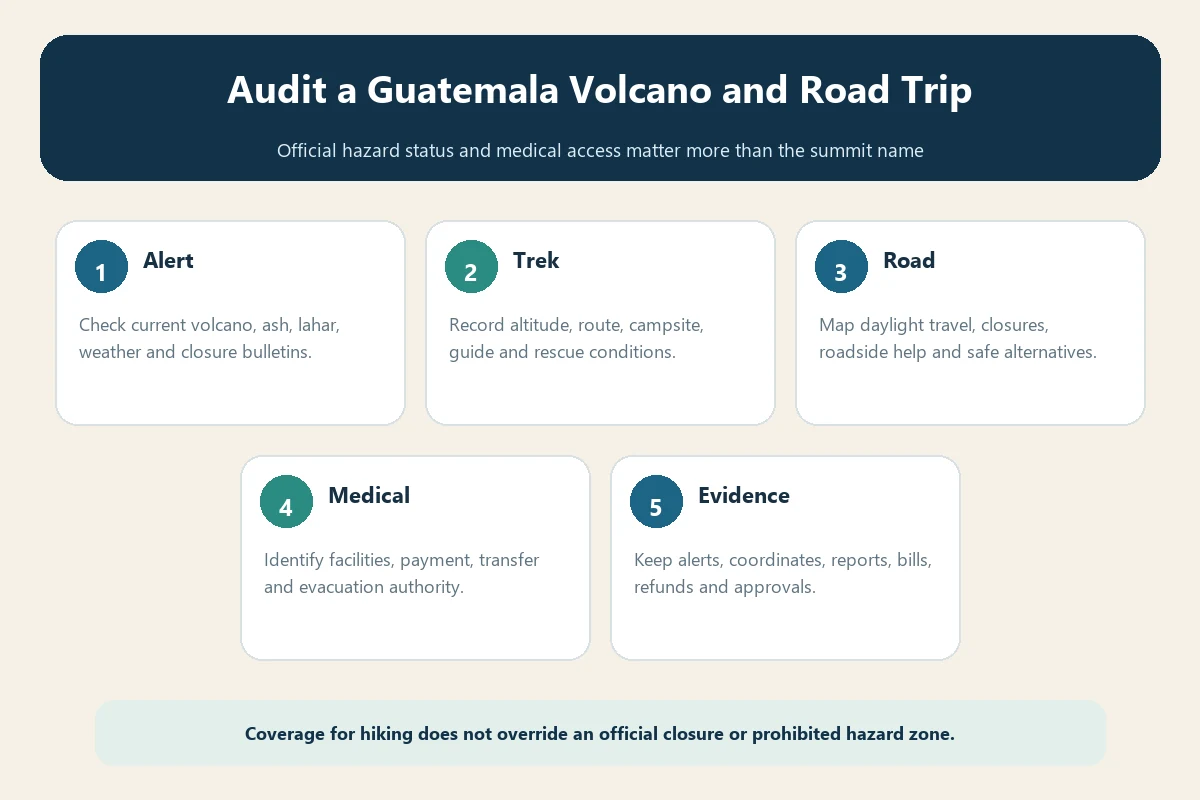
List the airport, Guatemala City stays, Antigua, Lake Atitlán villages, volcano trailheads, rural lodges, shuttles and private drives. Record road segments, expected travel times, guide pickup points, altitude, overnight camping and the nearest realistic medical facility.
The U.S. Department of State’s current Guatemala travel information notes that roads can be poorly maintained and poorly lit. It says U.S. government personnel are not permitted to drive outside Guatemala City at night and identifies PROVIAL as the road-assistance service for most major highways. Treat those details as planning inputs, not as insurance triggers by themselves.
Identify the volcano and activity precisely
“Volcano hike” is too vague for a coverage check. State the volcano, trail, altitude, day or overnight format, guide, group size and equipment. Add whether the itinerary includes camping, horseback transport, technical climbing, running or travel outside a marked route.
Review exclusions for altitude, mountaineering, climbing equipment, off-trail activity, professional or competitive participation and travel contrary to an official restriction. If a sports endorsement is available, compare its medical, rescue and equipment limits. The adventure-activity exclusion guide provides a named-activity checklist.
Request written confirmation tied to the planned facts. A booking platform’s “easy trek” label does not control the insurer’s definition.
Read the official volcano bulletin before the operator message
Guatemala’s National Institute of Seismology, Volcanology, Meteorology and Hydrology publishes official volcanology information, including activity bulletins and hazard resources. Save the bulletin for the named volcano, its issue time and the area or phenomenon described.
CONRED, Guatemala’s disaster-reduction authority, publishes national emergency information through its official portal. Compare any closure or evacuation instruction with the planned route. A social-media screenshot without issuer, date and location is weak evidence.
Never enter a restricted zone because an operator says conditions appear calm. Safety instructions take priority even if the loss does not meet an insurance definition.
Distinguish ash, lahar and closure effects
A bulletin about ash dispersion can affect air quality or flights without closing a hotel. A lahar warning may concern river channels after rain. A trail closure, road closure, airport disruption and mandatory evacuation are separate events with separate effects.
Record the issuing authority, named municipalities or routes, start time and actual supplier response. Ask the insurer which defined event can trigger cancellation, delay or interruption. The weather-delay coverage guide shows why a warning must be connected to the contract’s covered cause and minimum delay.
Verify the guide and exit plan
Record the operator’s legal name, guide, permits claimed, route, turnaround rule, communications, first-aid equipment and cancellation terms. Ask who monitors official bulletins and who has authority to cancel. Keep the booking description and waiver version.
For an overnight trek, note the campsite, water, temperature, evacuation route and expected time back to road access. Ask how an injured traveler moves from the trail to a vehicle and which responder takes over. An operator rescue is not automatically the same as insured medical evacuation.
Map treatment from rural highlands
The nearest clinic may stabilize a traveler but lack the specialty care needed for a fracture, breathing problem or serious illness. Identify the appropriate hospital path for each remote overnight. Ask whether the assistance company has provider relationships and whether payment must be made upfront.
Call the U.S. health plan about foreign care, reimbursement, claim forms and emergency notice. The health insurance abroad guide helps identify network and authorization gaps that can persist even when treatment is eligible.
Carry a medical summary, prescriptions and allergies offline. High altitude, exertion, heat or smoke can worsen an existing condition without creating a special coverage category.
Separate extraction, transfer and repatriation
A response can involve guide assistance, stretcher or vehicle extraction, ground ambulance, transfer between hospitals and later return to the United States. Ask which stage is search and rescue, which is medically necessary transport and who chooses the receiving facility.
Confirm whether evacuation ends at the nearest appropriate facility or can continue elsewhere, and whether a companion’s lodging or return is addressed. The remote evacuation guide gives a transport-authority framework.
In an emergency, contact local responders first. Notify the insurer’s assistance team as soon as practical and preserve every instruction and case number.
Audit highland roads and private transfers
Travel times can expand because of darkness, rain, construction, demonstrations or damaged roads. Build margin into airport and tour connections. Verify whether a shuttle is scheduled transportation, a private transfer or a tour service because policy carrier definitions can differ.
If renting, check permitted territory, road restrictions, third-party liability, collision protection, towing and replacement procedures. The rental car abroad guide separates vehicle contracts from trip benefits.
| Problem | First contract or clause | Evidence |
|---|---|---|
| Hiking injury | Medical and activity eligibility | Guide report, diagnosis and bill |
| Trail extraction | Rescue and evacuation wording | Coordinates, responder and authorization |
| Rental damage | Rental agreement or collision benefit | Photos, report and assessment |
| Road closure | Delay or interruption definition | Official notice and timed route impact |
| Airport disruption | Carrier delay and missed connection | Airline statement and replacement cost |
Classify a closure by trip timing
If a covered event occurs before departure and prevents the insured trip, cancellation may be relevant. After departure, unused arrangements and added transport may be interruption expenses. Waiting beyond a defined period can be delay. The traveler should not force every cost into one benefit.
Ask suppliers for refunds, changes or credits first. Record who canceled and the reason. The delay, interruption and cancellation guide helps match the event time to the correct claim path.
Review pre-existing-condition timing
A recent medication change, respiratory issue, heart condition or pending test may interact with a look-back period. A waiver can have a purchase deadline tied to the first trip payment and may require insurance of all applicable nonrefundable costs.
Use the pre-existing-condition waiver guide before the deadline. Coverage eligibility remains a contract question even when the immediate problem is triggered by altitude or exertion.
Test the assistance response with a highland case
Give each insurer one consistent scenario: a traveler on a permitted guided trek develops a serious medical problem, is extracted to road access, reaches a local facility and needs higher-level care. Ask who contacts providers, approves each transfer, helps with payment and decides whether return to the United States is appropriate.
Then test a nonmedical road closure that causes a missed flight. The assistance line versus claims guide distinguishes real-time coordination from later claim review.
Build the evidence chronology
Save the route, guide record, exact coordinates, official bulletin, closure notice, medical notes, itemized bills, proof of payment, transport record, supplier response and refund. Record when symptoms began and when each call was made.
The travel insurance claim guide provides a structured chronology. Keep original documents and submit translations when requested rather than replacing the source record.
Run one final Guatemala comparison
Quote the same itinerary and trip cost across plans. Include a named volcano hike, a Lake Atitlán stay, rural road travel, medical transfer, official closure and missed flight. Record exact wording pages rather than marketing summaries.
- Is the named activity eligible at the planned altitude?
- What guide, permit and official-restriction conditions apply?
- Are trail extraction and medical transfer separate benefits?
- Who selects the appropriate hospital and evacuation endpoint?
- Which official closure can activate a trip benefit?
- What notice, payment and evidence deadlines apply?
The best option is the contract that survives the weakest stage in the route. A large evacuation limit offers little value if the trek is excluded or the traveler ignores required authorization.
Prepare for altitude, cold and changing visibility
Ask the guide about expected temperature, wind, ash, rain, water and turnaround times. Pack the required layers, lighting, food and communication equipment. A clear morning at the trailhead does not guarantee stable conditions at a higher campsite or summit.
Follow medical advice about altitude and exertion. If symptoms appear, report them early rather than continuing to preserve a booking. Document the guide’s decision, altitude, time, symptoms and descent. A voluntary turnaround without a covered medical or official event may not reimburse the trek, but delaying a safe exit can make the outcome worse.
Store the route, assistance number and key medical information on paper as well as on the phone. Identify a daylight ground alternative if a planned shuttle cannot operate.
Bottom line
A strong Guatemala plan connects the current volcano bulletin, permitted activity, qualified guide, rural exit route and appropriate medical facility. Check that chain before booking, recheck it immediately before the trek and document every change that affects the itinerary.
