
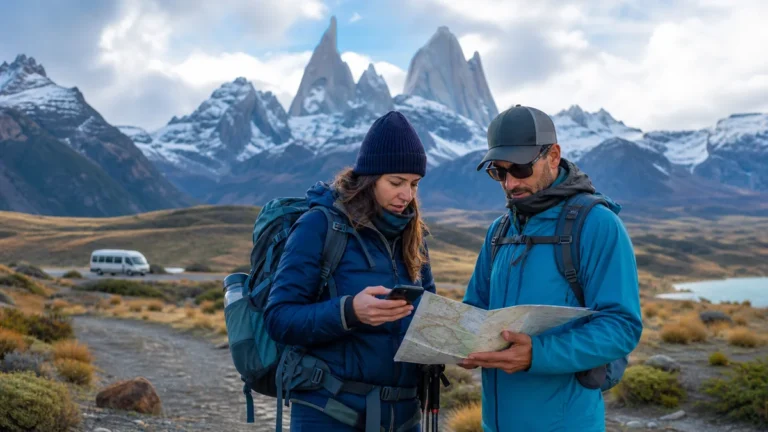
Travel insurance for Chile from USA trips should be compared against Chile’s extreme distances and the exact disruption chain. A Santiago stay, an Atacama excursion, a Patagonia trek and a visit to Rapa Nui use different flights, medical facilities and response systems. Build each route before comparing policy limits.
Key takeaways
- Map every remote overnight to transport and appropriate medical care.
- Use official earthquake and hazard information, not social-media clips.
- Separate park response, ambulance transfer and medical evacuation.
- Protect domestic flights with realistic buffers and refund evidence.
- Record supplier action before classifying a disruption claim.
Planning information reviewed August 16, 2026. Advisories, alerts, park access, transport and policy terms can change. Recheck official and supplier information for the travel dates.
Build three route files, not one Chile label
Create separate route files for central Chile, the Atacama north and Patagonia or the far south. Add Rapa Nui as a fourth if it is included. For every overnight, record airport, road transfer, first realistic clinic, higher-level hospital and time to reach each.
The current U.S. Department of State Chile travel guidance is Level 2, Exercise Increased Caution. It notes that strikes can cause significant delays to remote areas such as Rapa Nui, Punta Arenas and Chiloé, and that rural medical response can take longer.
Save the advisory on the purchase date and recheck it before departure. The country exclusions and advisories guide helps test whether a geographic or known-event exclusion affects the route.
Turn earthquake exposure into an operational plan
Chile’s SENAPRED publishes official earthquake preparation and response guidance. It tells people on the coast to evacuate immediately after shaking that makes it difficult to remain standing. Follow safety instructions first; insurance decisions come later.
Identify seismic protection locations at each hotel, coastal evacuation routes and an offline family contact. Store passport copies, policy details and medication information separately. Do not rely on a forecast to predict an earthquake or treat every tremor as a cancellation trigger.
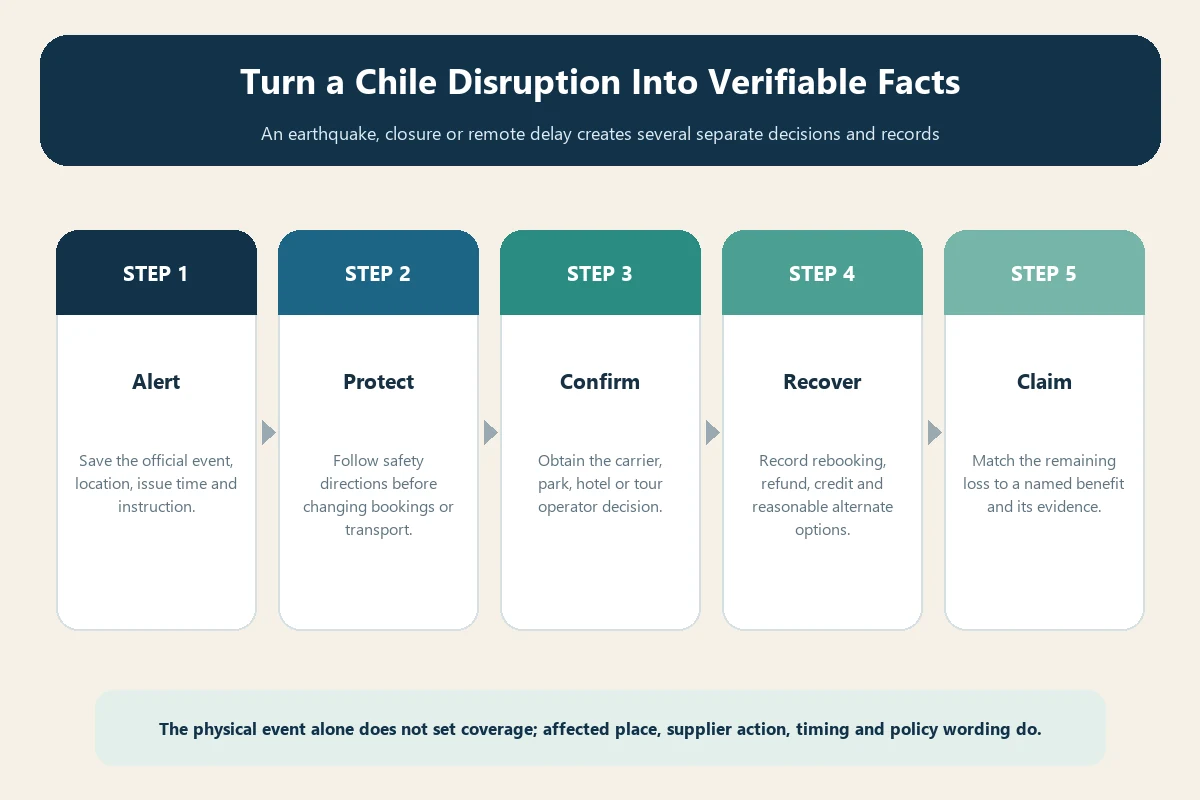
SENAPRED maintains a current alerts page and a broader hazard recommendations hub. Save the alert affecting the exact location and time, plus the carrier, park, hotel or tour decision that followed.
Distinguish the physical event from a covered reason
An earthquake can leave one itinerary untouched, close a road, cancel a flight or make lodging uninhabitable. Those facts may point to different benefits. Ask about natural disaster, destination uninhabitability, mandatory evacuation, common-carrier delay and destination inaccessibility.
The weather-delay guide provides a chronology method that also works for seismic disruption. Record first trip payment, policy purchase, event time, official instruction, supplier action, traveler decision and each refund.
A traveler’s fear after an event may be understandable but not a named reason. Optional cancel-for-any-reason coverage can offer broader discretion when purchased and used within its deadlines, but it normally reimburses less than the full trip cost.
Map Patagonia extraction in stages
For each trail, record registration, ranger contact, guide, communications, maximum remoteness and first road access. Ask the operator who coordinates response and what equipment it carries. Follow current park rules and closures.
Break a serious incident into on-trail response, movement to a trailhead, ambulance to a facility, inter-hospital transfer and possible air evacuation. Search and rescue or nonmedical extraction may have different limits from medical transport.
The emergency medical evacuation guide explains insurer control and appropriate-care wording. Ask who certifies medical necessity, confirms a receiving bed and chooses the transport destination.
Audit hiking and high-elevation activities
Give the insurer the named route, maximum and sleeping elevations, season, technical features, guide status and equipment. Ordinary hiking, mountaineering, glacier walking, skiing and guided climbing may be defined differently.
The Atacama can combine elevation, dryness, temperature swings and long road transfers. Discuss personal risk with a travel-health clinician. Ask whether activity or elevation thresholds apply and how pre-existing-condition language works.
The adventure activity exclusions guide provides a policy-comparison pattern. Confirm search-and-rescue, nonmedical extraction and equipment benefits separately.
Plan medical payment and higher-level transport
Identify the first facility near every remote stay and the larger city a clinician may use. Ask about hours, deposits, accepted cards and ambulance access. Do not promise yourself a Santiago hospital when a real transfer depends on medical judgment and availability.
Call the U.S. health plan about overseas emergency care, out-of-network rules, prior authorization and claim forms. The health insurance abroad guide structures the questions.
Ask travel assistance whether it can issue a payment guarantee, communicate in Spanish, arrange ground transfer and confirm a receiving facility. The assistance line versus claims guide separates coordination from reimbursement.
Protect long domestic flight chains
Record every ticket to Calama, Punta Arenas, Puerto Natales, Chiloé or Rapa Nui. Note the legal carrier, baggage terms, final flight, alternate airport and which connection shares one ticket. Chile’s length makes an airport substitution far more complex than a city transfer.
Ask whether a domestic delay can trigger missed-connection protection for a separate U.S.-bound flight. Determine the minimum delay and eligible carrier. The delay, interruption and cancellation guide helps classify lodging, replacement transport and unused bookings.
Preserve the original schedule, carrier message, rebooking offer, credit and replacement receipt. Build a realistic buffer rather than expecting insurance to repair an impossible connection.
Review remote road contracts
For a rental car, audit driver eligibility, liability, collision damage, theft, tires, glass, towing, excluded roads and cross-border restrictions. A gravel Patagonia road or an Argentina crossing may require explicit permission.
The rental-car abroad guide separates vehicle loss from medical and trip benefits. Photograph the vehicle and contract, then contact the rental company before nonemergency repair or towing.
Keep valuables out of unattended vehicles. The State Department specifically warns not to leave luggage unattended even in locked cars. Theft coverage often requires reasonable care and a police or carrier report.
Compare policies with one Chile scenario
Use identical ages, dates and prepaid costs. Include Santiago, a separate domestic ticket, a remote lodge, a named hike, a road closure, a clinic deposit, ground transfer and a missed international connection.
- Which advisory, geographic or known-event exclusions apply?
- Are the exact hike and elevation eligible?
- Who pays for extraction before an ambulance is available?
- How does assistance coordinate remote medical transport?
- Which supplier action can trigger a trip benefit?
- What records and notification deadlines control the claim?
Read the certificate and endorsements, not only the quote page. Record the policy page for every answer. A high evacuation limit is not useful when the activity, territory or first transport stage is excluded.
Build a dated claim packet
Keep the route, park registration, official alert, operator report, assistance case, medical note, transport record, carrier notice, supplier refund and added-expense receipt. Record the original currency and actual conversion.
The travel insurance claim guide explains coordination among suppliers, the U.S. health plan and travel insurer. Disclose all refunds and label medical, extraction and trip costs separately.
Give a companion an offline response role
Store passport details, medications, policy number, assistance contact and consent offline. Assign one person to follow safety instructions and another to record estimates, approvals and supplier options. A home contact can monitor carrier changes when local networks are overloaded.
After every call, record the representative, time, instruction and case number. Ask whether companion travel, dependent return or bedside lodging requires separate medical certification before booking it.
Test the Atacama route for altitude and road isolation
Do not describe the Atacama only as a desert. List the sleeping town, observatory, lagoon, geyser or high-plateau excursion, its elevation and the hours of road travel. Record the operator’s acclimatization, oxygen, communications and turn-back procedure. A short tour can still move rapidly from San Pedro de Atacama to substantially higher terrain.
Ask the insurer whether the maximum elevation changes activity eligibility and whether a road vehicle used for descent is medical transport, nonmedical extraction or an ordinary tour cost. If a traveler becomes ill, preserve the guide’s observations, first clinic assessment and reason for transfer. Fitness does not prevent altitude illness, and a policy does not replace a clinician’s pretravel advice.
Store water, medication and emergency contacts within reach during road segments. Identify the final safe departure back to Calama and the operator’s plan for a disabled vehicle. A missed flight caused by a voluntary late return is different from a documented breakdown or medical interruption.
Audit Rapa Nui as a closed transport loop
If the itinerary includes Rapa Nui, treat the island flight, lodging, tours and onward connection as a closed loop with limited replacement options. Record the final flight, alternate dates, hotel extension rate and supplier cancellation terms. Ask whether a strike, airport closure or medical event can trigger delay or interruption benefits.
Map the first local facility and the process for higher-level care on mainland Chile. Ask who decides that island capability is inadequate, who secures the receiving hospital and whether an ordinary scheduled flight can safely carry the patient. Do not assume that “evacuation” always means an air ambulance.
Keep the tourist card, airline messages and tour refunds in the same chronology. If the island remains accessible but a specific excursion closes, preserve the operator’s alternative and credit before claiming the original activity cost.
Bottom line
A strong Chile plan follows the real geography. It connects official alerts, remote response, appropriate care, domestic flights and supplier contracts. Verify every stage before purchase and preserve the evidence that converts a disruption into an eligible, unreimbursed loss.
