

A Europe travel insurance policy can exclude a country, region or cause of loss even when the quote describes the plan as “Europe” or “worldwide.” Check the territory definition, destination restrictions, government-advisory wording, war and civil-unrest exclusions, sanctions limits and the date an event became known. An advisory alone does not automatically create or remove coverage; the certificate must connect the advisory or event to a benefit or exclusion.
Key takeaways
- Europe, the European Union and the Schengen area are not the same insurance territory.
- A country may be inside the broad territory but subject to a separate restriction.
- Travel advisories do not have one universal effect across all policies.
- War, civil unrest and terrorism are different defined causes of loss.
- Timing and causation matter: when the event became known and what actually caused the claim.
Territory, exclusion and service restriction are different
Begin by separating three questions that are often compressed into “Is this country covered?”
- Territory: Is the destination inside the geographic area stated in the certificate?
- Coverage: Is the event a covered reason, and does an exclusion remove it?
- Service feasibility: Can assistance, payment or transport actually be arranged under applicable law and provider rules?
A traveler can receive three different answers. A country may fall inside “Europe,” while claims caused by war remain excluded. Emergency medical care may still be eligible for an unrelated illness, yet a security evacuation may not be included. The assistance team may also face practical limits in arranging transport or payment.
For a route with several countries, first use the multi-country Europe travel insurance checklist to list every stop, transit country and activity. Then apply the five checks below to each destination.
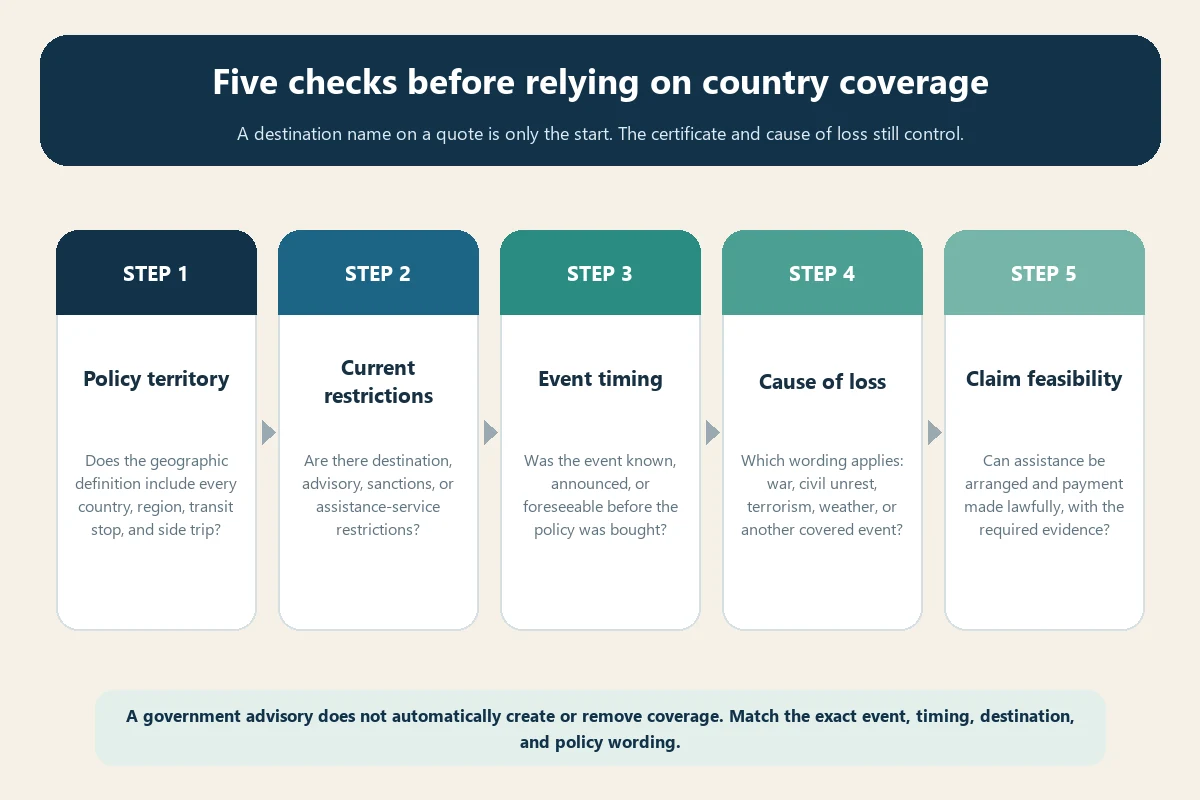
Check 1: read the policy’s geographic definition
Search the certificate for “geographic scope,” “territory,” “destination,” “covered trip” and “excluded countries.” Some plans list individual countries. Others use regions such as Europe, Schengen, worldwide or worldwide excluding specified countries. A state-specific endorsement can modify the main form.
Do not substitute political or border groupings for the insurance definition. The European Commission currently lists 29 Schengen countries, including four that are not EU members. Ireland is outside Schengen, while Switzerland is inside Schengen but outside the EU. Türkiye is in Europe and Asia but is not in the Schengen area. A product label may group these destinations differently.
Also record:
- airport connections and overnight transit stops;
- cruise ports and territorial waters;
- day trips across a border;
- autonomous territories and islands;
- regions the policy names separately; and
- any country added after purchase.
Our overview of how Europe travel insurance differs by country explains why medical access, rescue systems and transport can change even when the policy territory remains the same.
Check 2: look for destination and advisory restrictions
The US State Department uses four advisory levels, from “Exercise Normal Precautions” to “Do Not Travel.” These levels are government risk guidance, not standardized insurance triggers. One certificate may refer to a specific advisory level. Another may exclude only losses caused by a named hazard. A third may not use State Department levels at all.
Check whether the policy:
- excludes travel to a destination already under a stated advisory when the trip begins;
- limits benefits when an advisory rises after purchase;
- covers cancellation only if an advisory is tied to a listed covered reason;
- distinguishes a whole country from a named region; and
- requires the traveler to leave after an official evacuation order.
An advisory can change while the policy remains in force. Save a dated copy of the advisory at purchase, at the time of any change and at the loss. Also save the certificate version. A search result or later webpage is weak evidence of what the policy said on the relevant date.
Check 3: establish when the event became known
Travel insurance is designed for unexpected covered events. Once a disruption is known or foreseeable under the policy, buying or extending coverage may not protect against that event. The relevant date can be the announcement of a strike, the naming of a storm, the closure of an airport, the start of unrest or another point defined by the insurer.
Build a short timeline:
- Initial trip deposit.
- Policy purchase.
- Announcement or public start of the event.
- Advisory or official-order change.
- Cancellation, delay, interruption or medical loss.
The purchase-order guide for buying Europe travel insurance explains why an early policy can preserve options that disappear after an event is public. It still does not turn every future consequence into a covered claim.
Check 4: match the exact cause of loss
A loss near a political or security event is not necessarily caused by it. Suppose a traveler in a city experiencing demonstrations is hospitalized for appendicitis. The claim analysis may be different from an injury caused during the demonstration or a cancellation based only on fear of traveling.
Read separate definitions for:
- War or military action: often broadly excluded, whether formally declared or not.
- Civil unrest or riot: may be excluded or handled under specific wording.
- Terrorism: may be a covered cancellation reason only when location, timing and designation rules are met.
- Government action: may include border closure, confiscation or travel prohibition.
- Natural disaster or weather: may require destination damage, common-carrier stoppage or another listed trigger.
- Carrier or supplier disruption: may be handled as delay, strike or financial default rather than a country exclusion.
The existing travel insurance exclusions guide covers the standard medical, activity, conduct and property exclusions. This article is narrower: it shows how territory and public events interact with a cross-border Europe itinerary.
Check 5: confirm assistance and payment feasibility
A policy may contain broad worldwide language while assistance providers, banks, hospitals, airlines or transport operators face legal and operational restrictions. US sanctions programs can be comprehensive or targeted. The Treasury’s Office of Foreign Assets Control says global travel insurance may generally be provided for exempt or authorized travel, but insurers must still screen prohibited persons and transactions and comply with program-specific rules.
Do not turn that general statement into a promise about one destination or claim. Ask the insurer in writing:
- Is the destination eligible on the intended travel dates?
- Can the assistance provider arrange hospital guarantees of payment there?
- Can it organize medical or security transport from the region?
- Are there payment, banking or provider restrictions?
- What happens if circumstances change after departure?
Insurance and government evacuation are also different. The US government may help communicate or coordinate in a crisis, but the State Department states that it does not pay overseas medical costs for travelers. A policy must expressly include medical or security evacuation for those benefits to exist.
Worked itinerary: Dublin, Paris and Istanbul
Assume a US traveler flies to Dublin, continues to Paris and ends in Istanbul. The route includes Ireland, a Schengen country and a destination outside the Schengen area. The traveler has separate flights and nonrefundable hotels.
The review should answer:
- Does the policy’s Europe definition include Ireland and Türkiye as well as France?
- Do any destination or regional restrictions apply on the purchase date?
- Would a missed separate flight qualify under delay or missed-connection wording?
- How are civil unrest, terrorism and government action defined?
- Can medical assistance and payment be arranged in all three destinations?
A single policy may cover the whole route, but the answer does not come from the Schengen map. It comes from the certificate’s territory, benefit and exclusion language.
Common interpretation mistakes
- “The country is listed, so every event is covered.” Territory is not a promise that every cause of loss qualifies.
- “A Level 4 advisory automatically cancels the policy.” Check the certificate’s trigger and effective-date wording.
- “A lower advisory guarantees coverage.” War, unrest, sanctions or activity exclusions can still apply.
- “Terrorism and war mean the same thing.” Policies define them separately.
- “If the event happened after purchase, it is covered.” It must still be a listed covered event and not excluded.
- “Canceling because I feel unsafe is a covered reason.” Fear alone is commonly outside standard named-reason cancellation; review CFAR separately.
If standard cancellation wording is too narrow for a traveler’s risk tolerance, the CFAR guide explains purchase timing, insured trip cost and partial reimbursement. CFAR itself remains subject to eligibility and cancellation deadlines.
What to save before and during the trip
- The state-specific certificate and every endorsement.
- The insurer’s written confirmation that each destination is eligible.
- Dated State Department advisories and embassy alerts.
- Carrier notices, cancellation reasons and rebooking options.
- Government orders, border notices or evacuation instructions.
- Receipts, supplier refunds and unused-trip-cost records.
- Assistance calls, case numbers and approval messages.
A denial should identify the policy language used. Compare the stated cause and timeline with the certificate, then use the travel insurance claim-denial guide to identify missing evidence or an appeal issue. For airline labor action, the airline strike coverage guide deals with announcement timing and carrier documentation.
Sources and methodology
This guide was checked against the US Department of State travel advisory system, the CDC Yellow Book travel insurance chapter, the OFAC sanctions program index, OFAC FAQ 104 on global travel insurance, and the European Commission Schengen overview. These sources explain government risk information and legal context; the state-specific policy certificate determines coverage.
Editorial note: This article provides general educational information for US travelers. It is not a destination-safety recommendation, a coverage determination or legal advice.
Planning travel across Türkiye? Use the Turkey travel insurance guide for U.S. visitors to compare regional exclusions, private-hospital payment, natural-disaster disruption and evacuation.
Planning a two-island Trinidad and Tobago trip? Read the Trinidad and Tobago travel insurance guide for advisories, island transfers, private hospitals, events and evacuation.
Planning Colombia from the United States? Read the Colombia travel insurance guide for altitude, regional advisories, medical payment, domestic flights and evacuation.
Combining Brazilian cities, an event and the Amazon? Read the Brazil travel insurance guide for private care, contracts, health guidance and remote evacuation.
Planning Laos beyond Vientiane? Read the Laos travel insurance guide for current entry guidance, cash deposits, limited care and cross-border evacuation.
Illness transport, political or security evacuation, trip interruption, and government-assisted departure use different triggers and destinations. Use the medical evacuation insurance vs political evacuation guide to audit authority, advisories, safe-location wording, access, timing, authorization, onward travel, and cost.
A war or military-action exclusion can affect medical treatment and evacuation even when another section names terrorism or political evacuation. Use the medical evacuation insurance war exclusion guide to test causation, preserved benefits, advisories, sanctions, access, authorization, and evidence.
