
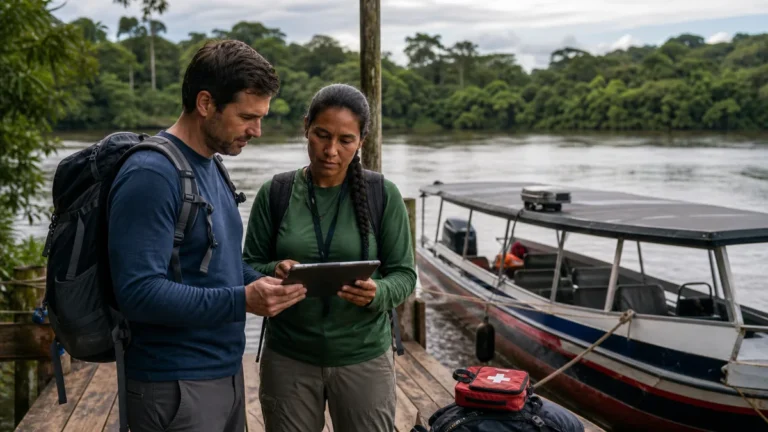
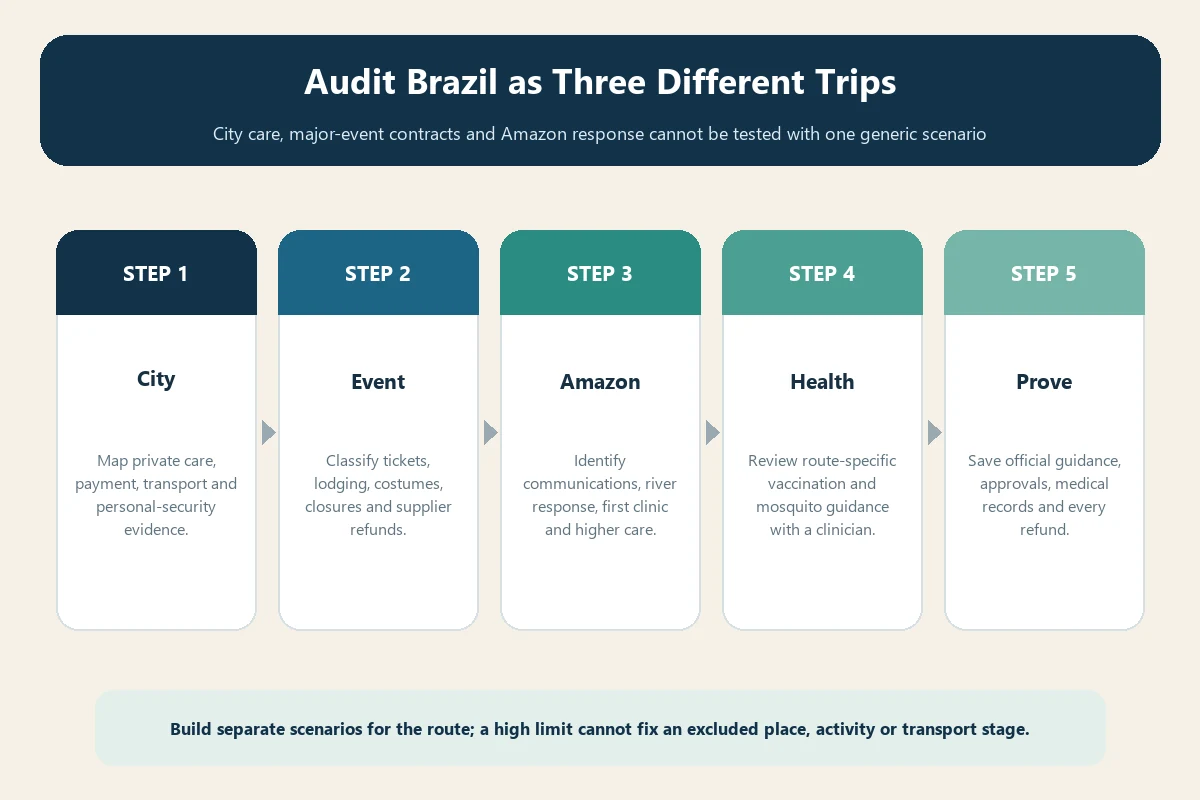
Travel insurance for Brazil from USA trips should be tested as several different journeys. Private care in a major city, prepaid Carnival arrangements and river travel in the Amazon create different payment, communications and evacuation problems. One generic medical limit does not answer them all.
Key takeaways
- Check current entry and advisory rules independently from insurance.
- Map urban private care, payment and assistance procedures.
- Audit event tickets, lodging, costumes and supplier refunds.
- Build the Amazon river-to-hospital evacuation chain.
- Use official route-specific vaccination and malaria guidance.
Planning information reviewed August 16, 2026. Visas, advisories, health guidance, events, transport and policy terms can change. Recheck official and supplier sources for the travel dates.
Separate entry requirements from insurance coverage
The current U.S. Department of State Brazil travel information says U.S. citizens require a Brazilian visa or e-visa. Check the linked Brazilian government procedure before travel. A valid insurance policy does not replace an entry document.
The same official page lists no required vaccination for entry but directs travelers to the Health section. Brazil’s Ministry of Health vaccination guidance for international visitors says proof is not mandatory for entry while recommending route-appropriate vaccines, including yellow fever in recommended areas.
Entry, medical advice and claim eligibility are three separate questions. Save the current official instruction. Discuss the itinerary with a travel-health clinician and ask the insurer how physician advice, pre-existing conditions and trip cancellation documentation work.
Read the advisory by exact geography
The current State Department guidance is Level 2 and identifies land-border areas and informal housing developments as Do Not Travel, with stated exceptions for Foz do Iguaçu and Pantanal National Parks. Map every route rather than applying one national label.
Ask the insurer whether an advisory or geographic exclusion affects the specific road, river, town or excursion. The country exclusions and advisories guide helps test purchase timing, known events and geographic scope.
Do not assume that an operator’s willingness to sell a tour proves insurance eligibility. Obtain the legal operator, route, permits, communications and emergency plan. Follow official safety guidance.
Map public emergency access and private care separately
Brazil’s Ministry of Health explains that foreign visitors can use the public emergency network. Its official during-your-stay guidance lists SAMU 192 and 24-hour emergency units. Availability and capability still vary by location.
Identify the first public emergency unit and a realistic private hospital for each urban stay. Ask the private provider about deposits, accepted cards and written estimates. Determine whether assistance can issue a guarantee of payment and communicate in Portuguese.
The health insurance abroad guide helps check the U.S. plan for overseas care. The primary versus secondary guide explains claim order; it does not promise direct billing.
Build the Amazon response chain before choosing a limit
For each river or lodge segment, record legal operator, vessel, guide, radio or satellite contact, nearest landing point, first clinic and higher-level destination. Estimate response time under ordinary conditions without presenting it as a guarantee.
Break a serious case into onboard or lodge response, river movement, road ambulance, stabilization, inter-hospital transfer and possible air evacuation. Ask who controls each stage and how a receiving bed is confirmed.
The emergency medical evacuation guide distinguishes transport to appropriate care from a preference to return to the United States. Confirm medical necessity, insurer control, companion travel and repatriation wording.
Test assistance with lost communications
Give each insurer the same case: a traveler becomes ill at a river lodge, the guide moves the patient by boat to a clinic, and a physician requests transfer to Manaus or another larger center. Ask how prior authorization works when mobile service is absent.
Locate the emergency exception and notification deadline in the certificate. Ask what documents the operator must provide and whether nonmedical river extraction has a separate limit. Record the representative’s answer and supporting page.
The assistance line versus claims guide separates real-time coordination from later adjudication. A case number does not guarantee every expense, but it preserves instructions.
Use route-specific health guidance
Brazil’s Ministry of Health maintains official yellow-fever guidance for travelers. It says vaccination should occur at least 10 days before travel to allow protection. A clinician must assess contraindications and the actual route.
The Ministry also publishes malaria guidance for travelers, emphasizing pretravel advice for transmission areas and prompt care for symptoms after return. Follow medical advice; an insurance article cannot prescribe prevention.
Ask how illness is covered, which pre-existing-condition rules apply and whether a clinician’s advice can support cancellation. Keep the itinerary and consultation record. Health guidance does not itself create a covered trip reason.
Audit Carnival and festival costs by contract
List each airfare, hotel, parade ticket, costume, event package, local transport and tour. Record the supplier, payment date, nonrefundable amount, cancellation deadline, transfer right and credit expiry.
An event postponement, venue closure, airline cancellation and traveler illness are different triggers. Ask what policy language applies to each. The trip cancellation guide explains named reasons and purchase timing.
Costumes, instruments, cameras or professional equipment can exceed baggage per-item limits. Check unattended-property, checked-baggage and professional-use exclusions. Photograph valuable items and preserve custody records.
Protect domestic flights and event connections
Brazil routes can combine separate flights to Rio, Salvador, Recife, Manaus or Foz do Iguaçu. Record ticket ownership, final departure, baggage terms and alternate airport. Do not assume one airline protects a separate ticket.
Ask whether a domestic delay qualifies for missed-connection coverage and whether the event or river departure counts as a covered connection. The delay, interruption and cancellation guide helps classify the expense by timing.
Obtain the carrier’s written delay, rebooking and refund options before purchasing replacements. Preserve the event operator’s missed-arrival rule and every credit.
Audit activities by exact facts
For hiking, diving, surfing, rafting, wildlife trips or small-vessel travel, give the insurer the named activity, operator, equipment, remoteness and maximum elevation or depth. Ask whether search, rescue and nonmedical extraction are separate.
The adventure activity exclusions guide provides a comparison method. A licensed operator improves planning but does not override a policy exclusion.
For a boat excursion, classify the craft as a scheduled carrier, tour vessel or charter. Keep passenger terms, weather policy, safety briefing and incident report.
Compare policies with one Brazil scenario
Use identical ages, dates and prepaid costs. Include a city hotel, event ticket, separate domestic flight, Amazon lodge, river transfer, clinic deposit, inter-hospital transport and missed U.S. connection.
- Does any itinerary area trigger a geographic exclusion?
- How does assistance handle private payment in Portuguese?
- Which river and nonmedical extraction stages are eligible?
- Are the exact activities and vessel covered?
- Which event or carrier action can trigger trip benefits?
- What evidence and notification deadlines control the claim?
Compare certificates and endorsements, not provider rankings. Record the page for every answer. Avoid adopting Google’s generic dollar recommendations without testing route, age, costs and definitions.
Build the claim chronology
Keep the visa record, itinerary, dated advisory, health consultation, operator contract, medical note, assistance authorization, transport log, carrier notice, refund and receipt. Record Brazilian reais and the actual card conversion.
The travel insurance claim guide explains coordination among suppliers, the U.S. health plan and travel insurer. Disclose all public or private reimbursements and label each benefit separately.
Give a companion an offline case card
Store passport details, allergies, medications, assistance contacts and consent offline. Assign one person to communicate with clinicians and another to record estimates, approvals and refunds. A home contact can monitor flights during a remote incident.
Ask whether interpretation, companion lodging, dependent return and bedside travel require medical certification. Do not book them on the assumption that approval of the patient’s transfer approves every companion cost.
Create a Carnival loss ledger before purchase
Separate a parade ticket, costume, hotel block, airport transfer, rehearsal, party admission and guided experience. For each line, record who holds the money and what happens after traveler illness, event postponement, venue closure or supplier cancellation. A single package invoice can hide several different refund rules.
Ask the insurer how unused event-specific property is valued. A custom costume may be neither ordinary baggage nor a refundable tour expense. Check per-item limits, depreciation, professional-use exclusions and whether shipping is included. Keep receipts, photographs and proof of delivery.
If crowd control or security instructions change access, follow authorities first. Then obtain the event organizer’s written decision. A changed entrance, shortened program and full cancellation are not the same loss. Preserve any replacement ticket or transferable credit.
Document a river medical incident by handoff
Give one companion the job of recording coordinates or named location, first symptoms, guide decision, boat departure, landing time, clinic arrival and every assistance call. Connectivity may return only after movement begins, so the offline chronology matters.
Ask each provider for its own record: the boat operator for transport, the clinic for diagnosis, the ambulance for destination and the hospital for receiving acceptance. A bundled lodge invoice can obscure medical necessity and the actual service provider.
Keep food, lodging and companion costs separate from patient transport. If the operator provides a refund or emergency service within the package, record its value. This avoids presenting the same river movement as both a supplier loss and an insurance expense.
Bottom line
A strong Brazil plan fits the real journey. It handles urban payment, event contracts, Amazon communications, appropriate medical transport and route-specific health preparation. Verify those pieces independently, then preserve the evidence that connects each cost to a covered event.
