
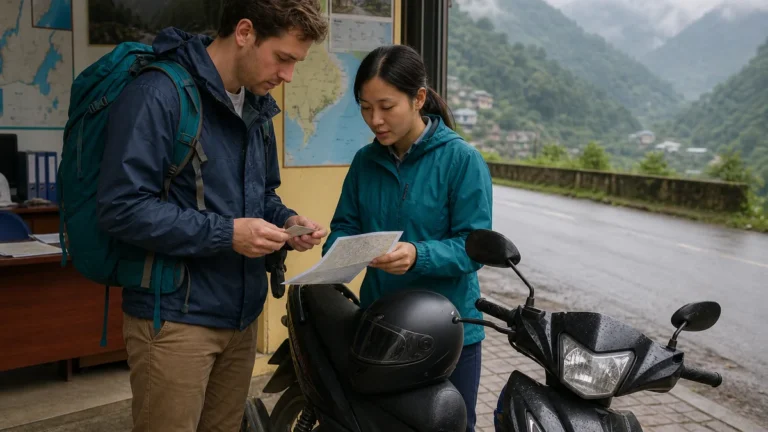
Travel insurance for Vietnam from USA trips should be selected around legal motorbike use, upfront medical payment and route-specific access. The critical question is not whether a shop will rent a moped. It is whether the traveler has a valid Vietnamese license and remains eligible under the policy.
Key takeaways
- Renting a moped without a Vietnamese license is illegal.
- An unlicensed accident may leave medical bills outside coverage.
- Prepare for cash or advance hospital payment.
- Test mountain, cave and coastal response separately.
- Use official forecasts and supplier decisions for monsoon claims.
Planning information reviewed August 16, 2026. Licensing, entry rules, weather, medical access and policy terms can change. Recheck official and supplier information for the travel dates.
Start with the transport choices
List flights, trains, buses, ride-hailing, tours and any proposed motorbike segment. Record the driver, vehicle class, route and reason for riding. A passenger transfer is different from self-driving a mountain loop.
Map Hanoi, Ho Chi Minh City, central coast and highland segments separately. Use the delay and interruption guide for missed domestic connections and unused bookings.
Treat the license as the first coverage gate
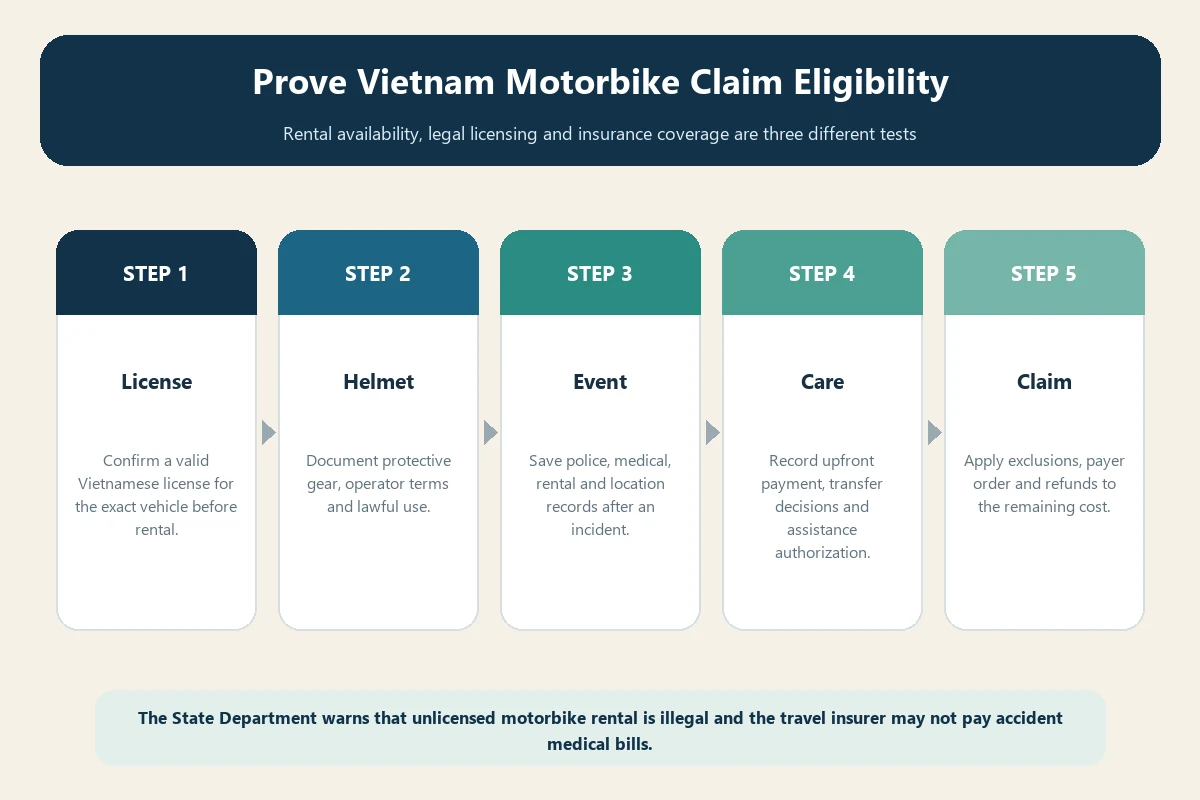
The current State Department Vietnam travel guidance states that renting a moped or motorbike without a Vietnamese driver’s license is illegal. It warns that travel insurance may not pay accident medical bills when the rider lacks that license.
Confirm the exact licensing process with Vietnamese authorities before renting. Give the insurer the vehicle class and license evidence. A U.S. license, international permit or rental agreement should not be assumed sufficient without verification.
Audit helmet and conduct exclusions
Ask about certified helmets, passenger use, engine size, alcohol, drugs, off-road riding, commercial use and local-law violations. Get the answer in writing and save the certificate page.
The activity exclusions guide provides a comparison pattern. If lawful eligibility cannot be proven, choose a licensed driver or other transport.
Prepare for advance medical payment
State Department guidance says most hospitals and medical professionals require cash, and public and private facilities may demand payment upfront or proof of good insurance. Cards are not always available.
Ask whether assistance can issue a guarantee, identify a facility and arrange interpretation. Keep secure payment capacity and preserve itemized bills, diagnosis, payment proof and discharge instructions.
The health insurance abroad guide structures the U.S. plan call.
Test rural and mountain response
Official guidance says adequate care can be hard to find in rural areas and first responders may not reach remote locations. Mountain roads can be steep, curved and affected by falling material.
Ask who coordinates local stabilization, ground transport and a receiving hospital. The medical evacuation guide maps each stage and approval.
Distinguish rescue from evacuation
A trek, cave or remote road incident may require nonmedical extraction before an ambulance can begin. Ask whether rescue and medical evacuation have separate benefits or exclusions.
Record guide qualifications, route, communications and emergency plan. A headline evacuation limit cannot create a rescue team, clear a flooded road or guarantee a receiving bed.
Use Vietnam’s official weather service
The National Center for Hydro-Meteorological Forecasting publishes official Vietnam weather and marine information, including flood, landslide and sea conditions. Save the affected area, issue time and warning.
Then obtain the railway, airline, bus, boat, hotel or tour action. The weather-delay guide explains why a forecast and covered carrier delay are separate facts.
Audit cave and water activities
State guidance notes that caves can flood quickly during rainy periods and that coastal conditions change. Give the insurer the exact cave, trek, diving or boating plan, guide and equipment.
Follow closures and operator instructions. Preserve cancellation and refund records. Voluntary participation after an official closure can change claim evaluation.
Check destination health guidance
The CDC provides current Vietnam traveler health guidance. Review it with a clinician for the route, season, activities and health history.
Verify medicine legality separately. State guidance warns that some ingredients common in U.S. prescriptions may be illegal. Insurance cannot override import or drug laws.
Plan visa timing around medical delay
Vietnam issues visas for defined periods. State guidance warns that a traveler unable to depart on time, including for a medical emergency, may face fines and permission delays.
Carry passport and visa copies. Ask assistance how it coordinates with the traveler and consular resources, while recognizing it cannot extend a visa or override immigration rules.
Separate liability and vehicle damage
Medical coverage does not automatically pay damage to the motorbike, another vehicle or another person. Review local rental liability and damage terms before accepting the keys.
The rental vehicle guide explains the layers, but many rental-car benefits exclude two-wheeled vehicles. Confirm rather than infer.
Compare one Vietnam scenario
Use the same ages, dates and prepaid costs. Include a legally licensed mountain motorbike plan, a domestic train, a cave tour, monsoon warning and hospital deposit.
- What license and helmet evidence is required?
- Which vehicle and activity exclusions apply?
- How is upfront care funded?
- Who authorizes rural transfer?
- What operator action triggers weather benefits?
- Which documents prove the final loss?
Read the certificate. Generic search-result limits do not answer legal eligibility, payment or access questions.
Use assistance and preserve the file
Record insurer representatives, instructions and case numbers. The assistance versus claims guide distinguishes coordination from final approval.
Keep license, rental contract, helmet evidence, police report, medical bills, weather alert, carrier notice and refunds. The claim guide explains payer reconciliation.
Rehearse a no-motorbike route
Price a licensed driver, bus, train or reputable transfer before travel. If the license or policy test fails, a safer alternative prevents the trip from depending on an excluded activity.
Share the route and check-in times with a home contact. Store emergency numbers and documents offline for weak-service areas.
Use a motorbike eligibility decision record
Write down the proposed vehicle class, engine capacity, rider, passenger, provinces and road surfaces before paying a deposit. Put the Vietnamese licensing answer, rental terms and insurer response beside those facts. The record should show who supplied each answer and when it was checked. A shop’s willingness to release a bike is commercial availability; it is not the government or insurer confirming lawful eligibility.
Ask the insurer to address accident medical treatment, local ambulance, evacuation, personal liability and vehicle damage separately. These benefits may sit in different policy sections, and a medical answer does not establish protection for the rented bike or a third party. If the certificate excludes violations of law, ask how licensing evidence is evaluated at claim time.
Set a firm stop rule: if the accepted license cannot be documented for the exact class, remove self-riding from the itinerary. Keep the rail, bus or licensed-driver alternative in the same file so the safer choice is practical when a rental offer appears.
Vet a mountain or cave operator
Ask a remote operator for the precise route, seasonal limits, guide qualifications, group size, communication equipment, turnaround rules and method for reaching public emergency services. For a cave, identify water monitoring, escape points and the rule used to cancel after heavy rain. For a mountain loop, identify overnight stops, fuel range, road-surface changes and how an injured traveler reaches an ambulance-accessible point.
Give those activity facts to the insurer instead of using a broad label such as “adventure tour.” Ask whether elevation, underground travel, motorized transport, trekking distance or professional rescue changes coverage. Verify whether search and rescue has its own limit and whether an insurer-authorized medical movement begins only after extraction.
Retain the operator’s booking terms and safety messages. If it cancels, request a written reason plus the refund or credit decision. If it offers an alternate route, document that option before purchasing a replacement. This separates operator recovery from any eligible policy loss.
Reconcile a Vietnam medical claim in local order
Start the file with the incident time and location, then place the police or operator record, first clinical note, payment request, receipt, transfer recommendation and later treatment in sequence. Translate only through a method the insurer accepts, and preserve the Vietnamese originals. A card statement proves a payment amount but usually does not identify diagnosis or service.
Create a ledger with Vietnamese dong paid, the card or cash source, actual conversion, insurer case number, health-plan response and every provider refund. Keep companion transport and unused trip costs on separate rows. When assistance directs the traveler to a facility, save the message but do not describe it as a benefit approval unless the insurer expressly says so.
If a medical delay affects the visa or departure, record the clinician restriction, airline response and immigration instructions independently. A medical claim and permission to remain are separate processes, even when the same event caused both.
Bottom line
Before departure, print a one-page decision summary showing the accepted transport plan, the no-motorbike fallback, assistance contacts and the documents stored offline. Give the same version to a companion or home contact. Include the nearest consular contact, allergies and a plain-language description of the first remote segment. If the route, rider or vehicle changes, update the summary and repeat the legal and policy checks. A dated decision record makes the safe option easier to follow and prevents a later rental conversation from replacing verified information. Review it again after any operator substitution or severe-weather warning.
A strong Vietnam plan begins with legal motorbike authority and ends with a documented payment and transfer chain. Verify the route, follow official warnings and preserve every record connecting an eligible incident to the unreimbursed cost.
