

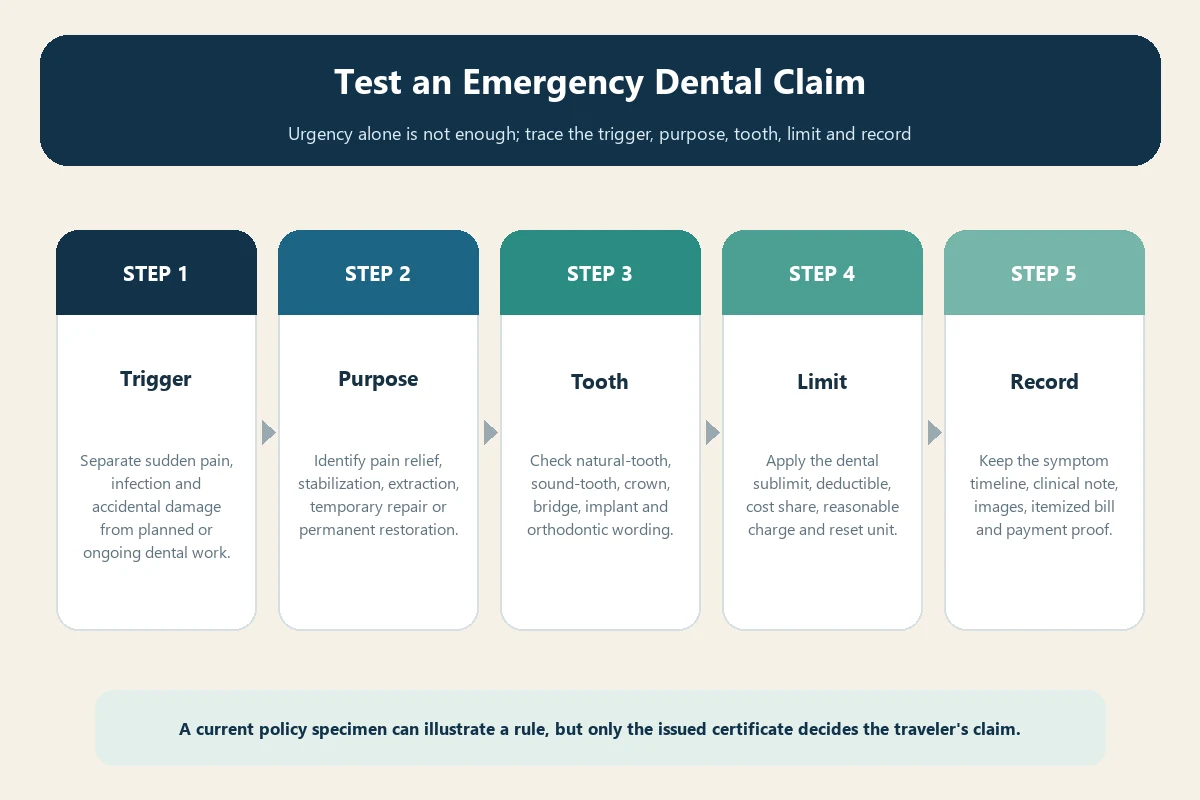
Travel medical insurance emergency dental coverage is usually a narrow benefit for an unexpected problem during a trip, not a substitute for ordinary dental insurance. Sudden pain, an acute infection and a tooth damaged in an accident can enter different policy tests. The safest way to evaluate coverage is to trace the trigger, treatment purpose, tooth or dental device, benefit limit and evidence.
Key takeaways
- Separate sudden pain from accidental tooth damage before reading the benefit.
- Emergency relief and permanent restoration may not receive the same treatment.
- Natural teeth, crowns, bridges, implants and orthodontic devices can follow different definitions.
- A small dental sublimit can control payment even when the policy has a large medical maximum.
- Keep a clinical note, dental images, itemized bill, treatment codes and payment proof.
Planning information reviewed August 16, 2026. Dental practice, prices and policy language vary. Confirm the issued certificate and obtain advice from a qualified dentist for any urgent condition.
Start with the event, not the treatment name
“Dental emergency” can describe the urgency of care without proving the insurance trigger. Write what happened: severe pain began overnight, a fall fractured a tooth, swelling developed around a previously treated tooth, or an old crown detached while eating. Then record when symptoms began and whether a similar problem existed before departure.
The travel medical benefits guide shows why the service must connect to a covered event. A receipt labeled emergency treatment does not replace the policy definitions, exclusions or timeline.
Separate pain relief from accidental damage
Some certificates describe treatment needed to resolve acute pain. Others separately describe restoration of teeth lost or damaged in a covered accident. These are not interchangeable. A toothache with no accident may fit only the pain-relief branch, while a fall can require proof of both the accident and the dental damage.
Ask the dentist to record the clinical finding and the likely cause rather than only the procedure. “Temporary filling” says what was done; “temporary filling to control sudden pain from a newly fractured natural tooth after a fall” connects the procedure to the event.
Define emergency purpose before approving the plan
Urgent dental treatment can aim to control pain, drain an infection, stop bleeding, stabilize a tooth, remove a dangerous tooth or protect exposed tissue. A later crown, implant or cosmetic restoration has a different purpose even if it follows the same incident.
Build two columns in the trip file: immediate treatment needed to prevent deterioration, and definitive work that can safely wait. Ask the insurer how each column is treated. Do not assume that coverage for stabilization includes the full permanent repair.
Check natural-tooth and sound-tooth wording
A certificate may distinguish a natural tooth from a crown, bridge, implant, denture or orthodontic appliance. It may also use a term such as sound natural tooth, which can add a condition test before the accident. Read the definition section instead of guessing from the schedule.
If an accident affects a restored tooth, ask the dentist to identify the natural structure and the existing device separately. Photographs and dental images can help show what was damaged by the event and what existed beforehand.
Do not treat a lost crown as a simple yes-or-no claim
A detached crown can create pain, expose tissue or make eating unsafe. Yet the device itself may be excluded while an examination, pain-control procedure or temporary protection is evaluated differently. Ask for separate line items for the consultation, imaging, temporary work and replacement device.
The prescription medication guide applies if the dentist orders antibiotics or pain medicine. The drug claim still needs the diagnosis, prescription and pharmacy record; it is not automatically included because the visit was dental.
Routine and planned care belong outside the emergency test
Cleanings, checkups, maintenance fillings and work recommended before travel are commonly outside an unexpected-event benefit. A traveler who postpones known treatment does not convert it into a new event by receiving care overseas.
Record any symptoms, advice or scheduled work that existed before departure. The pre-existing conditions guide explains why timing and prior medical advice matter. A waiver must be read exactly; it does not automatically create routine dental coverage.
Look for the dental sublimit
A policy can display a large overall medical maximum and a much smaller ceiling for emergency dental treatment. The dental number may be per tooth, per occurrence, per certificate period or a combined maximum for the trip. It may sit outside the main medical maximum or reduce it.
Use the travel medical sublimits guide to record the amount, unit, reset rule and interaction with other caps. Never infer the dental limit from the headline medical amount.
Test deductible and cost sharing separately
One policy can waive the medical deductible for a dental benefit, while another applies the deductible and coinsurance before the sublimit. A per-incident deductible can produce a different result from a certificate-period deductible when the traveler needs two visits.
The travel medical deductible guide provides a worksheet for the reset unit. Add reasonable-charge rules and any provider-network treatment to the same calculation.
Use a four-line cost scenario
Before travel, test one hypothetical dental episode without assuming any policy amount. List the dentist’s total charge, the amount the policy recognizes, the deductible or cost share, and the dental maximum. Then calculate the traveler balance after the smallest applicable ceiling.
This exposes a common mistake: comparing two plans only by their medical maximum. The plan with the larger medical headline can still have the weaker dental result because the dental row controls first.
Contact assistance without delaying urgent care
For severe pain, swelling, facial trauma, uncontrolled bleeding, fever or difficulty breathing or swallowing, seek qualified care promptly. The assistance service may help identify a provider, explain documents or open a case, but it cannot examine the patient.
Record the case number, time, representative and instructions. If the insurer asks for contact before non-emergency treatment, preserve proof that the traveler complied or that immediate care made prior contact impractical.
Expect point-of-service payment
The CDC’s current travel insurance guidance warns that medical care abroad often requires out-of-pocket payment. Dental offices may have no direct relationship with a travel insurer, so prepare a payment method and request a price estimate when the condition allows.
Ask for a receipt showing amount, currency, payment method and patient name. A card slip alone does not identify the service. Keep proof of any later refund from the dentist.
Collect a dentist record that can travel
Request a clinical note describing symptoms, examination findings, diagnosis, cause when known, treatment and recommended next step. Obtain dental images in a common digital format when possible. Ask for the tooth number or location and a coded, itemized invoice.
The U.S. Department of State’s medicine and health guidance reminds travelers that they are responsible for overseas medical costs and may face advance payment. A complete portable record protects both the next dentist and the claim.
Translate without losing the original
Keep the original note and invoice even if the claims administrator requests an English translation. A translated summary should preserve dates, tooth references, diagnosis, procedure, currency and provider identity. Do not replace the original with an informal rewrite.
If assistance arranged translation, retain the case message. If the traveler pays for professional translation, ask whether that expense is eligible before adding it to the claim.
Use policy specimens only as examples
A current travel medical document specimen illustrates that emergency dental, local ambulance and other medical services can appear as distinct provisions. It does not establish the terms of another product, state filing or issued certificate.
Use specimens to learn what questions to ask, then return to the traveler’s own schedule, definitions, eligible expenses, exclusions and claims section. Marketing pages are not a substitute for the issued contract.
Read exclusions next to the benefit
Search the entire certificate for dental, tooth, teeth, pain, accident, crown, bridge, implant, denture, orthodontic, cosmetic, pre-existing and medically necessary. A benefit row can be narrowed by a definition or exclusion many pages later.
The policy reading guide explains how to follow cross-references. Record the page for every rule so a representative can confirm the interpretation in writing.
Separate treatment abroad from follow-up at home
The overseas dentist may recommend a permanent restoration after the traveler returns. Coverage can end at the border, on the scheduled end date or after a certificate-specific continuing-treatment window. The fact that the later work is medically sensible does not prove it remains payable.
Ask the insurer whether treatment had to begin abroad, which services can continue at home, what maximum remains and which domestic plan pays first. Ask the dentist abroad to state whether the later care is completion of the same episode or new treatment.
Avoid duplicate recovery
Domestic dental insurance, a credit-card benefit, an accident policy and travel insurance can all be relevant. List each billed service once and record what every payer allowed, denied or paid. Submit explanations of benefits when requested.
Do not claim the full invoice from multiple payers. The final claim should show the remaining eligible amount after provider adjustments, refunds and other coverage.
Build the emergency dental claim packet
Use one chronological packet: symptom or accident statement; assistance case; dentist note; images; treatment plan; itemized bill; payment proof; prescription and pharmacy invoice; translation; other-payer decisions; and follow-up recommendation. Label every file with the same incident date.
The travel insurance claim guide includes a currency and payment ledger. Convert amounts only as instructed and keep the original-currency documents.
Compare plans with three dental scenarios
Test sudden pain with no accident, a sound natural tooth fractured in a fall, and a detached pre-existing crown. For each scenario, locate the trigger, eligible purpose, excluded item, dental maximum, cost sharing, contact rule and evidence requirement.
NAIC’s current travel insurance consumer guidance emphasizes that each policy sets its own limits and covered situations. Scenario testing turns that warning into a practical comparison.
Make the final coverage decision
Choose a plan only after the dental wording answers the traveler’s actual risks. A strong result states what event starts coverage, what urgent purpose is recognized, how restored teeth or devices are treated, which limit applies, whether cost sharing reduces it and what proof is required.
The most useful travel medical insurance emergency dental plan is not the one with the loudest headline. It is the one whose issued certificate can be applied to a realistic dental event, whose assistance path is reachable and whose remaining out-of-pocket exposure the traveler can manage.