

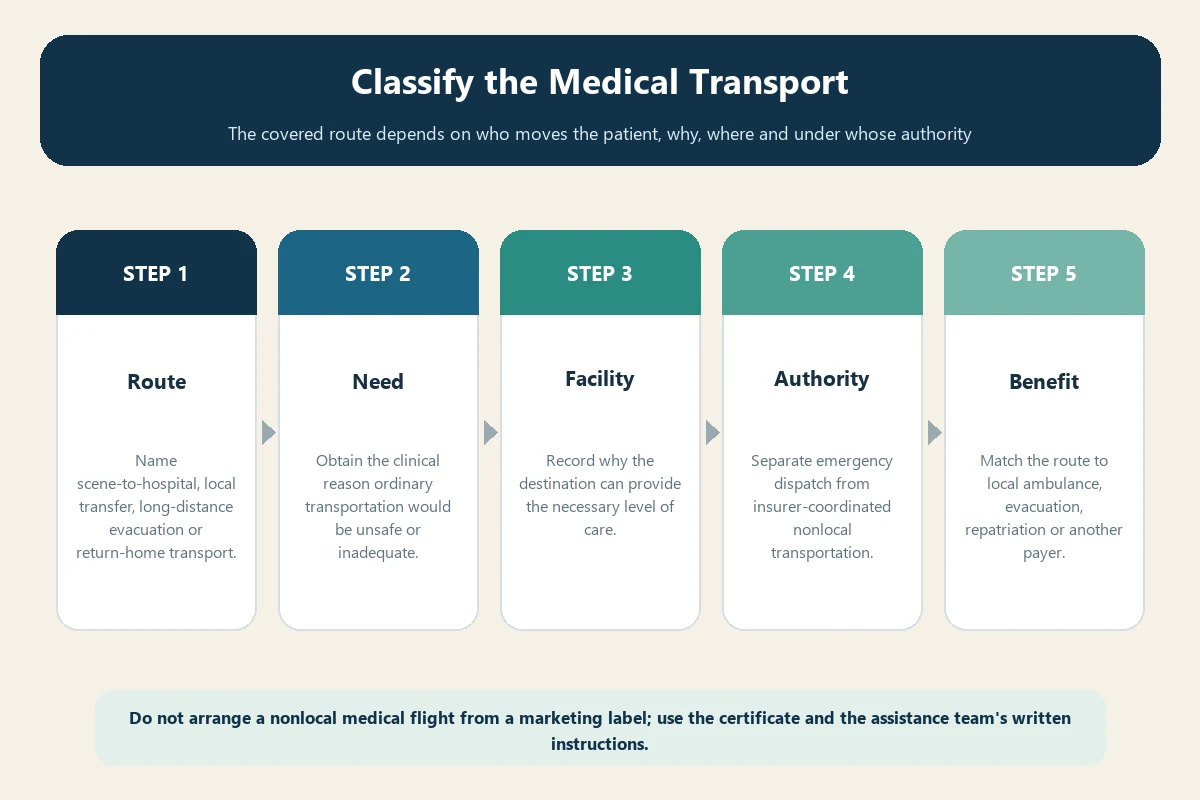
Travel medical insurance ambulance coverage depends on the route, clinical need, destination facility, dispatch or approval process and the benefit that actually applies. A local ride from an accident scene is not the same as a transfer between hospitals, a helicopter from a remote area, an international medical flight or transport home after stabilization. Classify the movement before comparing limits.
Key takeaways
- Name the exact starting point and destination for every transport.
- Local ambulance and emergency medical evacuation can be separate benefits.
- Medical necessity must explain why ordinary transportation was unsafe or inadequate.
- Nonlocal transport often requires coordination through the assistance service.
- Keep dispatch, clinical, route, carrier, invoice and payment records together.
Planning information reviewed August 16, 2026. Emergency services, medical transport systems and policy terms vary by destination. Call the local emergency number when immediate help is needed.
Classify four transport routes
Use four rows: emergency response from the scene to a local facility; transfer between nearby facilities; evacuation to a capable regional facility; and repatriation or later transport toward home. A fifth row may be ordinary taxi, rideshare, rental car or public transport, which is not an ambulance merely because the destination is medical.
The travel medical benefits guide explains why one incident can touch several benefit sections. Do not put every movement under the medical expense maximum without checking the schedule.
Use emergency services first when delay is dangerous
For serious trauma, chest pain, breathing difficulty, stroke signs, uncontrolled bleeding, loss of consciousness or another immediate threat, call the destination’s emergency number. Do not wait for an insurer to decide whether the local ambulance is payable.
After help is moving, contact the assistance team as soon as practical. Record who called, the dispatch number, pickup location, destination and time. These details can later show why prior insurer contact was impossible.
Define local ambulance carefully
A certificate may use local ambulance, emergency ground ambulance or similar wording. The definition can require a licensed service, covered illness or injury, medical necessity, transport to a hospital, or even inpatient admission. The charge may be evaluated under usual, reasonable or customary rules.
Do not infer coverage from an ambulance logo or vehicle type. Obtain the provider’s legal name, license or service description, pickup and destination, mileage when available and the level of medical support provided.
Separate interfacility transfer
A patient may be moved from a clinic to a hospital, from one hospital to another, or from a small facility to a specialist center. The transfer can be local but still have a different purpose from scene response. Ask the referring clinician to document why the first facility could not provide the required care.
Record who chose the receiving facility and whether a bed or specialist was confirmed. A transfer arranged for convenience or preference can be evaluated differently from one required for the necessary level of treatment.
Identify when transport becomes evacuation
Medical evacuation generally addresses movement from a location where appropriate care is unavailable to a facility able to provide it. The route may use a ground ambulance, commercial flight with support, helicopter or fixed-wing aircraft. The vehicle alone does not decide the benefit.
The CDC Yellow Book’s current insurance chapter distinguishes travel health insurance from medical evacuation insurance and notes that evacuation decisions are controlled by the policy process. That distinction should appear in every plan comparison.
Do not equate evacuation with a flight home
Many evacuation provisions focus on the nearest or most appropriate facility that can treat the condition. A traveler may prefer a hospital near home, but preference does not establish medical necessity or a right to choose the destination.
The medical evacuation limits guide separates capable-facility transport, later repatriation and hospital-of-choice arrangements. Verify the exact destination clause before relying on a marketing term such as “fly me home.”
Build the medical-necessity statement
A strong record explains the condition, risks of ordinary transportation, care available at the current location, care required at the receiving facility and why the timing or transport level was necessary. “Ambulance recommended” is less useful than a reason connected to the patient’s safety.
Ask whether the attending clinician must sign, whether the insurer’s medical team must concur and whether a local dispatch decision is enough for an emergency ground ride. Different routes can have different authorizers.
Contact assistance before arranging nonlocal transport
When the situation permits, open a case before booking a private medical vehicle, helicopter or flight. The assistance service may evaluate facilities, coordinate clinicians, obtain quotes and select a safe method. Self-arranged nonlocal transport can fall outside the approval process even when the patient needed care.
The assistance versus claims guide explains that coordination is not final reimbursement. Keep the case number, written instruction and name of the arranging entity.
Test the receiving-facility rule
Ask whether the policy says nearest adequate, nearest appropriate, most appropriate or home-country facility. Those phrases are not interchangeable. Record what specialty, equipment, bed or procedure the patient required and how the selected facility met that need.
If two facilities could provide care, ask who chooses between them and what happens if the traveler selects the farther option. Include destination selection in the pretrip scenario rather than discovering it during a crisis.
Read ambulance and evacuation limits separately
A local ambulance may sit inside eligible medical expenses and the overall medical maximum. Evacuation may have its own larger maximum outside that calculation. Interfacility transfer can be assigned to either section depending on the wording.
The travel medical policy limits guide provides a cap map. Record every benefit’s amount, unit, location rule, age adjustment and relationship to the overall maximum.
Check service-specific sublimits and conditions
Even when ambulance is listed, a sublimit, mileage boundary, transport-type restriction, inpatient condition or reasonable-charge rule can reduce payment. The benefit may recognize only transport connected to an eligible illness or injury.
Use the sublimits coverage guide to trace the smallest controlling ceiling. Ask whether medical equipment and clinical staff are included in one transport invoice or assessed as separate lines.
Compare billed, allowed and payable amounts
The carrier’s bill is not automatically the amount recognized by insurance. List the billed charge, allowed or reasonable charge, deductible, coinsurance, specific transport limit, other-payer amount and final patient balance.
Keep the complete invoice even if a hospital collects the transport fee. It should identify the transport provider, route, date and service level. A single hospital line labeled “ambulance” can require a supporting carrier bill.
Prepare for direct payment and reimbursement paths
A local emergency service may bill the traveler, the hospital, a public system or an insurer. An evacuation coordinated by assistance may be paid through a separate arrangement. These payment paths do not change the need to prove eligibility.
The direct billing guide distinguishes a provider accepting billing details from a provisional payment guarantee and a final approved claim. Retain every balance statement and explanation.
Use destination research before departure
Emergency response times, staffing, language, terrain and availability can differ widely. The U.S. Department of State’s medicine and health guidance directs travelers to review destination medical services in advance. Check every country and remote segment in the itinerary.
Save local emergency numbers offline. Identify the nearest realistic facility, the nearest higher-level center and the insurer’s international contact method. A plan with a large limit is less useful if the traveler cannot activate assistance.
Account for remote activities and access points
Mountain trails, islands, cruises and rural roads can require search, rescue or extraction before an ambulance begins. Rescue and medical transport may be different benefits. Adventure-activity exclusions can apply before either is considered.
Record where responsibility changes from local rescue to ambulance to evacuation. Ask whether the activity is covered, whether a guide or operator must arrange the first leg and whether the insurer must coordinate the next one.
Build the transport evidence packet
Collect the emergency report, dispatch record, clinician order, diagnosis, medical-necessity statement, sending and receiving facility notes, carrier invoice, route, payment proof and assistance communications. For air transport, add flight, medical-crew and ground-transfer records.
The claim documentation guide helps reconcile currencies, deposits and other payers. Submit the final unreimbursed amount without losing the original route evidence.
Review the policy for transport verbs
Search for ambulance, ground, air, helicopter, evacuation, transfer, transport, repatriation, nearest, appropriate, adequate, medically necessary, approved, arranged and coordinated. Then follow every defined term and exclusion.
Marketing summaries often group these words under “emergency transportation.” The issued certificate can split them into separate sections with different limits and decision makers.
Test a realistic route before buying
Assume a traveler is injured on an island, taken by local ambulance to a clinic, transferred by boat and ground ambulance to a regional hospital, then considered for an international medical flight. Mark who authorizes each leg and which benefit pays it.
NAIC’s current consumer guidance explains that evacuation can include emergency flights or transport to a capable hospital. The scenario reveals whether the certificate actually supports every connection.
Know what happens after stabilization
Once the patient is stable, medical necessity for an emergency vehicle can change. A commercial flight, medical escort or ordinary transport may become appropriate. Ask which team makes that decision and whether later movement belongs to evacuation, repatriation, trip interruption or the traveler’s own expense.
If hospitalization continues, use the hospitalized abroad guide to manage records, family communication, bills and discharge planning.
Make the final ambulance coverage decision
A useful comparison does not ask only whether “ambulance is covered.” It identifies the route, medical trigger, required provider, receiving facility, authorizer, payment path, limit, cost sharing and documents for each possible movement.
The strongest travel medical insurance ambulance plan is the one whose transport clauses work as a connected system. Local response must lead to appropriate care, nonlocal movement must have a reachable coordination path, and the traveler must understand which parts can still become an out-of-pocket balance.
Medicare ambulance coverage and travel medical evacuation solve different transport problems. Use this Medicare medical evacuation route guide to test medical necessity, nearest appropriate facility, foreign-location rules, air transport, and return-home gaps.
COPD travel planning must align respiratory stability, inhalers, oxygen, altitude, infection risk, destination care, and insurance. Use this senior COPD travel insurance guide to test pre-existing conditions, delays, cancellation, emergencies, ambulance, and evacuation.
