

A travel insurance waiver purchase deadline is a contract date, not a universal countdown. It may run from the first trip payment, first nonrefundable deposit, or another event defined in the issued certificate. Buying before departure is not the same as buying in time for a pre-existing-condition exclusion waiver.
This U.S.-focused guide shows how to calculate and prove the deadline when a trip is paid in stages. It is educational information, not insurance, legal, medical, or coverage advice. The policy, certificate, schedule, declarations, and state endorsements issued to the traveler control.
Key takeaways
- Find the trigger phrase in the issued form before counting days.
- Keep four dates separate: first trip payment, plan purchase, later payment, and coverage update.
- A refundable deposit can still matter if the contract calls it the initial trip payment.
- Later airfare, hotels, and tours may create separate update duties.
- Save timestamped confirmations because eligibility can be tested during a later claim.
Reviewed August 16, 2026. Time-sensitive periods and later-cost rules vary by insurer, plan, and state. Examples below illustrate a method, not a promise of coverage.
Start with the waiver, not a marketing number
Search the form for “pre-existing medical condition exclusion waiver,” “time-sensitive period,” “initial trip payment,” “first trip deposit,” “nonrefundable,” and “subsequent arrangements.” Follow every bold or capitalized term to its definition. Then read the schedule and endorsements for a maximum trip cost or different deadline.
The pre-existing condition waiver guide explains the whole eligibility structure. This article isolates the clock, because a traveler can satisfy medical and trip-cost conditions yet still miss the purchase window.
The four dates that should never share one column
Date one is the first payment connected to the trip. Date two is the policy purchase or effective timestamp. Date three is each later payment to a supplier. Date four is the date the traveler tells the insurer about a later cost or changes the insured trip cost.
Create one ledger row for every event. Record the local date, time zone, supplier, amount, refund status, payment method, confirmation number, and source document. A single “trip booked” date hides the exact sequence a claims reviewer may need.
What can start the initial clock?
Do not assume the largest or first nonrefundable payment starts it. The contract might use “initial trip payment,” “first trip payment or deposit,” or “first nonrefundable trip payment.” Those phrases are not interchangeable.
For example, a $100 refundable cruise hold may be an initial trip payment under one form even though the traveler could recover it. Another plan may expressly measure from the first nonrefundable payment. Copy the actual trigger beside the receipt instead of translating it into a personal rule.
Count calendar days exactly as the form directs
Once the trigger is known, identify whether the trigger date is day zero or day one, whether the deadline is expressed as “within” a number of days, and whether a purchase time matters. Use a calendar, not mental arithmetic. Include weekends unless the form says otherwise.
Allianz’s current existing-condition explanation describes purchase within 14 days, or the period specified in the plan, of the first nonrefundable trip payment or deposit. Travel Guard’s current medical-condition page generally describes a 15-day window from the initial trip deposit. These are provider examples, not a market-wide rule.
A practical deadline calculation
Suppose a traveler pays a deposit on March 3 and the issued form says the plan must be purchased within 14 days of that payment. The traveler should not simply assume March 17 without confirming how the form counts the period and the insurer timestamps online transactions. The safe workflow is to ask the insurer to state the last eligible purchase date in writing before the apparent cutoff.
Save the quote, checkout receipt, policy confirmation, declarations, and full certificate. A credit-card posting date may differ from the supplier transaction date, so retain the supplier confirmation that shows when the payment was actually accepted.
Buying after the window does not erase the whole policy
Missing a waiver deadline usually concerns the waiver, not necessarily every other benefit. A plan purchased later may still cover specified new illnesses, injuries, delays, baggage events, or other covered reasons, subject to its exclusions and effective dates.
That distinction matters. “Too late for the waiver” should not be rewritten as “travel insurance is useless.” Use the travel insurance purchase-timing guide to review which other time-sensitive benefits may change when purchase is delayed.
Rolling payments create a second kind of deadline
A traveler may pay a cruise deposit, buy the plan, and add flights or hotels later. The initial waiver deadline and the later-cost update deadline are different tests. The second may run from each later supplier payment or from the date a cost becomes nonrefundable.
A current Travel Guard Vermont sample policy ties its time-sensitive period to the initial trip payment and requires additional trip arrangements to be added within two days of payment. The form also says failure to insure all trip costs within that period terminates its waiver. That narrow state-specific example demonstrates why a generic 14-day checklist can be wrong.
Refundable bookings can become deadline events later
A hotel can be fully refundable when reserved and acquire a cancellation penalty 30 days before arrival. A tour can move through several penalty tiers. Record each change in loss exposure and ask whether the policy requires the insured amount to be updated when the cost becomes nonrefundable.
The full trip cost ledger separates cash paid, current cancellation penalties, points, credits, and later changes. Use it alongside the timing ledger; one proves amount and the other proves dates.
Trip changes can preserve or break the sequence
Changing dates, adding travelers, replacing a supplier, or transferring a deposit can affect more than price. The insurer may need an updated itinerary, trip cost, or departure date. Do not assume a transferred deposit becomes a brand-new initial payment or that the original waiver automatically follows it.
Ask the administrator to confirm how the change is recorded and request updated declarations. Save both the original and revised versions so the history remains visible rather than overwriting the evidence.
State-specific wording defeats universal deadline tables
U.S. travel insurance is regulated at the state level, and forms can differ. The National Association of Insurance Commissioners’ current travel insurance examination standards call for information about pre-existing-condition exclusions, waiver circumstances, material coverage terms, and claim procedures. They do not create one consumer deadline for every product.
Confirm that the certificate matches the traveler’s state of residence. A sample from another state is useful for learning what to look for, but it cannot replace the issued form.
The deadline is only one waiver gate
Early purchase does not automatically remove the exclusion. A plan may also require the insured to be medically able to travel at purchase, insure a specified amount of trip cost, remain within a maximum, or add later costs promptly.
Run the waiver eligibility checklist after calculating the date. A “yes” in the timing row cannot cure a “no” elsewhere.
What if the first payment date is unclear?
Collect the supplier invoice, email confirmation, bank or card statement, booking portal history, travel-agent ledger, and any receipt for points plus cash. If an agent made the payment, ask for the transaction timestamp and the date the supplier accepted it.
Then contact the insurer in writing with the facts rather than asking a vague question. State each candidate date and ask which one the issued form treats as the trigger. Keep the response with the policy file, but remember that a service email does not amend the contract unless the insurer issues an endorsement.
Build a defensible evidence packet
Save the complete certificate, schedule, declarations, state endorsements, purchase receipt, quote, checkout confirmation, and every supplier payment record. Export webpages or emails as PDFs with visible dates. Name files chronologically, for example 2026-03-03-cruise-deposit and 2026-03-08-policy-purchase.
Keep refund and cancellation terms as they existed at booking, not only the supplier’s current webpage. The travel insurance claim documentation guide explains how payment proof, supplier recovery, and medical evidence come together after a loss.
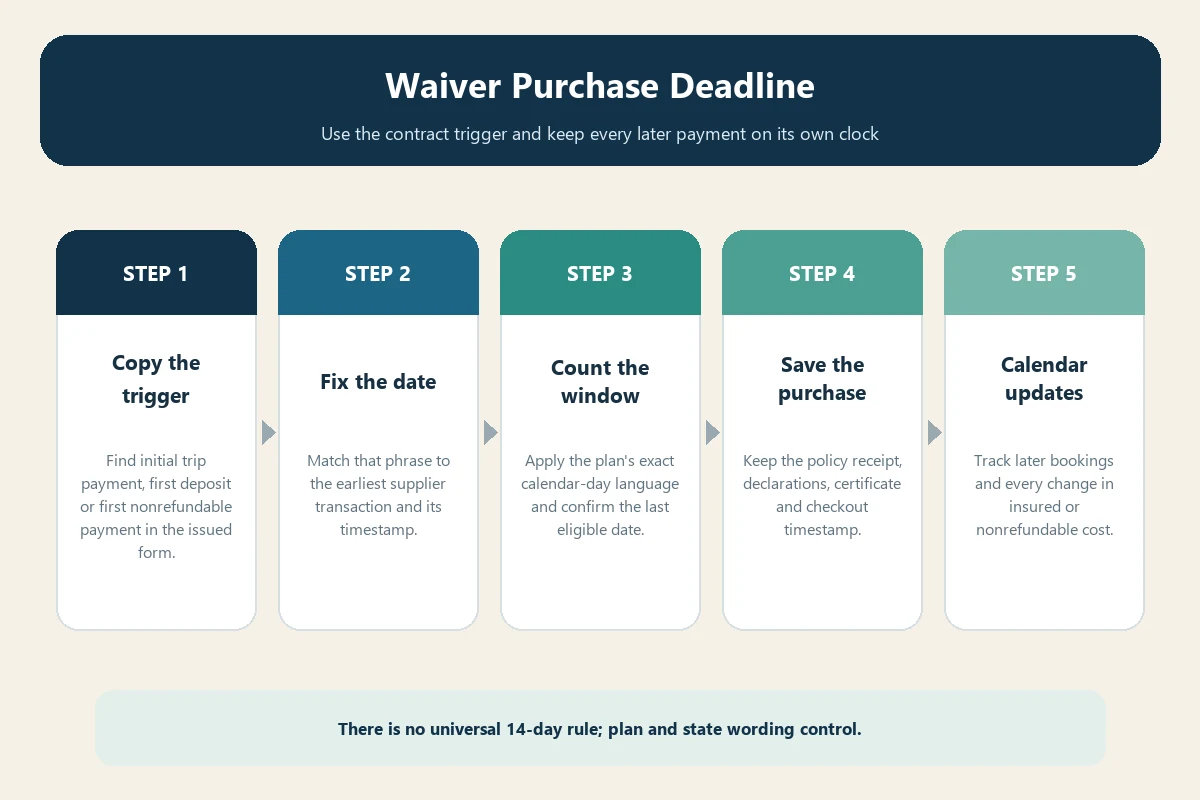
A five-step purchase-deadline workflow
- Copy the waiver’s exact trigger and time-sensitive period.
- Identify the earliest transaction that fits the trigger.
- Calculate the last date conservatively and confirm it with the insurer.
- Buy and save the timestamped policy documents before that date.
- Calendar every later cost, refundability change, and required update.
If the deadline may already have passed, do not alter dates or omit payments. Ask what coverage remains, compare forms that are still lawfully available, and evaluate the trip with the pre-existing exclusion in force. Accurate disclosure and documentation are more useful than forcing a waiver conclusion.
Bottom line
The travel insurance waiver purchase deadline is calculated from defined contract language and proven with transaction records. Treat the first trip payment, plan purchase, later supplier payments, and insurance updates as separate events. Then test medical ability, trip cost, state wording, and other eligibility conditions before relying on the waiver.