
Multiple travel insurance claims from the same trip can be correct when different people, incidents, benefits, or policies are involved. They can also become accidental duplicates when the same expense appears in two files without explanation. The solution is not one universal form: administrators use different filing structures.
This U.S.-focused guide shows how to map the claim architecture before submitting, follow plan-specific instructions, link related files, allocate shared costs, and disclose other recovery without requesting more than the net loss.
Start with four claim dimensions
Build a matrix with one row for each combination of traveler, incident, benefit, and expense. Add the governing policy and claim number after the administrator assigns it.
| Dimension | Question | Example |
|---|---|---|
| Traveler | Who experienced the loss or incurred the bill? | Parent treated; child’s ticket changed |
| Incident | What event and date caused the loss? | Illness on June 4; baggage loss on June 9 |
| Benefit | Which policy section may respond? | Medical, interruption, baggage, delay |
| Expense | What exact net amount is requested? | Clinic invoice or unused hotel night |
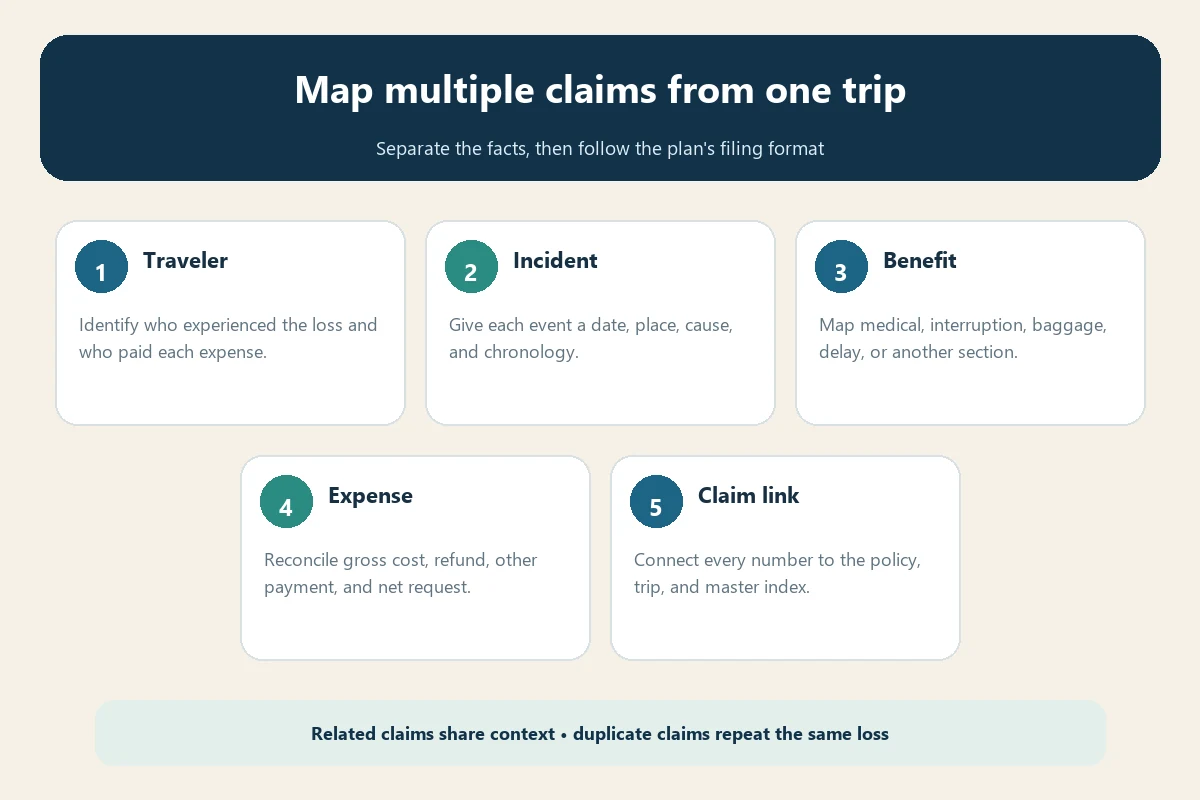
Do not begin by guessing whether the trip is “one claim.” Begin by identifying the facts, then ask the administrator how its system groups them.
Follow the administrator’s filing architecture
There is no universal format. UnitedHealthcare SafeTrip’s claim guidance says separate forms are needed for each issue and for multiple affected people, with the policy ID connecting the claims. By contrast, Allianz’s U.S. claims-process page says travelers claiming multiple incidents, such as baggage loss and hospitalization on the same trip, should file everything at the same time for faster processing.
These instructions are not contradictory once you separate timing from file structure. An administrator can ask for several forms submitted together, or one submission containing several incident sections. Use the current form and portal for the exact plan.
Build an evidence index for each benefit
Shared context does not make every attachment relevant to every claim. Create a short evidence index for each benefit. A medical file may need treatment records, an itemized bill, and proof of payment. A baggage file may need a carrier report, property list, purchase evidence, and the carrier’s settlement. An interruption file may need the covered-cause evidence, original itinerary, unused booking terms, refunds, and replacement travel.
Travel Guard’s required-document page lists different evidence by claim type, illustrating why one large undifferentiated upload is difficult to review. Treat it as a carrier-specific example, not the checklist for another plan.
Reuse a shared source document by cross-reference rather than making inconsistent edited copies. For example, one airline cancellation notice may support delay expenses for several travelers. Put the same stable filename in each relevant index, identify the page or fact it proves, and keep person-specific receipts under the correct claimant. This structure lets the administrator review related claims together while maintaining separate evidence boundaries.
When separate claims commonly make sense
Different travelers
Medical records, signatures, identity, eligibility, deductibles, and payments can be person-specific. A family policy does not necessarily turn every traveler’s loss into one claimant. If a parent’s illness also changes a child’s ticket, link the files through the same incident and policy while allocating each expense accurately.
Different incidents
A stolen phone on Monday and a flight delay on Friday may require separate evidence, reports, causes, waiting periods, and deductibles. Give each incident its own date, location, chronology, and expense subtotal even if the portal places both under one claim number.
Different benefits
One event can activate several policy sections. An illness may generate emergency medical bills, trip interruption, additional lodging, changed transportation, and companion expenses. The same clinical record can support several sections, but each dollar should appear under the benefit that best describes it.
Different policies or payers
Domestic health insurance, a travel policy, credit-card protection, carrier remedies, and supplier refunds can each have a role. Separate claims may be required for coordination, but disclose every other source and reconcile the result.
Distinguish related claims from duplicate claims
Related claims share a trip, person, incident, record, or expense but seek different eligible outcomes. A duplicate claim asks for the same loss again without a clear reason or link. Duplication can happen when a portal times out, a paper form follows an online form, spouses each list the full shared booking, or an administrator instructs the traveler to open a new file for a supplement.
If you suspect duplication, do not delete evidence or conceal the second number. Notify the administrator, identify both files, state which submission should control, and ask whether the other will be linked, merged, or closed. The wrong administrator guide provides a routing ledger for misdirected or parallel files.
Create a master claim-family index
Use one index above all claim folders:
- policy and certificate number;
- trip dates and master itinerary;
- traveler and claimant for each file;
- incident label, date, cause, and location;
- benefit section and claim number;
- administrator and assigned examiner;
- gross expense, refund, other payment, and net request;
- shared supporting documents;
- current status, open item, owner, and deadline.
Use consistent identifiers such as INC-01-Medical and INC-02-Baggage. Put the appropriate identifier in filenames and cover notes without altering original documents.
Allocate shared family expenses once
A hotel room, taxi, rental car, or replacement booking may serve several insured travelers. Do not automatically enter the full receipt in every person’s claim. Ask how the administrator allocates joint expenses and deductibles.
Create a shared-expense row showing payer, travelers served, service date, gross amount, currency, refund, proposed allocation, and rationale. The family shared-expense guide provides allocation methods that reconcile back to the original invoice.
The sum across all claims must not exceed the eligible net expense. Keep a cross-reference in each affected file so an examiner does not mistake a disclosed shared receipt for an undisclosed duplicate.
Keep incident cause and expense category separate
An incident is what happened; a benefit is the contractual bucket; an expense is the financial line. One illness can cause several expenses, and one expense should not be split across benefits merely to avoid a limit or deductible.
For each line, identify service, traveler, date, supplier, amount, currency, payer, benefit requested, refund, other insurance, and net amount. If the administrator reclassifies the line, preserve its explanation and revised calculation.
Coordinate other insurance and supplier recovery
A secondary travel medical benefit may require an Explanation of Benefits or denial from another health plan. The travel claim EOB guide explains how to reconcile billed, allowed, paid, denied, and patient-responsibility amounts.
Airline compensation, hotel refunds, cruise credits, card benefits, and responsible-party payments can also reduce the net loss. Update every affected claim when a recovery arrives. The supplier refund and subrogation guide explains why later recoveries must stay connected to the original expense.
Work through a multi-incident example
Two parents and a child are insured on one trip. Parent A receives emergency treatment abroad. The family then returns early, leaving an unused hotel booking and buying three replacement flights. Three days later, checked baggage does not arrive on the return route.
The matrix may contain Parent A’s medical expense, interruption expenses for each traveler, one shared unused hotel amount, three ticket differences, and baggage-delay purchases assigned to their buyers and users. The medical record supports the causal event, but it is not an invoice for the family’s flight changes. The airline baggage report supports the later incident, not the earlier interruption.
The administrator may request person-specific forms, incident-specific forms, or one coordinated packet. Whatever the structure, link all claim numbers to the same policy and trip. Allocate the hotel once, disclose the three ticket amounts separately, and do not copy the full family total into every traveler’s file.
Handle supplements without opening an accidental duplicate
A late invoice, corrected refund, new EOB, or additional eligible expense may belong in an existing claim. Ask whether to upload it under the original number or open a supplemental claim. The supplement and reopen guide explains how to connect new evidence to an earlier decision.
If the system forces a new claim, label it as related, cite the original number, list only the new or changed lines, and request written cross-linking. Preserve both calculations so the cumulative payment can be audited.
Reconcile payments across all files
Maintain a payment ledger with claim number, benefit, payee, decision date, approved amount, deductible, reduction, payment method, payment date, and expense lines satisfied. A partial payment does not always close every related claim.
Use the partial payment calculation guide to compare claimed, allowed, excluded, refunded, deductible, and paid amounts. If a duplicate payment occurs, do not spend or return it through an unverified channel; notify the administrator and request written reconciliation instructions.
Multiple-claim checklist
- Map every traveler, incident, benefit, expense, and policy.
- Read the plan-specific rule for separate forms and joint timing.
- Create a master index linking all claim and assistance numbers.
- Give each incident its own chronology and evidence.
- Allocate shared expenses once and show the allocation.
- Disclose other policies, refunds, credits, and payments.
- Label supplements and forced new files as related.
- Ask the administrator to link, merge, or close duplicates in writing.
- Reconcile cumulative decisions and payments to the net loss.
Multiple claim numbers are not automatically a problem. The risk comes from unclear relationships. A master claim-family index lets every examiner trace each person, incident, benefit, expense, recovery, and payment without counting the same loss twice.
