
A travel insurance supplemental claim or request to reopen a closed claim can mean several different things. The traveler may have a new receipt, corrected medical bill, final supplier refund, revised EOB, missing translation, later expense, or evidence challenging a denial. The proper path could be supplementation, correction, reconsideration, formal appeal, reopening, a new benefit claim, or a recovery adjustment.
Do not rely on the word “reopen.” Ask the administrator to identify the file status, accepted procedure, deadline, and effect on prior decisions. A closed portal status does not guarantee a legal or contractual right to reopen, and uploading a document does not automatically preserve an appeal.
Key takeaways
- Supplementation adds information to a pending or permitted file; an appeal challenges an adverse decision.
- A new expense can belong to an existing event, a different benefit, or a separate claim.
- Corrected bills and EOBs should preserve prior versions and explain every change.
- Later refunds or other payments require reconciliation even after payment.
- No submission should be assumed to extend appeal or legal-action deadlines.
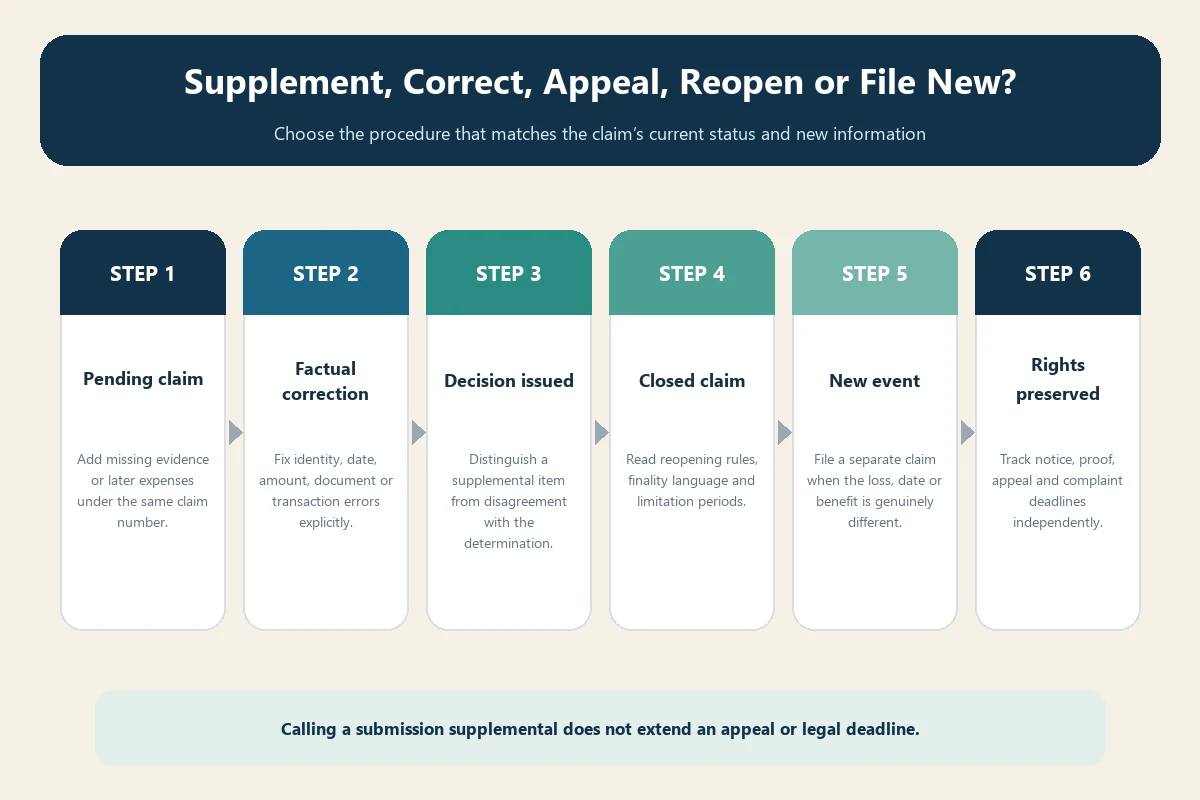
First identify the current status
Ask whether each benefit is unsubmitted, received, incomplete, under review, approved, partially paid, denied, administratively closed, or finally closed. One claim number can contain benefits in different stages. Obtain the answer in writing.
Use our claim status follow-up guide. Do not assume “closed” means denied; it can also mean paid, inactive for missing records, duplicated, transferred, or archived.
Supplementation
A supplement adds evidence or expense to a file that remains open or that the administrator agrees to receive. Examples include an airline delay letter, corrected invoice, missing receipt, translation, physician note, final hotel folio, EOB, or proof of payment.
Label the submission “supplemental” with the claim number, benefit, original submission date, new document index, and reason. State whether the amount requested changes. Ask for receipt and confirmation that the adjuster reviewed it.
Correction
A correction fixes an error in a prior form, calculation, name, date, currency, provider, or document. Do not silently replace the old file. Preserve both versions and provide a short change log showing the incorrect fact, corrected fact, source, and effect on the claim.
If the error was the traveler’s, say so. If a provider reissued the bill, obtain its explanation or ledger. Transparent correction is safer than making the record appear as though it never changed.
Reconsideration
Some administrators use “reconsideration” for an informal review before or instead of a formal appeal. The term has no universal meaning. Ask whether it preserves appeal rights, who reviews it, what deadline applies, and whether a written decision will issue.
Do not let an informal reconsideration consume the formal appeal period. When uncertain, submit the evidence in a document that expressly preserves and invokes the appeal procedure before the deadline.
Formal appeal
An appeal challenges a denial, reduction, exclusion, calculation, or other final adverse decision. It should answer the cited reason and policy provision with a chronology and targeted evidence. A supplemental upload that says only “see attached” may not count.
Use our travel insurance appeal guide. Identify the decision date, appeal deadline, requested remedy, and every disputed line.
Reopening a closed file
A request to reopen asks the carrier to reactivate a file after closure. The insurer may allow it for new records, administrative error, later provider information, or another reason under its process. It may also say the correct route is appeal or a new claim.
Request written confirmation of reopening, claim status, issues under review, preserved rights, and expected next step. A portal that accepts an upload without error does not prove the file is active.
New claim or new benefit
A later expense can require a new claim when it involves a separate event, insured, trip, or benefit. A medical event that also caused interruption may need distinct forms even when the same policy and claim number are used. Ask the administrator rather than duplicating the entire submission.
Cross-reference related case numbers. Explain which records are shared and which costs belong only to the new benefit.
Later medical expenses
Follow-up treatment after the trip can be covered, excluded, or limited by continuation-of-treatment wording, coverage dates, benefit period, and medical necessity. Do not assume every later bill can be added to the travel claim.
Submit the provider, service date, itemized bill, clinical link to the covered event, payment evidence, and any first-payer EOB. Ask which benefit period and limit the carrier applies.
Corrected medical bill
A hospital can remove duplicate charges, add a physician line, change coding, apply an insurer payment, or refund a deposit. Keep the original bill, corrected bill, provider explanation, and final ledger. Reconcile the difference line by line.
For foreign records, keep the original language and updated translation. Use our foreign medical bill guide.
Revised EOB
A health plan can reprocess a claim after appeal, coding correction, coordination, or late information. The revised EOB can increase or decrease the amount remaining for travel insurance. Submit every page and mark the prior EOB it replaces.
Follow our EOB workflow. Do not send only the new patient-responsibility total without the reason codes and prior decision.
Additional trip expenses
Interruption, delay, or evacuation can generate charges over several days. A later hotel folio or transportation receipt may belong to the same covered event, but it still must be within the eligible time, category, and limit. Add a chronology showing why the expense was necessary and when it was incurred.
If the new expense exceeds a daily or benefit maximum, the carrier may accept it as eligible but make no additional payment. Request a line-level decision.
Supplier refund after closure
A cash refund, voucher, chargeback, medical-provider credit, or other-insurance payment after closure changes the net loss. This is not an appeal; it is a recovery or reconciliation update. Notify the insurer promptly and provide the final posting.
Use our later refund and recovery guide. The carrier can reopen the accounting even if the traveler is not requesting more money.
Partial payment with pending lines
Confirm whether unpaid lines are denied, pending, or held for documents. If pending, a supplement can complete them. If denied, a formal appeal may be required. If capped by a limit, more receipts may not produce more payment.
Use the partial payment audit before choosing a path.
Do not change the original event date
A later receipt, diagnosis, refund, or provider correction does not necessarily create a new loss date. Keep the original event, treatment, cancellation, interruption, and claim-notice dates intact. Add the later document date separately.
Changing the event date to make a portal accept the submission can create inconsistencies in coverage dates and deadlines. If the system requires a new case, cross-reference the original claim and explain that the new file concerns later evidence or expense from the earlier event.
Document manifest
Every supplemental package should contain:
- claim number, policy, insured, trip, and benefit;
- current status and prior decision date;
- purpose: supplement, correction, appeal, reopening, new benefit, or recovery;
- new filename, date, source, and page count;
- fact or expense the document supports;
- change in amount requested;
- prior version replaced, if any; and
- requested action and confirmation.
Do not resend the entire claim unless instructed. A concise manifest prevents the new record from being lost inside duplicate files.
Version control
Name files with provider or supplier, document type, service date, and version date. Mark corrected documents without editing the issuer’s content. Keep a master index showing submitted, superseded, and final versions.
If the portal renames files, preserve the local filename and screenshot or confirmation mapping. Ask the adjuster to confirm which version it used.
Deadline matrix
Track notice, proof of loss, continuation-of-treatment, supplemental submission, appeal, health-plan claim, supplier refund, and legal-action deadlines. The earliest may control. Use our deadline guide.
A carrier’s agreement to review new evidence does not necessarily waive a deadline. Obtain any extension or preservation statement in writing.
Sample supplemental cover note
This submission supplements claim [number], benefit [type]. It adds [document/expense] received on [date] and changes the requested amount from [amount] to [amount/no change]. It does not replace prior records except [identified file]. Please confirm the file status, receipt, and whether any additional action or formal appeal is required.
When the portal will not accept files
Capture the error, date, time, claim number, filename, and file size. Use the approved alternative channel and notify support. Do not create a duplicate claim unless instructed. Preserve delivery evidence.
If the carrier refuses to review
Ask for the policy or procedural basis, final status, appeal instructions, and applicable deadline. If the dispute concerns a final denial, use the formal appeal. If it concerns claim handling, consider the insurer’s complaint process and the relevant state insurance department.
A regulator complaint does not guarantee reopening or pause legal deadlines. Obtain legal advice for a large loss or approaching limitation.
FAQ
Can I add receipts after the claim is paid?
Possibly, but coverage, limits, deadlines, and closure status matter. Ask the carrier which process applies.
Does uploading new evidence reopen the claim?
No. Obtain written confirmation of status and review.
Is a supplemental submission an appeal?
Not necessarily. A formal appeal should invoke the appeal procedure and challenge the decision before its deadline.
Must I report a later refund?
Recovery clauses can require it. Report changes to the net loss and request reconciliation.
Bottom line
Choose the procedure based on purpose. Supplement a pending file, correct an error transparently, open a new benefit when required, appeal an adverse decision, and report later recoveries. Preserve versions, identify the requested action, and never assume that an upload or reopening discussion extends a deadline.
Sources
- NAIC — Unfair Claims Settlement Practices Act
- NAIC — Travel Insurance Model Act
- NAIC — State Insurance Departments
- New York DFS — File a Complaint
- California Department of Insurance — Getting Help
- Washington OIC — File a Complaint
Reviewed August 16, 2026. This article is general educational information, not legal advice or a promise that a carrier will reopen or pay a claim.