

A travel insurance claim wrong deductible can occur when the calculation uses the wrong amount, traveler, incident, benefit, or policy period—or fails to credit a deductible already satisfied. Before challenging it, confirm that the reduction is actually labeled a deductible rather than a sublimit, coinsurance share, excluded charge, refund, or payment by another insurer.
This U.S.-focused guide explains how to reconstruct the calculation, read the governing unit, build an accumulator ledger, and request a precise correction.
Identify the exact reduction first
Request a written payment or denial breakdown. For every expense line, record billed amount, recognized amount, excluded amount, other-insurance payment, refund, deductible, coinsurance, sublimit, benefit maximum, and final payment.
| Reduction | What it usually means | Audit question |
|---|---|---|
| Deductible | Initial eligible amount borne by the insured under stated terms | What unit and period apply? |
| Coinsurance | Percentage split after the applicable calculation stage | Which recognized amount was multiplied? |
| Sublimit | Maximum for an item, service, day, or category | Which clause creates it? |
| Exclusion | Charge or event outside coverage | What fact and wording control? |
| Other recovery | Refund or another payer reduces net loss | Was the amount actually received or owed? |
Read the deductible’s governing unit
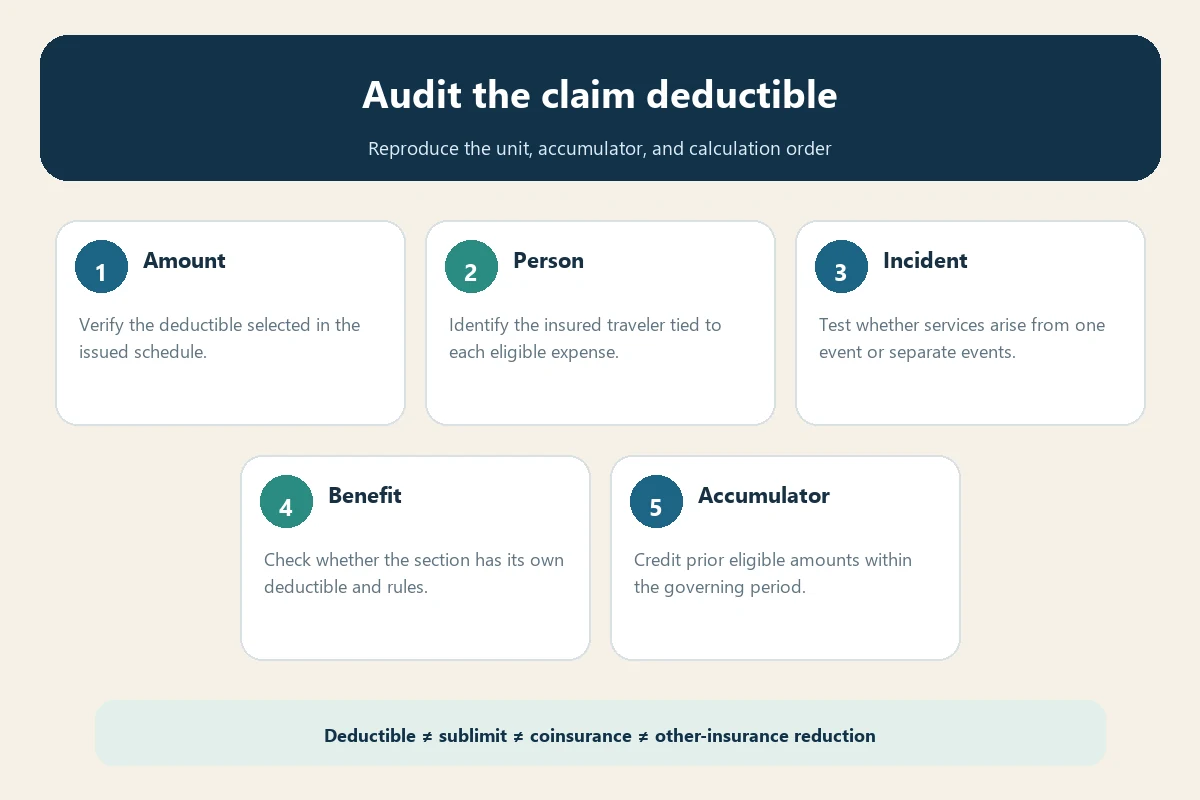
Use the issued schedule, policy, definitions, endorsements, and state-specific form. Look for wording such as per insured person, per incident, per claim, per trip, per benefit section, or per policy period. Do not import a rule from another product with the same brand.
Squaremouth’s deductible explainer gives a medical example using a per-person deductible and notes that not every travel plan has one. It is general guidance; the issued contract determines the actual unit and amount.
Record the selected plan tier and deductible shown on the declarations or schedule. If the purchase allowed a deductible choice, preserve the quote, confirmation, and issued certificate rather than relying on memory.
Distinguish per person from per family
A family policy can cover several people while applying limits or deductibles individually. Ask whether each insured person has a separate deductible and whether any family aggregate or cap exists. Do not divide one person’s medical bill among family members to reduce the deductible.
For shared trip expenses, allocation and deductible rules are separate questions. The family shared-expense guide explains how to allocate hotel, transport, and booking costs without counting the receipt more than once.
Define the incident without guessing
Two invoices can arise from one continuing incident or two separate incidents. The policy may define occurrence, sickness, injury, loss, or claim—or leave the administrator to apply the facts and wording. Record symptoms or event, onset, diagnosis, treatment dates, recovery, recurrence, new cause, and provider assessment.
Do not ask a provider to rewrite medical facts to create one incident. Ask the administrator to state why it treated services as one or several incidents and cite the policy basis. A follow-up visit is not automatically a new incident, and a second event on the same trip is not automatically part of the first.
Check whether each benefit carries its own deductible
A plan may apply a deductible to emergency medical expenses but not to delay, or apply an amount separately under baggage and cancellation. If one event touches several benefits, calculate each section independently before testing any overall rule.
The wrong benefit classification guide helps determine whether the expense was placed under the correct section. A classification error can make a deductible appear wrong even when the amount matches that section.
Build an accumulator ledger
An accumulator shows how eligible expenses satisfy a deductible over the governing unit and period. Use these columns:
- traveler and policy number;
- incident ID and date;
- benefit section;
- service date, provider, and expense ID;
- recognized eligible amount;
- deductible applied on this line;
- cumulative deductible satisfied;
- remaining deductible;
- other payment, coinsurance, and policy payment;
- decision and claim number.
Use the recognized eligible amount, not automatically the provider’s gross bill. An excluded service generally does not satisfy a deductible unless the policy or decision says otherwise.
Reconcile primary and secondary coverage
A secondary travel medical plan can require the traveler to submit first to another health insurer. The other plan’s deductible is not automatically the travel plan’s deductible, and the two calculations should not be blended.
Allianz’s secondary coverage explainer describes filing with a primary insurer first and uses an example involving the primary plan’s deductible. Use the travel claim EOB guide to map billed, allowed, deductible, coinsurance, paid, and patient-responsibility fields from each payer.
Ask the travel administrator which amount it recognizes after the primary decision and how its own deductible applies. Do not assume the travel plan reimburses every domestic-plan deductible.
Work through a deductible example
A traveler has a $250 emergency medical deductible per covered incident. One illness produces a $180 clinic visit and a $420 follow-up that the administrator recognizes as eligible. If both visits belong to one incident, the ledger may apply $180 to the first line and the remaining $70 to the second, leaving $350 before any other applicable adjustment.
If the second calculation applies another $250 without explaining why the follow-up is a new incident, request the incident determination and accumulator. Conversely, if the second visit follows a distinct accident, one deductible may not carry over merely because the services occurred during the same trip.
Now add a $100 excluded service to the first invoice. The deductible calculation should show whether the administrator first removes that service and applies the deductible to $80, rather than treating all $180 as eligible. The sequence matters.
Audit multiple claims from the same trip
Different claim numbers do not automatically justify multiple deductibles, and one claim number does not automatically create one deductible. Claim file structure and contractual deductible unit are distinct.
Use the multiple claims from one trip guide to map each person, incident, benefit, and expense. Then overlay the deductible wording on that matrix.
Work through a family and claim-number example
Two insured parents become ill after the same meal and each receives treatment. The portal creates claim M-101 for Parent A and M-102 for Parent B. If the issued schedule applies a medical deductible per insured person per incident, two claim numbers may correctly produce two deductibles because two people incurred separate medical expenses—even though the cause and trip are shared.
Change the facts: only Parent A receives care, but the administrator opens one claim for the clinic invoice and another for a later hospital bill from the same continuing illness. Two claim numbers do not necessarily create two deductible units. The audit should compare the incident definition, clinical chronology, recognized expenses, and accumulator carried from the first decision.
Now add trip interruption costs claimed by the whole family. That benefit may have a different deductible unit or no deductible. Do not transfer Parent A’s medical accumulator to interruption unless the policy expressly connects them. Build separate rows for each person and benefit, then summarize which contractual unit caused every applied amount.
If the administrator changes its incident determination after receiving later records, ask for a revised accumulator and payment calculation across all affected claim numbers. A corrected deductible on one file may require an adjustment to another.
Request the full calculation, not only the result
Re: Claim [number], traveler [name]. The decision dated [date] applies a deductible of [amount] to [expense/benefit]. Please provide the policy clause, governing unit (person, incident, claim, trip, benefit, or period), recognized eligible amount before the deductible, prior accumulator credit, remaining deductible, and calculation sequence. My attached ledger shows [specific discrepancy]. I request recalculation and a revised written breakdown if the applied amount or unit is incorrect.
Attach the issued schedule, relevant clause, prior decisions, EOBs, and accumulator—not an unrelated policy example from the internet.
Correct arithmetic, currency, and sequencing errors
A deductible can appear wrong because foreign currency was converted incorrectly, a refund was subtracted twice, or coinsurance was applied before the deductible instead of after the order specified by the plan. Reproduce every step using the administrator’s exchange date and rate.
The claim currency conversion guide explains how to preserve original amount, currency, transaction date, posting date, conversion source, and U.S.-dollar result.
Use correction, appeal, and complaint channels in order
Ask the examiner to correct an apparent data-entry or arithmetic error and issue a new calculation. Protect the formal appeal deadline while informal review is pending. If the administrator maintains the result, use the travel claim appeal guide to present the decision, policy wording, accumulator, evidence, and requested remedy.
The NAIC directory links to U.S. state insurance departments. Rules vary, so obtain appropriate guidance when a material dispute turns on contract interpretation, claim handling, or a legal deadline.
Deductible audit checklist
- Confirm the reduction is actually a deductible.
- Verify the selected amount in the issued schedule.
- Identify the governing person, incident, benefit, and period.
- Separate eligible from excluded charges.
- Build the accumulator across all related decisions.
- Keep primary and travel-plan deductibles separate.
- Reproduce currency, refund, deductible, and coinsurance order.
- Request the clause and line-level calculation in writing.
- Preserve correction, appeal, and complaint deadlines.
A strong deductible dispute is a calculation audit. It shows the issued amount, contractual unit, eligible expense base, prior credit, and exact point where the administrator’s math or classification diverges.
