
A travel insurance claim sent to the wrong administrator needs prompt correction, but not a panicked second submission to every company named on the policy. A travel plan can display a retailer, brand, licensed producer, insurer or underwriter, assistance provider, and third-party claims administrator. Each may perform a different function.
This U.S.-focused guide explains how to identify the correct claim recipient, preserve the first delivery record, protect policy deadlines, move documents securely, and prevent two claim files from drifting apart.
Map every organization before resubmitting
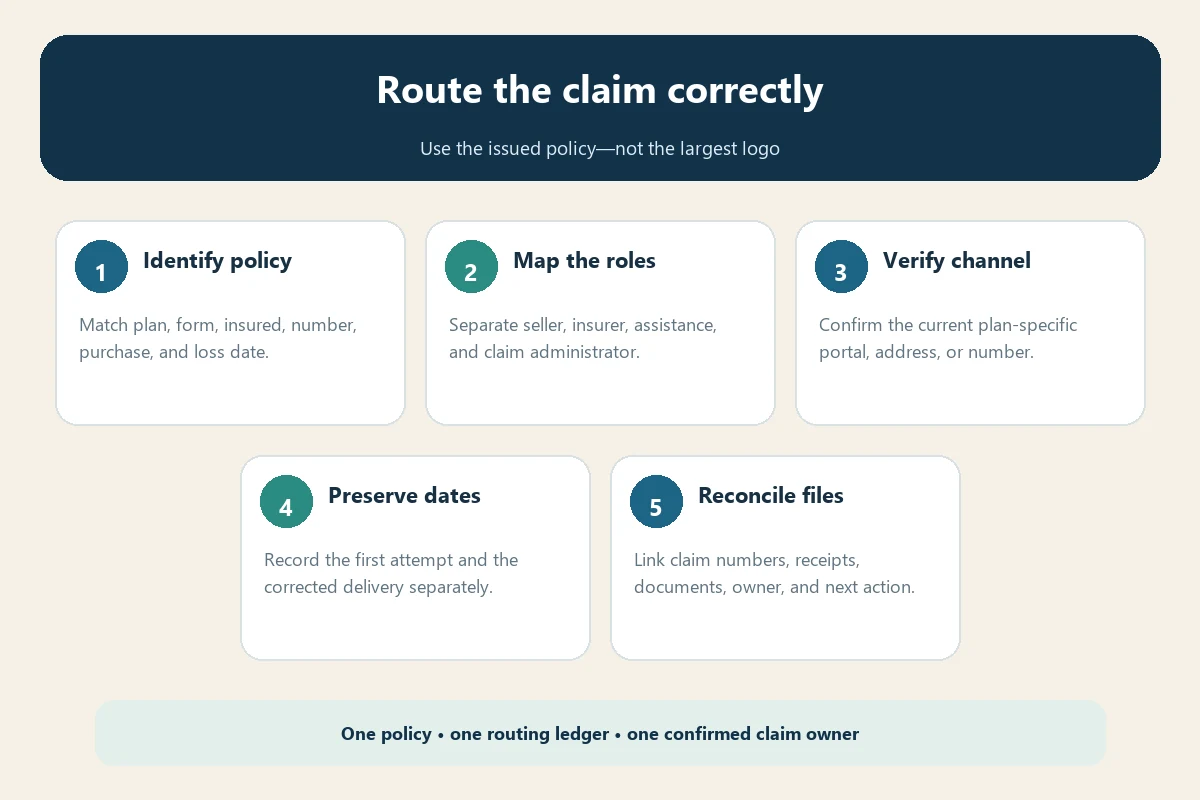
Open the policy or certificate issued for the trip—not only the sales receipt or wallet card. Record the exact plan name, policy or certificate number, state form, insured traveler, purchase date, trip dates, and loss date. Then map each named organization.
| Role | Typical function | Do not assume |
|---|---|---|
| Seller or retailer | Sells or displays the plan | It adjudicates claims |
| Producer or broker | Arranges the purchase | Sending it documents opens a claim |
| Insurer or underwriter | Bears the insured risk named in the contract | Its general inbox is the claim channel |
| Claims administrator | Receives and reviews claims under stated authority | It is the same company as the brand |
| Assistance provider | Coordinates urgent travel or medical services | An assistance case is a reimbursement claim |
| Travel supplier | Provides flight, hotel, cruise, or tour | Its refund request replaces insurance notice |
Find the controlling claim instructions
Look for sections titled Notice of Claim, Proof of Loss, Claims, How to File, or Contact Us. Check endorsements and state-specific notices that may replace the address in a generic booklet. The current administrator may also appear on the official plan-specific claim page.
Cover-More USA’s claim page, for example, identifies a travel claims administrator and gives claim contact information. Travel Insurance Services directs travelers to select the plan before using its claim instructions. These examples show why the logo alone is not enough. Use the documents and official page for the exact purchased plan.
If the policy and website conflict, call a verified number and ask which instruction governs this policy number and loss date. Save the representative, date, time zone, reference number, and written confirmation.
Do not assume the first recipient forwarded anything
Ask the wrong recipient to confirm what it received, when, under which reference, and whether any information was forwarded, deleted, quarantined, or returned. Request the destination and transfer date if it says the material was forwarded. A polite statement that “the other team handles this” is not proof of delivery to that team.
Until the correct administrator confirms a claim number and readable submission, treat forwarding as unverified. The claim portal upload guide explains how to preserve confirmation IDs, filenames, page counts, and alternate-channel receipts.
Protect notice and proof-of-loss dates
Separate the date you told the wrong company from the date the correct administrator received notice. Do not represent them as identical. Read the policy for notice, proof-of-loss, supporting-document, appeal, and legal-action provisions.
Send corrective notice through the verified channel as soon as possible. State the loss date, first attempted notice date, identity of the first recipient, reason for the routing error, and date you discovered it. Attach proof of the initial delivery and ask the correct administrator to confirm how it will record the chronology.
The notice-of-claim and proof-of-loss guide explains why initial notice and a completed evidence packet are distinct. Do not wait for the wrong recipient to investigate before protecting a deadline with the correct one.
Build a claim routing ledger
Use one row for every transmission:
- date, time, and time zone;
- sender and recipient organization;
- verified address, portal, fax, or telephone channel;
- claim or case number used;
- filenames, versions, and page counts;
- delivery receipt or reference number;
- recipient’s stated action;
- current owner and next deadline.
Keep the original failed or misrouted transmission. It may establish diligence and explain the chronology, even if it did not satisfy a contractual requirement.
Send a controlled correction packet
Do not forward a long email chain containing unrelated personal data. Create a cover note, routing ledger, claim form required by the correct administrator, and the smallest complete set of supporting documents. Preserve original filenames and label any new copy as a resubmission.
Re: Policy [number], traveler [name], loss [date]. On [date/time], I attempted to report this loss to [organization] through [channel], reference [ID]. On [date], I learned that claims for this policy are handled by your organization. I am submitting corrective notice and the attached indexed documents through your stated channel. Please confirm the recorded notice date, claim number, readable files, outstanding requirements, and applicable response deadlines. The attached routing ledger distinguishes the earlier transmission from this submission.
Do not ask the new recipient to backdate a record. Ask it to record both dates accurately and provide its position in writing.
Prevent duplicate claim files
If both organizations generated claim numbers, disclose both. Ask whether one file will be closed, transferred, or linked and which number controls future correspondence. Never submit the same expense twice without explaining the duplicate routing.
If two different policies may cover the loss, that is not merely a routing error. Preserve each policy, notify each as required, disclose other coverage, and follow coordination instructions. The purpose is to establish the net eligible loss, not obtain duplicate reimbursement.
Separate assistance cases from reimbursement claims
An emergency assistance team may arrange care, transportation, or payment guarantees and create a case number. That case may contain valuable authorization records, but it may not be the formal reimbursement claim required after the trip.
Ask assistance whether it opened a claim, transmitted records to claims, or only managed the live incident. Preserve both numbers. The assistance line versus claims guide maps emergency coordination and later benefit adjudication.
Work through a two-number example
A traveler calls emergency assistance from Spain and receives case A-4107. The assistance team helps locate a clinic and receives a medical summary. After returning home, the traveler emails receipts to the assistance address and assumes reimbursement has begun. Two weeks later, the policy’s claims page reveals that a separate administrator requires an online claim form.
The correction packet should not claim that A-4107 is already an insurance claim number. It should identify it as an assistance case, preserve the date of the original call and email, and ask whether the medical summary can be transferred lawfully. The traveler should then file through the verified claim portal, obtain claim number C-8821, and map both numbers in the routing ledger.
If the administrator says the earlier email does not constitute notice, ask for that position and policy basis in writing while continuing the correct submission. If it accepts the earlier chronology for some purpose, record exactly what was accepted. Accurate labels prevent an assistance authorization, privacy transfer, notice date, and benefit decision from being treated as the same event.
Verify identity before moving sensitive records
A message claiming that a file was “transferred to a new administrator” can be genuine or fraudulent. Verify the change using a telephone number or portal obtained independently from the issued policy or official site. Check the exact domain and organization name.
Do not send passport copies, medical records, bank statements, signatures, or payment credentials to an unverified address. The travel claim phishing guide provides a verification workflow for unexpected payment and banking requests.
If sensitive data went to the wrong legitimate company, ask about secure deletion, retention, privacy contact, and breach procedure. If it went to an unknown party, preserve evidence and follow appropriate identity, financial, and law-enforcement guidance for the data exposed.
What if the correct administrator rejects the notice as late?
Request the decision and policy basis in writing. Preserve the full chronology, including the issued materials that caused confusion, the initial delivery receipt, attempts to correct the error, and the date you learned the proper route. Do not assume the first submission automatically cures lateness, and do not assume the claim is over because a representative says so by phone.
Follow the policy’s appeal or complaint process. The NAIC directory links to U.S. state insurance departments. State rules and facts differ, so qualified legal or regulatory guidance may be appropriate when a material claim turns on notice, prejudice, agency, or limitation questions.
Track the corrected claim to a defined status
After the correct administrator accepts the submission, ask for the claim number, assigned team, documents received, missing items, current status, and expected next action. Use the claim status follow-up guide to keep each update tied to a date and owner.
If the file later moves to another examiner, preserve the routing ledger and use the new examiner handoff guide rather than rebuilding the chronology.
Wrong-administrator correction checklist
- Identify the exact issued plan, insurer, form, and policy number.
- Map seller, producer, assistance provider, and claims administrator.
- Verify current plan-specific claim instructions independently.
- Preserve the first transmission and obtain its receipt.
- Send corrective notice promptly through the proper channel.
- Record both the attempted and confirmed notice dates accurately.
- Use an indexed correction packet instead of an uncontrolled forward.
- Disclose and reconcile any duplicate claim or case numbers.
- Protect sensitive records and verify any changed destination.
- Confirm the corrected claim’s owner, open items, and next action.
A routing mistake is easier to repair when every organization, transmission, document, and date has a defined place. The objective is a single auditable claim file at the correct administrator, with the earlier attempt preserved rather than hidden or confused with confirmed receipt.
