
A travel insurance claim check with two payees can be harder to deposit than a check issued to one claimant. The exact connector between the names, each person’s authority, the receiving account title, and the bank’s procedures can all matter. Read the front before anyone signs the back.
Do not add “and,” “or,” punctuation, or another endorsement yourself. Do not sign for a spouse, child, provider, estate, or other payee without valid authority accepted by the bank and payer. This U.S.-focused guide is general information, not legal, banking, tax, estate, or insurance advice.
Copy the payee line exactly
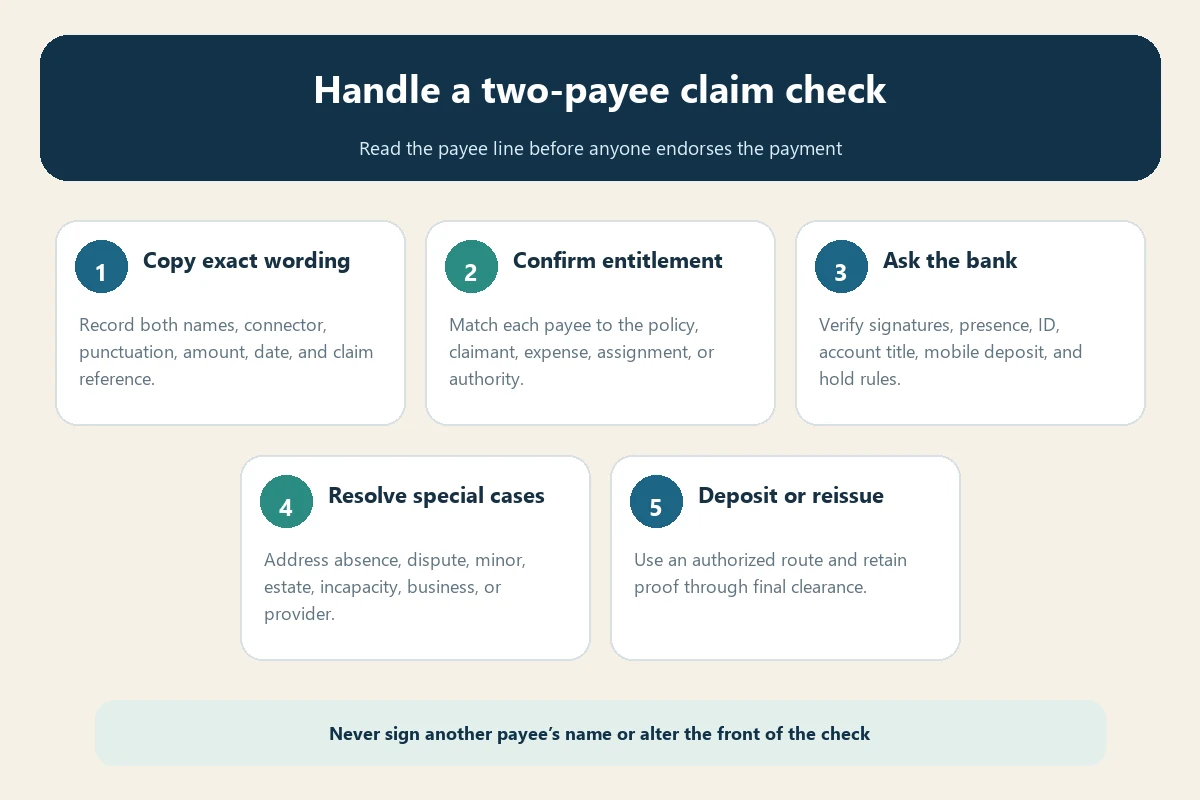
Photograph or scan the front and back before endorsement. Transcribe the names, titles, connector, punctuation, amount, currency, issue date, check number, claim reference, issuer, and any “void after” wording. A slash, ampersand, comma, line break, “and,” “or,” “and/or,” or no connector can lead to different questions.
| Payee line | Initial issue to verify | Who must answer |
|---|---|---|
| Alex and Jordan | Usually treated as joint payees | Bank and applicable state law |
| Alex or Jordan | Usually permits either payee | Bank’s acceptance policy |
| Alex and/or Jordan | Wording can create interpretation questions | Issuer and bank |
| Alex, Jordan | Connector may be ambiguous | Issuer and bank |
| Alex and Clinic LLC | Individual plus entity authority | Clinic, bank, and payer |
| Alex and Estate of Jordan | Fiduciary and estate account issues | Issuer, bank, and local adviser |
Understand “and” versus “or”
The Consumer Financial Protection Bureau says checks issued to two people together, such as “Pat and Chris Doe,” generally need both signatures. A check issued to “Pat or Chris Doe” can generally be signed by either person. Review the official CFPB answer on checks with two payees.
That short guidance does not settle every ambiguous payee line or bank procedure. States adopt versions of the Uniform Commercial Code, and a financial institution may impose operational requirements about identity, account ownership, physical presence, remote deposit, or acceptable endorsement. Ask before signing.
Model UCC section 3-110 says an instrument payable to multiple people alternatively can generally be negotiated by any of them, while one payable not alternatively generally requires all of them. It also addresses ambiguous wording. See the Legal Information Institute text of UCC 3-110, then confirm the law enacted in the relevant state and obtain advice for a dispute.
Ask why each person is a payee
Do not assume that every named person owns half of the claim payment. The insurer may list multiple insured travelers, a policyholder and claimant, the person who paid an expense, a medical provider, attorney, assignee, estate, guardian, or another party with a documented interest.
Request the claim decision and payment instruction that explain each payee. Compare the policy definitions, claimant identities, expense ownership, assignments, authorizations, and benefit calculation. If a person appears by mistake, correct the payer’s record instead of asking that person to sign away an unclear interest.
Call the receiving bank before endorsement
Provide only the non-sensitive facts needed for a procedural answer: two-payee wording, check type, account title, payee relationship, and whether both can appear. Ask:
- which endorsements are required and in what form;
- whether every payee must be physically present;
- which identification and authority documents are needed;
- whether the deposit account must include every payee;
- whether a branch, mail, ATM, or mobile deposit is allowed;
- whether a third-party endorsement is prohibited;
- what hold, review, or return risk applies;
- whether a rejected mobile image prevents later branch deposit.
Record the bank unit, representative, date, and answer. A teller’s preliminary view is not a guarantee that back-office review or the issuing bank will finally pay the item.
Do not improvise an endorsement
Each required payee should sign only in the permitted endorsement area, using the name and capacity accepted by the bank. Do not forge, trace, stamp, electronically paste, or sign another person’s name. Do not write “pay to the order of” a third party unless the receiving and issuing institutions explicitly accept that route.
Keep the check unendorsed until the process is known. An incorrect or restrictive endorsement can complicate reissue. If the bank requires all parties in person and that is impossible, ask the issuer for a different disbursement method.
Two travelers may not share a bank account
Friends, adult relatives, unmarried partners, separated spouses, coworkers, group members, or travelers living in different states may have no joint account. Even if both endorse, the receiving bank may decline deposit into an account owned by only one payee.
Ask the administrator whether it can split the approved amount according to its decision and issue separate payments. Do not invent an allocation. Obtain a written line-item breakdown showing which benefit and expense belong to each claimant, plus any shared cost allocation.
The family shared-expense claim guide explains how to document one booking, multiple travelers, reimbursements, and allocation without duplicating the loss.
Someone else may have paid for the trip
The traveler, policy purchaser, cardholder, parent, employer, host, or group organizer can be different people. Payment proof does not automatically determine the insured claimant or final payee. The policy and administrator’s authorization process control the claim decision.
One U.S. travel insurer’s public claim page says a claimant seeking payment to a specific alternate party must provide a written statement. That is a company procedure, not a universal rule, but it illustrates why alternate payees should be authorized before issuance. See Travel Insured’s claim center.
A provider or assignee needs separate review
A hospital, clinic, repair vendor, attorney, travel supplier, or other entity may be listed because of an assignment, direct-payment arrangement, authorization, lien, or administrative choice. Confirm the entity’s exact legal name and who can endorse for it.
Use the assignment of benefits guide to separate an assignment from ordinary reimbursement or direct payment. Do not ask an employee to sign an entity’s name without verified organizational authority.
Handle a minor payee lawfully
A parent is not automatically free to endorse every check payable to a child. Account type, custodial authority, court approval, amount, and state law can matter. Ask the insurer why the child is named and ask the bank what documentation and account structure it requires.
The minor child travel claim guide distinguishes insured, claimant, guardian, expense payer, and payment recipient. Obtain qualified local advice when a settlement, release, guardianship, or restricted account is involved.
A deceased or incapacitated payee changes the process
Do not sign a deceased person’s name or deposit a jointly payable check as though death removed that payee. Notify the issuer and bank. The appropriate estate representative, successor, guardian, conservator, or agent may need documented authority, and the check may need reissue to the correct legal capacity.
Use the deceased traveler estate claim guide for executor and estate records. A power of attorney may end at death, so do not rely on a prior authorization without legal review.
When a payee is absent, unreachable, or refuses
Do not bypass the absent person. Ask the issuer why that payee was included and what formal alternatives exist. These may include verified separate payment, corrected payee, new authorization, entity endorsement procedure, power of attorney, court or estate documentation, or another payment method.
If the payees dispute ownership or allocation, the insurer and bank may not resolve the underlying private dispute. Preserve the check and obtain legal advice. Do not deposit it secretly, threaten a signature, or make a false lost-check statement.
Request reissue when the payee line is wrong
Send the administrator a clear copy of the unendorsed check, claim decision, identity records, proof of the error, bank rejection or requirements, and requested correction. Ask whether the original must be returned, whether stop payment is needed, and when the replacement will issue.
Use the claim name mismatch guide when spelling, former names, entity names, or identity records differ. A reissue request should preserve the approved amount and explain only the payee change unless the claim decision itself is also disputed.
Prevent expiration while coordinating signatures
Multiple endorsements and institutional review can take time. Record the issue date and any “void after” notice immediately. Ask for the bank process and co-payee availability early rather than waiting until the deadline.
If the check becomes stale, follow the expired claim check reissue guide. Do not change the date or attempt deposit after the issuer confirms stop payment.
Keep a final deposit and allocation record
Copy the completed endorsements, deposit receipt, account credit, hold notice, final clearance, and any distribution between payees. Protect full account numbers and unrelated transactions. If one payee receives the funds for later distribution, preserve the written agreement, payment proof, and tax or accounting advice.
A cleared joint check does not by itself prove that every payee received the agreed share. Keep the insurance calculation and the post-deposit allocation as separate records.
Escalate an unresolved payment problem
If the insurer repeatedly issues an unusable payee line, send a timeline with the policy, decision, check copies, bank requirements, identity or authority documents, correction request, and proposed workable method. Ask for the payment-resolution unit and written response.
The NAIC directory of state insurance departments links to official insurance regulators. A bank-deposit dispute may fall under a separate banking complaint route. Identify which party made the contested decision before escalating.
Bottom line
For a travel insurance claim check naming two payees, start with the exact front-of-check wording. Confirm why each party is named, obtain the receiving bank’s requirements before endorsement, and address minors, estates, providers, absent parties, and ownership disputes through documented authority. Never alter the payee line or sign for someone else; request a controlled reissue when the check cannot be lawfully negotiated.
