
A travel insurance claim bank statement proof of payment should connect a specific insured expense to the person or account that paid it. The invoice shows what the supplier charged; the statement shows what posted to an account. Neither record alone always proves traveler, service, covered loss, final currency, or refund.
This guide explains how to reconcile bank and credit-card statements with invoices, receipts, itineraries, refunds, points, installments, shared costs, and foreign currency while protecting unnecessary account data.
Build a payment reconciliation row
For every claimed expense, record traveler, supplier, service, invoice number, service date, invoice currency and amount, payer, payment method, transaction date, posting date, statement descriptor, posted currency and amount, refund, and net claim.
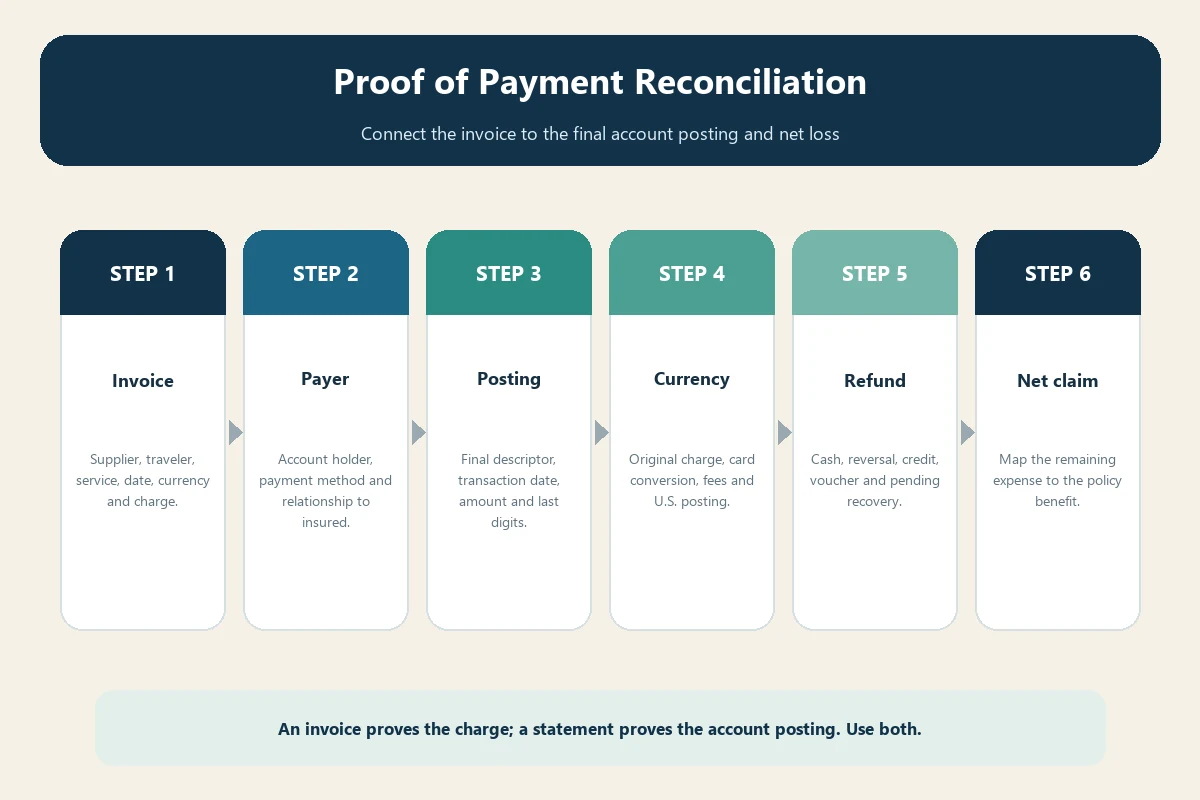
Attach the invoice and statement page to the same row. Do not submit a monthly statement without identifying the relevant transaction.
Understand what each record proves
| Record | Strongest fact | Common gap |
|---|---|---|
| Invoice | Supplier, service, traveler, charge | May not prove payment |
| Receipt | Payment acknowledged | May omit payer or card link |
| Card statement | Charge posted to cardholder account | Descriptor may differ from supplier |
| Bank statement | Debit, transfer, check, or cash withdrawal posted | May not identify purchased service |
| Supplier ledger | Charge, payments, refunds, balance | May mask funding source |
Follow the administrator’s current checklist
Berkshire Hathaway Travel Protection lists a credit-card or bank statement as proof of payment when the trip invoice does not already provide it. Travel Guard likewise lists paid invoices, card statements, or bank statements for various reimbursement claims.
Those are U.S. examples. Use the requirements for the exact policy, benefit, and claim administrator.
Wait for a posted transaction when possible
A pending authorization can change amount, descriptor, currency, or disappear. A final posted transaction is stronger. If the deadline arrives first, submit the pending record, explain its status, protect the deadline, and supplement with the final statement.
Record transaction date and posting date separately. The supplier invoice may use local time while the card posts on a later U.S. date.
Match a different merchant descriptor
A booking platform, payment processor, hotel management company, medical group, or parent company may appear instead of the familiar brand. Obtain a supplier receipt or statement connecting the descriptor to the booking or invoice.
Do not edit the statement label. Add a factual bridge: reservation number, processor receipt, supplier confirmation, amount, and date.
Prove the payer without exposing the full account
Keep the account holder, issuer, statement period, relevant transaction, and last digits when required. Mask full account or card numbers only according to the administrator’s instructions.
Our claim document redaction guide explains how to preserve necessary evidence and test the final PDF for hidden data.
Connect the payer to the insured traveler
A spouse, parent, employer, friend, group leader, or travel companion may pay. Label purchaser, insured, expense payer, claimant, and proposed payee separately. Attach the booking allocation and a concise explanation of why that person paid.
Payment by another person does not automatically establish or defeat coverage. The policy’s covered-person and loss provisions control.
Peer-to-peer transfers need two connected records
Venmo, PayPal, Zelle, Cash App, or another transfer can show money moving between people without identifying the travel service. Preserve the platform transaction, sender and recipient, date, amount, status, note, underlying funding source when relevant, and the supplier invoice or group organizer ledger.
If one traveler reimbursed another, show the original supplier charge and the later reimbursement as separate events. Do not present the peer-to-peer transfer as though it was paid directly to the airline, hotel, or hospital. Explain which person initially incurred the charge and how the travelers allocated it.
Employer and business-card payments require ownership clarity
A business card or employer account may pay travel that includes personal components. Obtain the employer’s expense report, card statement, supplier invoice, reimbursement policy, and statement of amounts ultimately borne by the traveler. Identify any employer refund, write-off, or recovery.
Do not claim an expense the employer paid and did not charge back to the insured. Conversely, if the traveler reimbursed the employer, preserve that payment and the employer ledger. Ask the administrator who has the covered financial loss and who should receive any reimbursement.
Handle shared family charges line by line
One hotel room, cruise cabin, rental car, package, or family card transaction can benefit several travelers. Reconcile the total charge, supplier allocation, each insured traveler, refunds, and requested benefit.
Use our family shared-expense claim guide. Do not divide equally when the supplier used child pricing, occupancy, or traveler-specific components.
Foreign currency needs both sides of the transaction
Keep the invoice’s original currency and amount plus the card’s posted U.S.-dollar amount. Record transaction and posting dates, card conversion, foreign-transaction fee, dynamic currency conversion, and later refund.
Follow the claim currency reconciliation guide. Do not replace the bank’s actual posting with today’s web exchange rate.
Separate fees from the insured expense
A bank, card, wire, intermediary, ATM, or foreign-exchange fee can appear beside the purchase. Label each fee and ask whether the benefit considers it. Do not silently add fees to the supplier invoice amount.
If a transfer bundled several expenses, obtain a ledger showing how the total was allocated.
Installments require the full schedule
A cruise, tour, or vacation rental may be paid by deposit and installments across statements. List every payment, date, amount, card, refund, and remaining balance. Reconcile the sum to the supplier’s final ledger.
Do not claim an unpaid installment or refundable future balance as a paid nonrefundable loss.
Points, miles, and statement credits
A statement may show taxes and fees but not the points value. Preserve the loyalty redemption, points deduction, booking receipt, cash copay, card charge, redeposit, and any redeposit fee. Benefit definitions vary on points and rewards.
Do not assign your own cash value to points unless the policy or administrator instructs you to do so.
Digital wallets and virtual card numbers
Apple Pay, Google Pay, PayPal, virtual cards, and booking wallets can display a device or token number different from the physical card. Obtain the wallet transaction, underlying card statement, booking receipt, and issuer explanation needed to connect them.
Do not disclose wallet credentials or full token data. Preserve enough last-digit and transaction information to build the bridge.
Cash withdrawal is not proof of the purchase
An ATM withdrawal proves access to cash, not that the cash paid a hospital, taxi, pharmacy, or hotel. Pair it with an itemized invoice, receipt, provider statement, withdrawal timing and location, and explanation.
When cash evidence concerns overseas treatment, use our foreign medical bill guide and follow the administrator’s requested alternative evidence. Never create a receipt.
Check and ACH proof
For a check, retain front and back where available, payee, amount, date, memo, check number, and clearing record. For ACH, preserve sender, recipient descriptor, amount, date, status, and trace or reference number.
A scheduled transfer is not the same as a settled debit. Confirm final posting.
Refunds must be reconciled on the same evidence trail
Show cash refund, card reversal, partial credit, voucher, chargeback, refundable taxes, and pending amount. A refund can post under a different descriptor or exchange rate.
Use the supplier refund statement guide. The claim generally needs the remaining covered net loss, not the original gross charge.
Do not confuse payment evidence with coverage evidence
A statement proves money moved; it does not prove a covered event, medical necessity, trip occurrence, nonrefundability, baggage ownership, or policy eligibility. Attach the appropriate carrier, medical, police, supplier, itinerary, or policy records.
The main travel claim filing guide maps each document to the claim fact it proves.
When the statement is unavailable
Request an archived statement, transaction letter, canceled check, issuer confirmation, processor receipt, supplier ledger, or other accepted evidence. Protect the deadline while waiting and document the request.
Use our alternative proof guide for a structured evidence ladder. Do not submit a screenshot stripped of account holder, issuer, date, or transaction context unless the administrator accepts it.
Prepare a statement annotation page
Do not draw over the source. Create a separate index listing statement page, transaction date, descriptor, amount, invoice, traveler, benefit, and refund. If highlighting is allowed, apply it only to a working copy and keep text readable.
Revolut’s U.S. travel claim guidance provides a useful example of a statement showing the last four digits and the common-carrier charge.
Validate before upload
- Statement owner and issuer visible
- Relevant last digits retained as required
- Transaction posted, not merely pending
- Descriptor linked to supplier
- Date, currency, and amount reconciled
- Invoice and traveler mapped
- Refunds and credits included
- Full account data masked only as instructed
- Final copy readable and receipt saved
Bottom line
A strong bank or card statement submission does not dump an entire account history into the claim. It connects the account holder, relevant posting, supplier invoice, insured traveler, currency, refund, and net loss in a traceable row while protecting unnecessary account data. Use the invoice and statement together, and explain every gap instead of forcing a visual match.
