
If a travel insurance claim check was lost in the mail, first prove what “mailed” means in the payer’s records. Claim approval, check printing, handoff to a mail service, delivery, and deposit are separate events. Obtain the check number, mailing address, actual dispatch date, and current payment status.
Do not assume the postal service has the only relevant record, and do not request repeated replacements without cancelling the prior item. This U.S.-focused guide explains address verification, nonreceipt, stop payment, reissue, suspected negotiation, and final reconciliation. It is general information, not legal, banking, postal, tax, fraud, or insurance advice.
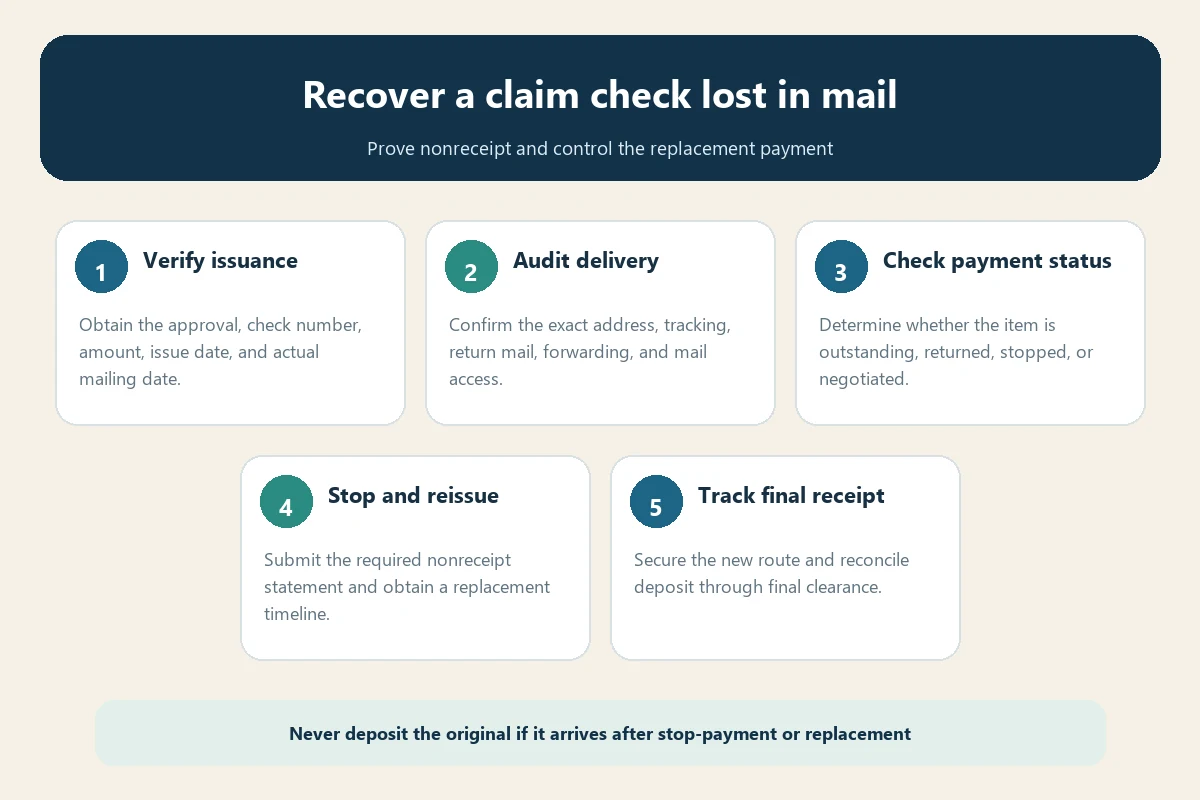
Confirm the check was actually issued
A portal can say “approved,” “paid,” or “processed” before a physical check enters the mail. Ask the claim administrator or payment unit for:
- written claim decision and net payment calculation;
- check number, amount, currency, payee, and issue date;
- print date and actual mail handoff date;
- sender or payment vendor name;
- mail class, carrier, and tracking number, if any;
- destination exactly as printed on the envelope;
- current status: outstanding, returned, stopped, cleared, or replaced.
The claim decision letter guide helps separate coverage approval from payment delivery when the payer has provided only a portal status.
| Record status | What it proves | What it does not prove |
|---|---|---|
| Approved | Claim adjudication was completed | A check was printed |
| Issued | A payment instrument was created | It entered the mail |
| Mailed | Payer records a dispatch event | Correct address or delivery |
| Delivered | Carrier recorded a delivery event | Claimant personally received it |
| Outstanding | Payer does not show final negotiation | The check remains safely in transit |
| Cleared | Issuer shows the item paid | The intended payee endorsed it |
Audit the complete mailing address
Compare the payment address with the claim form, policy, portal profile, recent correspondence, and a standardized current address. Check apartment or unit, building, street suffix, directional, city, state, ZIP Code, country, claimant name, care-of line, and mailbox restrictions.
Ask whether updating the claim profile also updates the separate payment system. The claim address change guide explains how to verify effective date, pending mail, old address, and authorized delivery channels.
If you moved, confirm mail-forwarding dates and limitations. Do not rely on forwarding for every financial document. If the check went to a hotel, university, military address, mailroom, employer, temporary rental, shared mailbox, or third party, identify its intake and retention process.
If the claimant returned abroad after the trip, ask whether the payer can mail checks internationally and whether the issuing bank’s check can be deposited in that country. Confirm address formatting, delivery service, currency, bank collection fees, expiration, and whether a verified U.S. electronic-payment alternative is available. Do not use another person’s U.S. address or account without documented authorization.
Check the delivery environment
Review household members, authorized agents, front desk, building management, package room, mailroom, neighbors, former occupants, and any person with mailbox access. Ask whether the envelope was returned, held, mis-sorted, damaged, or delivered under the insurer’s or payment vendor’s name.
For a tracked piece, save the carrier’s event history and delivery image or signature if available. For ordinary untracked mail, the absence of tracking is not proof of non-mailing or delivery. Document the expected window and follow the payer’s escalation process.
Use USPS missing-mail tools when relevant
The U.S. Postal Service provides a Missing Mail search process for qualifying items after preliminary tracking and inquiry steps. Eligibility, timing, information required, and available results depend on the mailpiece. A search does not cancel or replace the check.
Give USPS only the information needed to identify the envelope. Do not publicly post an image containing the check number, address, claim number, or financial details. Preserve the search confirmation and response for the insurer’s reissue file.
Ask how long the payer waits before stop payment
There is no single waiting period that applies to every private travel claim check. Ask the issuing organization for its policy and the date from which the window runs. One state-created insurer, Citizens Property Insurance Corporation in Florida, publicly says it verifies the issue date and mailing address and waits at least 20 business days from issuance before requesting stop payment. That is Citizens’ procedure, not a nationwide travel-insurance rule. See its official missing claim check answer.
Record the earliest stop-payment date and schedule follow-up. If the check has tracking that proves loss, return to sender, wrong destination, or theft, ask whether the payer can accelerate its normal process.
Confirm whether the check was negotiated
Before reissue, the payer should determine whether the original remains outstanding. Ask the payment or treasury unit—not only the claims examiner—to verify its bank record. Obtain the status and verification date in writing.
If the check cleared but you never received or endorsed it, request a front-and-back paid image and the issuer’s unauthorized-endorsement investigation process. Preserve the claimed signature, depositing institution information available, dates, amount, and case number. Do not accuse a specific person without evidence.
Complete the nonreceipt or lost-check statement accurately
The administrator may require an affidavit, declaration, indemnity, or lost-check form. Read it before signing. State whether the check was never received, received and later lost, stolen, destroyed, or returned by a bank. Those facts are not interchangeable.
Confirm the form’s promises about returning the original, reimbursing duplicate payment, cooperating with investigation, and notifying the payer if the item appears. Do not certify that you never attempted deposit if a bank processed and reversed it.
Obtain stop-payment confirmation
Ask for the date stop payment was requested, date it became effective, check number covered, case reference, and whether any waiting or bank confirmation remains. A verbal statement that the check was “cancelled” may not reveal whether the payment platform has completed every accounting step.
Once stop payment is effective, do not deposit the original if it arrives. Mark it according to the issuer’s written instruction and return or destroy it securely. Depositing both original and replacement can cause reversal, collection, or fraud investigation.
Correct the replacement route before reissue
Do not send the replacement to the same unverified address automatically. Confirm legal payee, address, delivery restrictions, and contact information. Ask whether tracked, signature-required, expedited, branch pickup, ACH, or another secure method is available and what fees or conditions apply.
The claim payment method guide compares check, ACH, and digital payment. If choosing electronic delivery, use an authenticated portal and verify account ownership rather than emailing full bank details.
Track the replacement as a new instrument
Obtain the replacement check number, amount, issue date, payee, mail date, destination, carrier, and tracking. Ask whether the previous check is visibly linked to the new one in the payment ledger. Record promised delivery and escalation dates.
When it arrives, compare it with the decision and deposit it promptly through a bank-approved route. Save the deposit receipt, hold notice, final account credit, and clearance. If two payees are named, follow the two-payee claim check guide before endorsement.
A damaged envelope or check requires preservation
If the envelope arrives empty, opened, torn, or resealed, photograph all sides, markings, contents, and delivery condition. Keep the packaging. Notify the payer and carrier promptly and ask whether the original check is outstanding.
If the check itself is damaged, do not tape, laminate, rewrite, or attempt mobile deposit unless the bank and issuer direct you. Request a controlled replacement with a copy showing the damage.
Protect against payment-redirection scams
A missing check can prompt fake calls offering immediate replacement. Verify every contact through the issued policy, official website, or authenticated portal. The claim payment scam guide explains altered instructions, fake fees, identity requests, and account takeover.
No legitimate replacement process should require gift cards, cryptocurrency, a one-time login code, remote device access, or a payment to “release” approved insurance proceeds.
Do not let a replacement become stale
Record any “void after” notice and deposit the replacement within the bank’s and issuer’s accepted period. If it becomes too old, use the expired claim check reissue guide rather than altering the date.
If a long period passes, ask whether the payment was transferred to a state unclaimed-property program. Obtain the state, holder name, report year, and property reference, then use the official state process.
Escalate a delayed replacement with evidence
A New Jersey Department of Banking and Insurance market-conduct report documented a property-liability file where an insured never received a mailed check, stop payment was later placed, and reissue was substantially delayed; examiners cited delayed settlement under the rule applicable to that review. This is not travel-insurance law for every state, but it shows why the file should preserve nonreceipt, stop-payment, and reissue dates. See the official New Jersey examination report.
If internal escalation fails, use the NAIC directory of state insurance departments to identify the appropriate regulator. Submit the decision, issue and mail records, address proof, nonreceipt report, payment status, stop-payment confirmation, reissue request, and complete timeline.
Bottom line
For a travel insurance claim check lost in the mail, verify issuance and dispatch rather than relying on “paid” status. Audit the address and delivery environment, determine whether the check cleared, complete an accurate nonreceipt statement, document stop payment, and secure a traceable replacement. Final payment is proved by receipt and clearance—not by the date a portal says a check was mailed.
