

A credit card travel insurance pre existing condition question cannot be answered from the card’s benefits summary. A card may include trip cancellation, emergency evacuation, travel accident, baggage, delay, or assistance services, but each benefit has its own eligibility trigger, covered reasons, exclusions, and limits. Some current U.S. benefit guides expressly exclude losses tied to a pre-existing condition.
This guide provides a five-part audit for U.S. cardholders. It is educational, not medical, insurance, legal, or credit advice. Always use the Guide to Benefits for the exact card and account, then confirm unclear terms with the benefits administrator.
Key takeaways
- Do not treat “travel protection” as comprehensive travel insurance.
- Check the exact card edition and current Guide to Benefits, not a network or issuer summary alone.
- A payment trigger may determine whether the trip is eligible before any medical issue is reviewed.
- Assistance can arrange referrals while leaving treatment or transportation costs to the traveler.
- A standalone policy can address gaps, but only if its own waiver and purchase conditions are satisfied.
Reviewed August 16, 2026. Card benefits can vary by account, issuer, network, state, policy year, and booking method. Benefits may change. The current Guide to Benefits and group policy govern.
Audit the benefit, not the marketing label
“Credit card travel insurance” is convenient shorthand, but it can hide several independent coverages and non-insurance services. A trip cancellation benefit does not prove the card pays overseas hospital bills. A medical referral service does not prove it pays for an evacuation.
Start with the credit card versus standalone comparison, then audit the condition-specific terms below. The goal is not to decide whether a card is “good,” but whether a defined loss is covered.
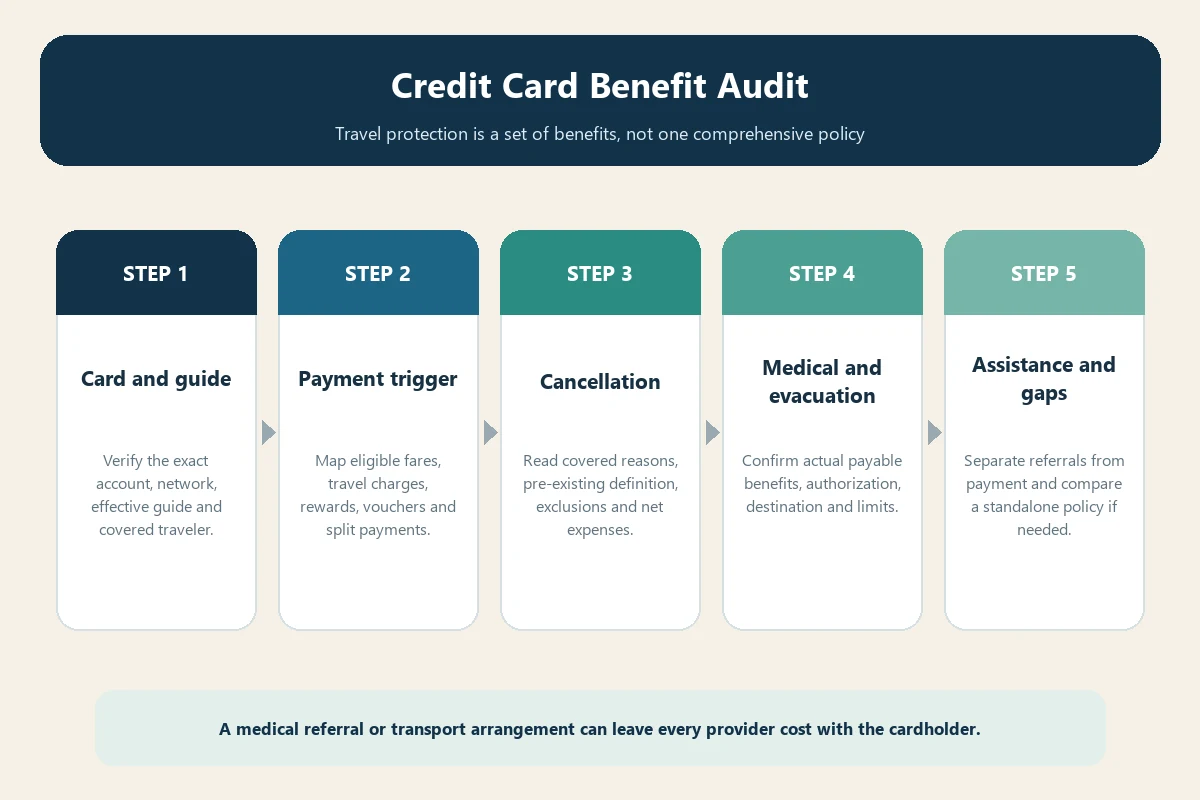
Part one: identify the exact card and guide
Record the card name, product generation, network, account status, covered cardholder, authorized-user rules, and Guide to Benefits effective date. Similar card names can have different benefits, and legacy accounts can differ from new applications.
Chase’s current travel-protection FAQ tells cardmembers to obtain their specific Guide to Benefits through their account or benefits portal. Capital One’s current card-network benefits guidance likewise says benefits depend on the card and directs customers to the cardholder guide.
Part two: prove the payment trigger
Many card benefits require some or all of an eligible fare or trip expense to be charged to the covered account or paid with associated rewards. The required charge can differ by benefit. Paying hotel costs with the card may not activate a benefit defined around common-carrier fare.
Keep the booking confirmation, itemized receipt, card statement, rewards redemption, and proof of any voucher or certificate. If several cards were used, create a line-by-line payment map.
Trip and traveler definitions come before exclusions
Check who is an eligible traveler, whether family must travel with the cardmember, the maximum trip duration, starting distance, destination, and covered transportation. A medical loss involving a non-traveling relative may be relevant to cancellation under one guide and irrelevant under another.
Do not jump directly to “pre-existing condition.” If the person, payment, or trip never meets the benefit definition, a waiver analysis cannot rescue it.
Part three: read trip cancellation and interruption
Find the covered reasons for sickness, injury, death, quarantine, weather, and other events. Then read the exclusions, pre-existing definition, look-back period, physician-certification rules, covered expense definition, and maximum reimbursement.
A current Chase Sapphire Reserve Guide to Benefits excludes a pre-existing condition and defines it using medical advice, diagnosis, care, or treatment within 60 days before the trip’s initial deposit or booking date, while controlled maintenance medication receives specified treatment. This is one current guide, not a statement about every Chase card.
Current issuer guides can use different wording
A current U.S. American Express trip cancellation and interruption guide also defines a 60-day pre-existing period and addresses stable maintenance medication. Its covered travelers, payment requirements, reasons, and exclusions must still be read as a whole.
The look-back examples show how to place symptoms, treatment, and medication events on the right side of the benefit’s anchor date. Never merge definitions from two issuers into a fictional common rule.
Do card benefits offer a waiver?
Do not assume a time-sensitive waiver exists merely because standalone travel policies sometimes offer one. Search the card guide for “waiver” and the entire pre-existing-condition exclusion. If no endorsement removes the exclusion, buying the ticket quickly with the card does not create one.
The card trip-cancellation gaps guide covers supplier credits, covered expenses, reimbursement order, and benefit limits that remain relevant even when the medical cause is not excluded.
Part four: check emergency medical expense
Some U.S. cards provide no overseas emergency medical expense insurance. Others may offer a limited benefit on a particular premium product. A general description of “emergency assistance” is not evidence of payment coverage.
Search the guide for emergency medical and dental expense, deductible, primary or secondary status, covered sickness or injury, pre-existing exclusion, trip length, country restrictions, required notice, and claim documents. Compare the amount with the traveler’s health plan abroad.
Travel accident insurance is not health insurance
Travel accident coverage commonly addresses specified accidental death or dismemberment associated with eligible transportation. It does not automatically reimburse ordinary emergency-room care, hospitalization, chronic-condition treatment, or prescription expenses.
A benefit name containing “accident” should never be used as proof of broad medical coverage. Read the loss schedule and definitions before counting it in the protection plan.
Part five: separate evacuation insurance from assistance
An emergency evacuation benefit may pay or reimburse medically necessary transportation under specified conditions. An assistance service may only provide referrals, translation, or coordination, with all provider and transport costs charged to the traveler.
Chase’s current Sapphire travel-insurance guide states that Travel and Emergency Assistance provides legal and medical referrals while the cardmember remains responsible for goods and services obtained. That distinction is easy to miss in a short benefits list.
Pre-existing conditions can affect evacuation too
If the card has an evacuation benefit, find whether illness or injury resulting from a pre-existing condition is excluded. Also check medical necessity, prior approval, permitted destination, transport selection, and maximum benefit.
The medical evacuation limits guide explains why a high maximum is not permission to arrange a private flight. The card benefits administrator may need to coordinate or approve transport.
Visa illustrates why the guide matters
Visa’s current U.S. Infinite trip cancellation and interruption document defines a pre-existing condition using a 60-day period before the purchase of common-carrier fare and describes a controlled-medication exception. But Visa also tells consumers that benefits and complete terms depend on the issuer’s Guide to Benefits.
A network-level document is useful evidence only when it applies to the card. Verify the issuing bank, eligible product, effective date, and account materials.
Secondary coverage changes the claim process
A card benefit may pay only after refunds, supplier credits, primary health insurance, or other collectible insurance. The traveler may need to file with another payer and submit its explanation of benefits or denial.
Preserve cancellation terms and request every available refund. The travel insurance claim guide explains how to show the gross loss, recoveries, and remaining net amount.
When a standalone policy can close a gap
A standalone policy may offer trip-cost coverage, medical expense, evacuation, and a pre-existing-condition exclusion waiver. It does not automatically close the gap: the traveler must buy an eligible plan inside its time window and satisfy full-cost, medical-ability, and other stated conditions.
Use the waiver eligibility checklist and compare the issued form with the card guide. Avoid paying twice for a low-priority benefit while leaving the medical or evacuation exposure unaddressed.
Coordinate two sources without assuming double payment
When card and standalone benefits overlap, each contract may require notice of other insurance or reimbursement. The card might be excess; the standalone plan might be primary or secondary. Neither necessarily pays an already-refunded expense.
Create a coordination table showing the expense, supplier refund, health-insurance payment, standalone decision, card decision, and remaining balance. Submit truthful, consistent records to every payer.
Questions for the benefits administrator
- Which Guide to Benefits and group policy apply to my account today?
- What charge or rewards payment activates each benefit?
- How does each benefit define a pre-existing condition and anchor date?
- Is there any waiver of that exclusion in this exact guide?
- Is emergency medical expense insurance included?
- Is evacuation a payable benefit or only an assistance service?
- Who must authorize transport and which destination is permitted?
- Which refunds or other insurance decisions must come first?
Keep a card-benefit evidence folder
- Downloaded Guide to Benefits with effective date.
- Card statement and itemized travel receipts.
- Rewards and voucher payment records.
- Original itinerary, supplier terms, and refund responses.
- Medical timeline and physician records.
- Benefits-administrator case numbers and written answers.
- Other insurance explanations of benefits.
- Claim form, uploaded files, and delivery confirmations.
Bottom line
For a credit card travel insurance pre existing condition decision, verify the exact card, payment trigger, traveler and trip definitions, then audit cancellation, medical expense, evacuation, and assistance separately. Current guides show that pre-existing-condition exclusions are real and product-specific. If a critical risk is excluded or absent, compare a standalone policy while its waiver window is still available.
