

Pre existing condition look back period examples become useful when you place real dates, symptoms, appointments, and medication changes on a calendar. In travel insurance, the decisive question is usually not simply whether a traveler has a diagnosis. The policy may instead ask what happened during a defined window immediately before a stated anchor date, such as the policy purchase date or initial trip payment date. These fictional timelines show how that review can work without pretending that every certificate uses the same rules.
The examples below are fictional and educational. They do not predict a claim decision. U.S. travel insurance forms vary by insurer, plan, state, coverage type, and edition. Always read the actual certificate that applies to your purchase, including its definitions, exclusions, waiver language, and state-specific endorsements.
Start with the policy’s exact dates and definitions
A look-back period is the span of time an insurer examines when deciding whether an illness, injury, or other medical condition meets the policy’s definition of a pre-existing condition. A certificate might review 60, 90, 120, or 180 days, but those are examples rather than a universal standard. The starting point is the definition in the issued document—not a marketing summary or another traveler’s policy.
First identify the anchor date. Some policies count backward from the effective date of insurance, while others use the date coverage was purchased. Then identify the length of the window and whether the certificate includes both boundary dates. If a 90-day window is anchored to June 30, do not assume the first reviewed day until the policy or insurer confirms the counting method. A one-day difference can matter when an appointment or medication change occurred near the boundary.
The National Association of Insurance Commissioners’ travel insurance overview recommends understanding limitations and exclusions before purchase. The NAIC’s market-conduct guidance also expects a pre-existing condition exclusion to be disclosed clearly and the relevant definition to be understandable. Those principles are useful because the label alone does not reveal what events the policy counts.
Example 1: symptoms occurred even though there was no diagnosis
Maria buys a policy on July 1. Her certificate uses a 90-day look-back period tied to the purchase date. On May 12, she visited urgent care for chest tightness. The clinician documented symptoms, ordered testing, and referred her to a cardiologist. The final diagnosis was not made until July 15.
It would be risky to conclude that the condition is automatically new merely because the diagnosis came after purchase. Some definitions focus on symptoms, medical advice, examination, testing, treatment, or a reasonable basis for seeking care during the reviewed window. Maria’s May visit may therefore be relevant even though no condition had yet been named. She should preserve the urgent-care note, referral, test orders, cardiology records, and the policy wording that was in effect on July 1.
Travelers managing cardiovascular concerns can compare the definition with the practical issues in our guide to travel medical insurance for heart conditions. The key lesson is that a diagnosis date and a condition’s policy status are not necessarily the same thing.
Example 2: testing or recommended care falls inside the window
Daniel’s certificate reviews the 120 days before his effective date. During that period, his primary-care clinician notices an abnormal lab result and recommends a repeat test after four weeks. Daniel feels well and has not started treatment. He postpones the repeat test until after buying the policy.
A traveler might call this “nothing more than monitoring,” but the certificate may treat a recommended examination, investigation, or follow-up as relevant. Whether the abnormal result and recommendation satisfy the actual definition depends on its wording. Daniel should not erase the event from his application or claim timeline simply because he had no symptoms. He should ask the insurer, in writing, how pending or recommended tests are handled and retain the response with the certificate.
This example also explains why our broader guide to the travel insurance pre-existing condition look-back period emphasizes medical records rather than labels. Claim reviewers reconstruct a chronology; a complete chronology is more useful than a traveler’s shorthand description.
Example 3: a stable condition with unchanged medication
Elena has taken the same blood-pressure medication at the same dose for two years. Her routine refill occurs during a 60-day look-back period. She has no new symptoms, no dose change, no extra visit, and no new test or treatment recommendation. Her certificate expressly says that taking or receiving a prescription drug does not by itself trigger the definition when the prescription remains unchanged.
Under that particular wording, the routine refill may be treated differently from a change in treatment. But Elena must read the entire definition: another policy may be structured differently, and an endorsement could alter the base form. The absence of a medication change also does not guarantee coverage for every later event. The claimed loss still must meet the policy’s covered-reason, timing, documentation, and other requirements.
Travelers who rely on ongoing therapy should review our guides to travel insurance and chronic medication and travel insurance for prescription medication. Those pages cover transport, documentation, replacement, and access questions that a look-back analysis alone does not answer.
Example 4: a medication change occurs two weeks before purchase
Kevin takes medication for anxiety. His clinician increases the dose 14 days before he buys travel insurance because his symptoms have returned. The policy uses a 180-day look-back period and includes a change in prescribed medication or dosage among the events it examines.
The timing and reason for the change are likely important under that wording. Kevin should collect the visit note, the old and new prescriptions, pharmacy history, and any follow-up plan. He should also check whether the plan offers a time-sensitive pre-existing condition exclusion waiver and whether he satisfies every eligibility requirement. A waiver, when available, is not usually created by paying an extra fee after the deadline; it is commonly tied to purchase timing and other conditions.
Our pre-existing condition waiver guide explains the concept, while the separate buying guide for travelers with pre-existing medical conditions provides a comparison workflow. The two analyses should be kept separate: the look-back definition asks what medical events occurred; waiver language asks whether an exclusion may be waived when all stated gates are met.
Example 5: the certificate states a narrow medication exception
Priya switches from a brand-name drug to its generic equivalent during the reviewed period, with no change in dosage or medical effect. A sample certificate might expressly say that this exact substitution is not treated as a prescription change. Another form might mention special rules for routine adjustments to insulin or anticoagulants when the medical condition remains controlled.
These are wording examples, not industry-wide promises. The current Travel Guard Minnesota sample certificate, for example, contains a rider-specific definition with stated medication exceptions, while the base wording and other state forms can differ. An Allianz Washington sample plan demonstrates a different look-back duration and structure. The useful comparison is not which company uses the friendliest excerpt; it is which complete, applicable certificate matches the traveler and trip.
A traveler with diabetes should read the plan beside our guide to travel medical insurance for diabetes. Even when a medication exception applies to the definition, an emergency abroad can still involve deductibles, benefit limits, provider coordination, and exclusions unrelated to pre-existing conditions.
Example 6: the medical event occurred just outside the window
Robert’s plan looks back 90 days from July 15. He completed physical therapy for a knee injury in early April and had no symptoms, care, tests, treatment, or medication changes afterward. If the last relevant event is outside the correctly calculated window, it may not satisfy that plan’s look-back definition. Yet the answer depends on the exact dates, inclusive-counting rule, and whether another relevant event occurred later.
Robert should not discard older records. They may help establish when treatment ended and whether the condition remained unchanged. He also must check other provisions: a loss can be outside the pre-existing condition definition and still fail for another reason, such as an uncovered activity, travel against medical advice, lack of medical necessity, or missing proof. Our article on continuation of treatment while traveling explains why planned or ongoing care is often different from an unforeseen emergency.
A reusable worksheet for calculating your own timeline
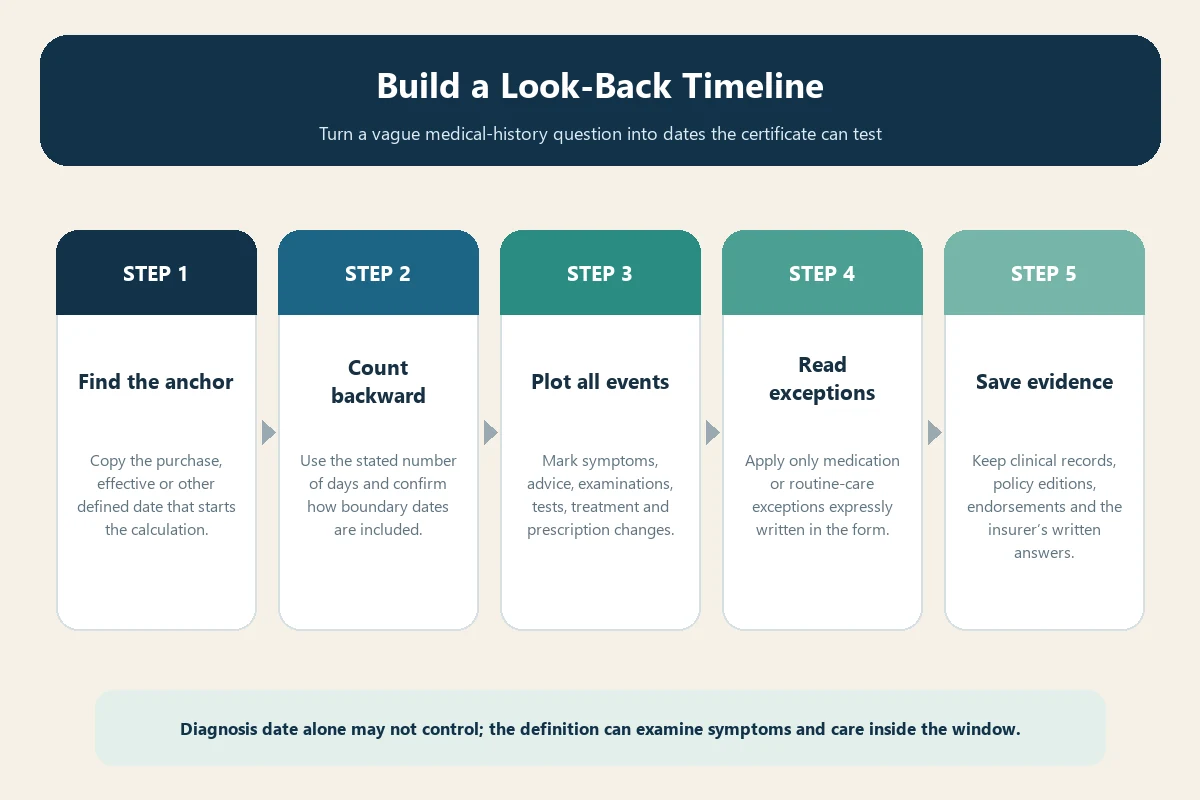
Before comparing plans, create one line for each potentially relevant medical event. Record the date, provider, symptoms, diagnosis if any, test or recommendation, treatment, medication and dosage, and whether follow-up remained pending. Then add the policy’s anchor date, the stated look-back length, and the first and last reviewed dates as confirmed from the certificate.
- Copy the definition exactly. Include cross-references and endorsements rather than paraphrasing from memory.
- Mark the anchor date. Confirm whether it is purchase, effective date, initial trip deposit, or another defined event.
- Calculate the boundary. Ask the insurer how it counts the first and last day if the form is unclear.
- Plot every medical event. Include symptoms, advice, tests, treatment, and prescription changes—not only diagnoses.
- Evaluate waiver language separately. Record its deadline, trip-cost rules, fitness requirement, and any other gates.
- Keep the evidence. Save the quote, certificate, endorsements, payment receipt, trip invoices, and written insurer answers.
A WorldTrips Atlas Journey brochure provides another current example of a defined look-back period paired with time-sensitive waiver language. Comparing such documents shows why a traveler should never copy a duration from a search result into a personal timeline without confirming the applicable state form.
What these examples can—and cannot—tell you
The examples reveal a consistent method: locate the controlling document, identify the anchor and window, plot facts rather than conclusions, and test waiver eligibility separately. They cannot determine whether a real claim will be paid. That decision may depend on confidential medical records, the claimed cause of loss, the complete policy, and state law.
Before buying, ask the insurer for the certificate applicable to your state and trip. If wording is ambiguous, request a written explanation tied to the specific provision. After a loss, notify the assistance provider promptly, follow medical and claim instructions when reasonably possible, and submit a coherent timeline with supporting records. A calendar does not replace the contract, but it turns a vague pre-existing condition question into a precise reviewable set of dates.
Mental-health history requires more than one policy check. Use the travel insurance mental health pre existing condition guide to separate look-back facts, waiver eligibility, independent exclusions and claim evidence.