

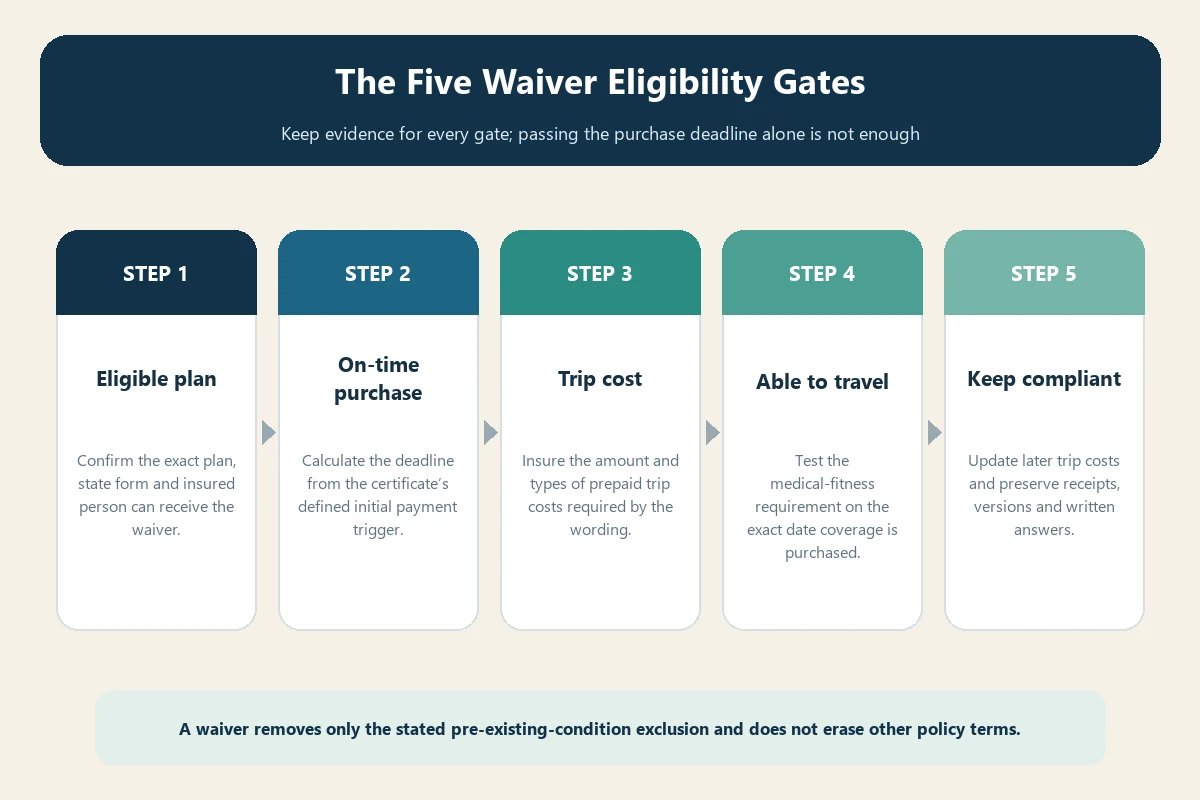
Pre existing condition waiver eligibility is controlled by the issued travel insurance certificate. Buying a plan that advertises a waiver is only the first step. The traveler may also need to meet a purchase deadline, insure the required trip cost, be medically able to travel and update later trip expenses on time.
This checklist helps U.S. travelers assemble evidence before purchase and maintain eligibility afterward. It does not guarantee coverage or determine a claim.
Use the worksheet while comparing the actual state certificates, not after selecting a plan from a short marketing description. Record the form number, edition date, purchase quote and the representative’s written answers. Those details make it possible to confirm later that every timing and cost calculation was based on the same contract version.
Key takeaways
- Confirm that the exact plan and state version offers the waiver.
- Calculate the deadline from the certificate’s defined payment trigger.
- Insure the amount required by the contract and update later costs.
- Evaluate “medically able to travel” on the purchase date.
- Remember that other exclusions, limits and benefit conditions still apply.
Reviewed August 16, 2026. Time-sensitive periods and eligibility conditions vary by insurer, plan and state.
Use five gates instead of one marketing promise
Mark each gate “pass,” “fail” or “confirm in writing”: eligible plan, timely purchase, required trip-cost insurance, medical ability to travel and continued compliance after later bookings.
The existing pre-existing-condition waiver guide explains the concept. This page turns it into an evidence checklist.
Gate 1: verify the exact plan offers a waiver
A company may sell several plans, and an annual plan can differ from its single-trip products. Availability can also change by state. Match the plan name, state of residence, form number and purchase channel.
Save the certificate, declarations page, schedule, endorsements and proof of purchase. A comparison-page badge is not a substitute for the issued contract.
Find the clause that creates the waiver
Search for “pre-existing medical condition exclusion waiver,” “existing medical condition coverage,” “time-sensitive period” and “early purchase benefit.” Record which benefits are affected.
Some waivers apply to trip cancellation, interruption and emergency medical expense. Others can be narrower. Do not infer scope from the heading alone.
Gate 2: identify the deadline trigger
The countdown can begin with an initial trip payment, first nonrefundable deposit or another defined transaction. Write down the actual trigger date and keep the receipt.
Do not substitute the date of final payment, airline purchase or insurance quote unless the certificate uses that event.
Count calendar days conservatively
If the certificate says “within 15 days,” determine whether the payment date is day zero or included in the count. Do not wait for the last possible day when the insurer can answer the timing question before purchase.
A current Travel Guard Washington sample policy defines its time-sensitive period as 15 days after initial trip payment. Its Minnesota example uses 21 days. Those documents demonstrate variation rather than a universal deadline.
Use the state-specific document
The current Travel Guard Washington sample policy requires timely purchase, medical ability to travel and coverage equal to cancellation penalties, including later arrangements.
Use the policy offered for your state and trip. Never copy the number or rule from another resident’s certificate.
Gate 3: calculate the required insured trip cost
Some waivers require all prepaid, nonrefundable costs or all cancellation penalties to be insured, subject to a stated maximum. Other products can use different wording.
Create a ledger for airfare, cruise, hotel, tour, rail, event tickets and other arrangements. Record purchase date, amount, refundable status and the date each amount becomes subject to penalty.
Refundable costs can change later
A hotel may be fully refundable when booked and nonrefundable closer to departure. A deposit can be followed by a final payment. The certificate may require an update when the cancellation penalty changes.
Ask whether zero-cost reporting is required for initially refundable arrangements and when the update clock begins.
Respect maximum insurable trip cost
A plan can cap the trip cost per traveler or per policy. Some certificates preserve the waiver if the maximum permitted amount is insured; others can use different conditions.
The policy limits guide helps separate an eligibility ceiling from the amount paid under a benefit.
Gate 4: be medically able to travel at purchase
This requirement is about the date the policy is bought, not only the scheduled departure date. A traveler who expects to recover later may not satisfy a clause requiring current medical ability.
Give the treating clinician the real itinerary and activities. Ask for an accurate clinical record rather than a vague letter prepared only for insurance.
Medical ability is not the same as no diagnosis
A person can have a chronic condition and still be medically able to travel. Conversely, a person without a final diagnosis can have symptoms or restrictions that make travel medically inappropriate.
The travel insurance with pre-existing conditions guide explains why medical history must be matched to policy wording.
Check whose medical ability matters
The requirement may apply to insured travelers rather than every family member whose illness could trigger cancellation. Do not generalize. Read the waiver’s defined subjects.
Allianz’s current explanation notes that its medical-ability requirement applies to people named in the plan. Review the Allianz eligibility explanation as one provider example.
Gate 5: update later trip arrangements
Waiver eligibility may be lost after purchase if later nonrefundable costs are not added within the stated window. Set a reminder for every new payment and change in cancellation terms.
Save the policy-change confirmation. A submitted request without an updated declaration can be difficult to prove later.
Build a one-page trip-cost ledger
| Arrangement | Payment date | Penalty today | Update due | Confirmed insured |
|---|---|---|---|---|
| Airfare | Enter date | Enter nonrefundable amount | Certificate deadline | Yes / pending |
| Hotel | Enter date | Refundable or penalty | Recheck date | Yes / pending |
| Tour or cruise | Enter date | Deposit plus schedule | Each payment deadline | Yes / pending |
Confirm residency and other plan conditions
A waiver can require U.S. residency, a trip-cost ceiling, coverage of all travelers or other conditions. The Allianz Washington brochure, for example, lists residency, timely purchase, full cost, medical ability and a per-person trip-cost limit.
Read the state-specific brochure, then verify the full policy rather than relying on the summary.
Do not confuse a waiver with a medical questionnaire
Some plans do not ask for a full medical history at purchase. That does not erase the certificate’s definitions or allow incomplete answers to any questions that are asked.
Save the exact application and responses. Correct errors promptly using the insurer’s documented process.
Other exclusions remain active
A waiver usually targets the pre-existing medical condition exclusion. Routine care, elective treatment, travel for medical care, intoxication, illegal acts, excluded activities and travel against medical advice can still apply.
Review the standard travel insurance exclusions and the medical benefit’s separate exclusions.
Planned treatment is not converted into an emergency
A valid waiver does not necessarily cover a scheduled infusion, checkup, refill or procedure abroad. Determine whether the service is an unexpected covered event and a covered expense.
The continuation-of-treatment guide helps separate planned care from recurrence and follow-up.
Check the benefit affected by the condition
A health event can produce trip cancellation, interruption, medical expense and evacuation claims. Each benefit has its own limit, trigger, documentation and effective date.
Use the medical benefits guide to identify which part of the policy would pay each expense.
Regulators expect clear disclosure
The NAIC’s 2025 market-conduct examination standard instructs examiners to determine whether consumers received information about the pre-existing-condition exclusion, whether it can be waived and under what circumstances.
Read the NAIC travel-insurance standard. It supports asking for precise documents before purchase.
Use a pass, fail or confirm worksheet
| Gate | Pass evidence | Failure or uncertainty |
|---|---|---|
| Plan | Waiver rider in correct state form | Marketing only or wrong plan |
| Timing | Receipt inside defined window | Trigger date unclear or late |
| Trip cost | Required penalties insured | Missing cost or cap question |
| Medical ability | Accurate clinical support | Restriction or unresolved advice |
| Maintenance | Later costs updated on time | Change not confirmed |
Ask the insurer these questions in writing
- Does this exact plan and state form include the waiver?
- What event starts the time-sensitive period?
- How is the final eligible purchase date calculated?
- Which prepaid costs and cancellation penalties must be insured?
- When must later arrangements or changed penalties be added?
- Who must be medically able to travel, and on what date?
- Which benefits have their pre-existing-condition exclusion waived?
- Which exclusions and limits remain unchanged?
Save an eligibility evidence packet
Keep the quote, application, payment receipt, initial deposit, trip-cost ledger, state certificate, waiver rider, declarations, later-cost confirmations and relevant medical records.
Name files by date. A chronological packet is easier to review than screenshots scattered across email and travel apps.
If one gate fails
Do not assume another plan will use the same deadline or requirements. Ask a licensed producer or insurer about products still available for the state and dates, then compare the actual certificates.
If no waiver is available, understand the look-back definition, unrelated new-condition coverage and alternative cancellation or medical financing options. Do not misstate dates to qualify.
Bottom line
Pre-existing condition waiver eligibility is a five-gate contract test. Confirm the exact plan, buy within its defined window, insure the required trip cost, be medically able to travel and maintain the coverage as new costs arise.
A waiver can be valuable, but it removes only the exclusion and benefits named in the certificate. Keep the full evidence packet and verify unclear requirements before purchase.
Waiver eligibility can depend on the amount and timing of insured trip costs. Use the travel insurance waiver full trip cost guide to classify deposits, later payments, refundable expenses, points and update deadlines.
The waiver clock may start with the first trip payment, not departure. Use the travel insurance waiver purchase deadline guide to record the plan date, later bookings and state-specific update windows.
Some waivers require the insured to be medically able to travel on the plan purchase date. The medically able to travel waiver guide separates that eligibility test from departure-day health and later claim proof.
A waiver-related claim needs more than a diagnosis. Build the pre-existing condition claim documents file with medical timelines, policy proof, trip payments, loss records and refunds.
A sudden chronic-condition flare is not automatically covered or excluded. Apply the chronic condition emergency coverage test to waiver status, the event, benefit terms, authorization and claim proof.
A waiver does not automatically authorize a flight home. Use this pre-existing-condition evacuation framework to test waiver scope, medical necessity, assistance-team approval, receiving facility, and transport fitness.
Older travelers need more than an age quote. Use these senior pre-existing-condition questions to compare look-back wording, medication changes, waiver eligibility, medical limits, and evacuation control.
A waiver dispute needs its own timeline. If a pre-existing-condition waiver was denied, separate eligibility, the medical exclusion, claim causation, requested records, reconsideration, and regulator escalation.
