
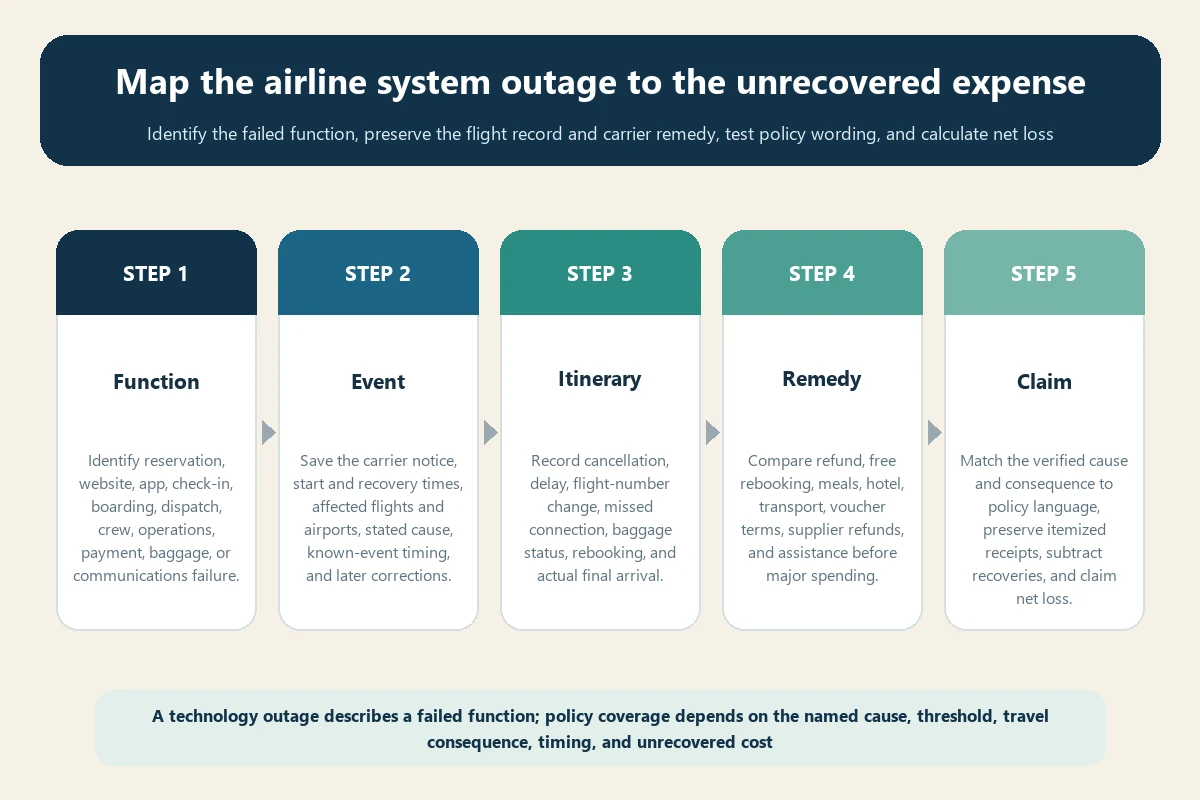
Travel insurance airline computer system outage coverage depends on the function that failed, the verified cause and timing, the flight-specific consequence, the airline’s remedy, and the traveler’s remaining expense. “The system was down” is not enough to establish a policy benefit.
A reservation website failure, airport check-in outage, dispatch interruption, crew-scheduling problem, and baggage-platform failure can affect the same trip differently. This U.S. guide explains how to build the evidence and recovery sequence. It is educational, not legal, insurance, cybersecurity, software, aviation, or safety advice.
Airline computer outage coverage at a glance
- Identify the airline function that failed and who operated it.
- Save carrier notices, timestamps, flight status, and later cause corrections.
- Distinguish inability to transact from an actual cancellation or covered delay.
- Use airline refunds, rebooking, and promised care before insurance.
- Match the cause and consequence to exact policy wording and thresholds.
- Document reasonable net loss with itemized receipts.
Reviewed August 17, 2026.
What counts as an airline computer system outage?
The phrase can describe failure of the reservation platform, website or mobile app, airport departure-control system, check-in kiosks, boarding-pass issuance, dispatch, flight planning, crew scheduling, aircraft assignment, payment processing, customer notifications, baggage tracking, or internal communications. Record the specific function rather than treating the airline as one computer.
A public website can fail while flights operate normally. Conversely, the app may appear normal while dispatch cannot release aircraft. Coverage follows the documented travel consequence, not the visibility of the outage.
Do not confuse airline IT with airport power
An airline system may fail across many airports while terminal electricity remains available. An airport blackout may disrupt several carriers even when their central systems work. A cloud or vendor incident can affect one airline function without changing the airport’s operational status.
Use the airport power outage coverage guide when the central evidence concerns utilities, terminal power, runway lighting, or airport infrastructure. This page addresses technology used by the carrier.
Identify the failed function
Ask what the airline could not do: find a booking, accept payment, issue a boarding pass, verify documents, board passengers, calculate weight and balance, dispatch the flight, assign crew, send notifications, locate baggage, or rebook disrupted travelers. Save the error message and the time it appeared.
Record whether staff used a manual process and whether passengers were told to wait, leave the line, call support, or return later. A screenshot should include the date and context, not just an isolated error code.
Verify the cause without guessing
Possible causes include internal software failure, a vendor or cloud outage, faulty update, communications disruption, hardware failure, power loss, cyber incident, security shutdown, or another event. Do not convert “technical issue” into a confirmed cyberattack, equipment breakdown, or power outage.
Preserve the first carrier notice and any corrected explanation. Insurers may apply different language to mechanical failure of a common carrier, computer-system failure, cyber event, power failure, or an event omitted from the covered-reason list.
Build a time-stamped event record
Save when the problem began, when the airline acknowledged it, the airports or flights affected, restoration milestones, and when normal processing resumed. Add the policy purchase time, trip booking date, and first nonrefundable payment. Timing matters if the outage was already public when coverage began.
Use carrier emails, app notices, social posts, airport boards, agent messages, and receipts as separate exhibits. Do not rely on a news report when the airline later publishes a more precise cause and scope.
Connect the outage to the booked flight
Keep the original itinerary and every revision. Record whether the flight was canceled, delayed, renumbered, rerouted, downgraded, or operated normally. Preserve scheduled and actual departure and arrival times, gate changes, connections, rebooking, and the carrier’s flight-specific reason.
An industry-wide incident does not prove that one traveler’s loss arose from it. A flight might be canceled for weather during the same period. The airline record should connect the system outage to the itinerary.
A failed booking is not the same as a canceled flight
If a website fails before a ticket is issued, the traveler may have a payment or reservation problem rather than an insured trip loss. Save the confirmation number, pending charge, ticket number, error message, and merchant response. Determine whether a contract and nonrefundable trip cost actually existed.
If the reservation disappears after ticketing, ask the airline to reconstruct the record and confirm ticket status. Do not buy a duplicate fare until the carrier explains whether the original ticket remains valid and assistance approves replacement spending when practical.
Protect the airline refund
The U.S. Department of Transportation states that when an airline cancels a flight and the passenger chooses not to travel or accept the offered alternative, the traveler is entitled to a refund. Its refund guidance also addresses defined significant changes and refunds for unused ancillary services.
Compare cash refund, free rebooking, a voucher, another airport, and a revised itinerary before accepting. Save restrictions and response deadlines. Insurance normally reviews the part not returned by the carrier or ticket seller.
Check the airline’s controllable-disruption commitments
A carrier-owned computer failure may be classified as controllable, but the airline’s written reason and customer-service plan matter. The DOT’s cancellation and delay dashboard displays airline commitments for rebooking, meals, hotel accommodation, and ground transport during qualifying controllable disruptions.
Save the carrier’s applicable commitment and request the benefit before paying privately. A green commitment does not settle a disputed cause, and discretionary care can differ from a legal refund.
Technology-outage passenger protections
After a major technology disruption in 2024, the DOT publicly reminded airline executives that passengers must be informed of refund rights and that airlines should make promised rebooking and care easy to obtain. The department’s technology-outage refund reminder distinguishes cash refunds from travel alternatives and carrier amenities.
Keep the airline’s response to each request. If no voucher is available and staff direct passengers to buy a reasonable meal or hotel, request written reimbursement instructions and limits.
Which insurance benefit may respond?
Trip delay may reimburse additional meals, lodging, and local transport after a stated minimum delay and for a listed reason. Missed connection may cover catch-up costs. Trip interruption may address unused arrangements and additional transport after travel begins. Trip cancellation generally requires a named reason before departure.
The benefit comparison guide helps classify the trip stage and expense. The outage’s existence does not remove the waiting period or covered-reason requirement.
Computer-system wording is not universal
Some policies expressly mention failure of airline, airport, reservation, or air traffic computer systems. Others list only weather, mechanical breakdown of the common carrier, strike, or natural disaster. Do not assume broad “technical failure” language exists. Copy the exact covered-reason and exclusion text.
If the plan names a computer-system failure, check whose system qualifies, how long the delay must last, whether the failure must affect a common carrier, and which benefit uses the definition.
Known-event timing
Coverage purchased after an outage becomes public may not protect losses arising from it. Record the carrier’s first notice, policy purchase and effective times, trip deposit date, and any warning issued before booking. A system that recovered and failed again may raise a fact-specific timing question.
Do not treat the scheduled departure date as the only cutoff. Policy language may focus on when the event became known or foreseeable.
Flight delay expenses
Ask the airline what it will provide before spending. Depending on the policy, waiting period, and covered reason, reasonable meals, modest lodging, local transport, and essential communications may qualify. Keep itemized receipts and note the delay interval each expense covers.
The trip delay reimbursement guide explains time thresholds, per-day limits, additional-expense tests, and duplicate recovery.
Missed connection and catch-up costs
Record the scheduled connection, actual arrival, boarding cutoff, protected-ticket status, airline rebooking, and cost of catching up. If the outage prevented check-in rather than delaying the inbound flight, preserve the queue, error, staff instruction, and processing-restoration time.
Use the missed connection insurance guide to test common-carrier, minimum-delay, cruise, tour, and separate-ticket requirements.
Flight changes after recovery
The airline may move the traveler to a different date, airport, routing, cabin, or flight number. Save the original and replacement itinerary, acceptance or rejection, fare treatment, and accessibility impact. A changed itinerary can create a refund right and downstream hotel or tour losses.
The flight change coverage guide organizes schedule, airport, route, cabin, and connection evidence.
Baggage-system effects
An outage can prevent bag acceptance, loading, tracking, transfer, or delivery. Save the bag tag, property irregularity report, delivery record, airline reimbursement, and receipts for necessary replacement items. Measure the baggage delay using the policy’s definition and carrier documentation.
The baggage delay and lost luggage guide explains essential purchases, ownership proof, depreciation, and airline recovery.
Do not self-cancel too early
A traveler who abandons the trip while the airline still plans to operate may not have the same refund or insurance position as a passenger whose flight is canceled. Ask for the current flight status, realistic processing plan, response deadline, and policy guidance. Follow safety directions, but do not convert frustration into an unsupported cancellation claim.
CFAR, if purchased, may offer a partial path when standard named-reason coverage does not, but deadlines and cancellation timing still apply.
Replacement flights and duplicate bookings
Before buying a new ticket, ask whether the original carrier will rebook on its own or another airline, whether the original fare will be refunded, and whether the insurer authorizes replacement cost. Document why the new option was reasonable and time-sensitive.
Cancel refundable backup bookings promptly when no longer needed. Insurance will not normally pay avoidable duplication, premium upgrades, or costs already returned.
Calculate net loss
Create a ledger with vendor, date, purpose, amount, currency, receipt, carrier request, supplier response, refund, voucher, card benefit, and balance. Separate unused prepaid arrangements from new transport and delay expenses. Report later refunds to the administrator.
The supplier refund and subrogation guide explains how overlapping recoveries affect the claim.
Airline computer outage claim checklist
- Policy certificate, schedule, purchase date, and effective time.
- Original itinerary, ticket number, receipts, and every revision.
- Carrier outage notices, error screenshots, timestamps, and cause updates.
- Flight-specific cancellation, delay, missed-connection, or baggage record.
- Refund, rebooking, meal, hotel, transport, and voucher responses.
- Supplier terms, refund requests, credits, and retained amounts.
- Itemized receipts, payment proof, approvals, and net-loss ledger.
Common mistakes
- Calling a failed website a canceled flight.
- Assuming a cyberattack without a verified source.
- Using an industry headline instead of itinerary-specific evidence.
- Ignoring airline refunds and controllable-disruption commitments.
- Buying expensive replacement travel without comparing remedies.
- Claiming gross cost instead of documented unrecovered loss.
How to file or appeal
Submit a short chronology: failed function, verified cause, outage timing, flight consequence, carrier remedy, supplier recovery, policy benefit, and net amount. Attach the corresponding evidence to each expense. The travel insurance claim guide provides a document-first format.
If denied, request the exact clause, factual finding, benefit selected, missing evidence, and appeal deadline. Correct a system-ownership or cause error with primary records. Coverage may still be unavailable when the cause is omitted, excluded, known, below threshold, or fully recovered.
Bottom line
An airline computer outage is not one event for insurance purposes. Identify the failed function, preserve the carrier’s cause and flight record, compare refunds and care, test the precise covered reason and waiting period, and claim only reasonable net expense. That sequence distinguishes an actionable delay claim from a visible technology problem that never created an insured loss.
A suspected cyberattack requires confirmation before it becomes a policy fact. Use this airline cyberattack travel insurance guide to verify the incident, preserve carrier remedies, test cyber exclusions and delay benefits, and document net loss.
