
Travel insurance airport power outage coverage depends on more than a dark terminal or a canceled flight. A claim must identify which system failed, what caused that failure, when it became known, how the booked itinerary changed, what the airline offered, and which expenses remain unpaid.
A regional grid failure, disabled runway lights, an airline computer outage, a failed baggage system, and loss of power at the traveler’s destination are not interchangeable. This U.S. guide organizes the evidence and recovery sequence. It is educational, not legal, electrical, aviation, cybersecurity, safety, or insurance advice.
Airport power outage coverage at a glance
- Locate the failure before labeling the cause.
- Preserve official airport, FAA, utility, and airline notices with timestamps.
- Obtain the carrier’s flight-specific reason and revised itinerary.
- Test the underlying event against covered reasons, exclusions, and known-event timing.
- Use airline and supplier remedies before calculating insurance loss.
- Keep itemized receipts and claim only reasonable, unrecovered expense.
Reviewed August 17, 2026.
First identify what actually lost power
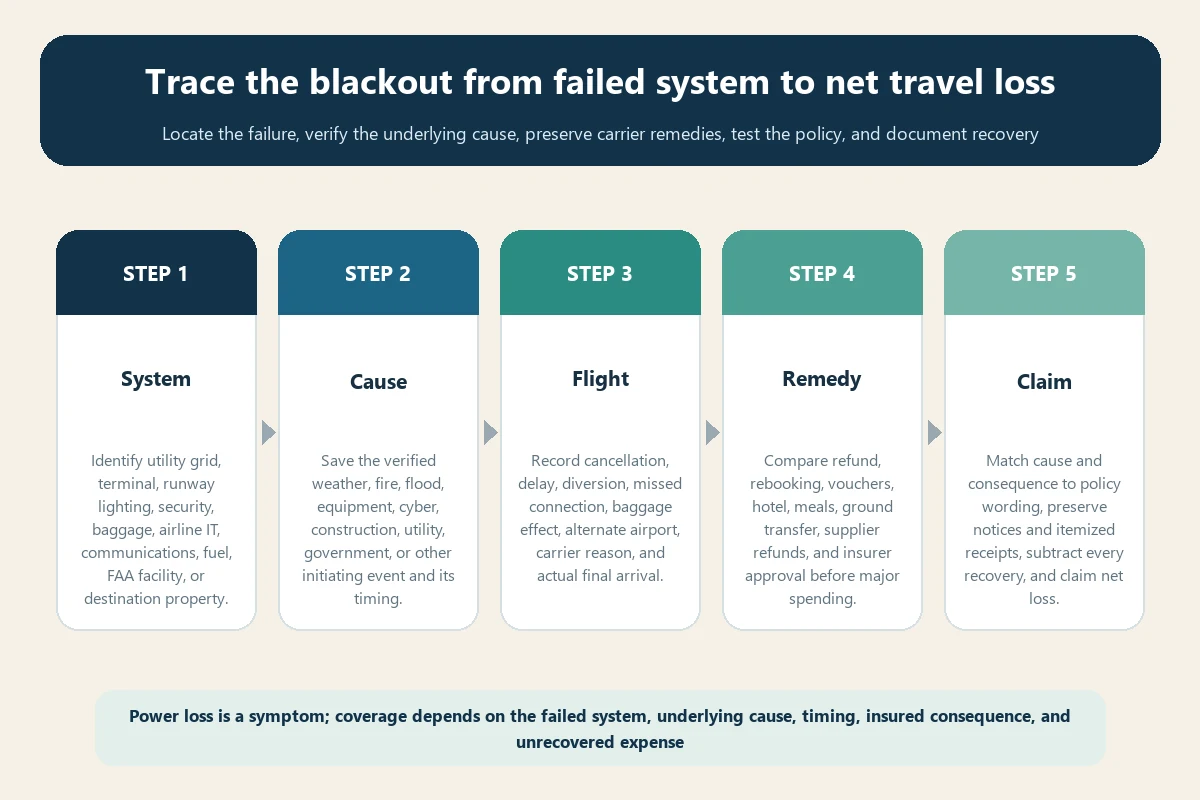
“Airport blackout” can describe a utility failure across the property, one terminal without normal power, runway or taxiway lighting problems, security-screening equipment offline, baggage conveyors stopped, fuel infrastructure unavailable, airline check-in systems down, communications interrupted, or a nearby grid problem affecting ground access and hotels.
Write down the airport code, terminal, airline, flight, affected system, start and restoration times, and whether backup power supported limited operations. Do not infer that the whole airport closed because one public area went dark.
Separate power, technology, and aviation-system outages
An airline reservation platform can fail while terminal electricity remains available. An FAA or communications facility can constrain traffic while check-in operates normally. A baggage system can stop without canceling departures. Each system has a different owner, operational record, carrier response, and potential policy description.
The FAA explains that a NOTAM states the abnormal status of a National Airspace System component, facility, service, procedure, or hazard. A relevant notice is useful evidence, but it does not prove that a travel policy covers the resulting loss.
Power outage versus airport closure
A serious outage may close an airport, but many blackouts produce partial operations, rolling delays, terminal changes, ground stops, or carrier-specific cancellations. Coverage analysis should follow the actual flight consequence rather than the most dramatic description in social media.
If the facility formally closes, use the airport closure coverage guide for official status, alternate-airport planning, and reopening evidence. This page focuses on locating the failed system and connecting it to the itinerary.
Verify the initiating cause
Power loss is usually a symptom. Possible initiating events include severe weather, wildfire, flooding, earthquake damage, utility equipment failure, construction damage, internal electrical failure, fuel interruption, cyber incident, government action, or deliberate shutdown for safety. The policy may name some causes and omit or exclude others.
Save the exact public explanation without rewriting it. “Electrical issue under investigation” is not proof of lightning, mechanical breakdown, cyberattack, or carrier fault. Update the claim file if the operator later publishes a confirmed cause.
Use official operational evidence
The FAA’s National Airspace System status summary reports major traffic programs, delay information, airport closures, and selected runway or equipment status. The page warns that its runway and equipment list is not complete, so retain relevant NOTAMs and airport notices too.
Capture timestamps because live displays refresh. Pair the operational record with airport alerts, the airline’s message, and—when relevant—the utility or emergency-management notice. Each source proves a different part of the chain.
Establish the flight-specific consequence
Save the original itinerary and every revision. Record whether the flight was canceled, delayed, diverted, moved to another terminal or airport, or operated after systems returned. Keep scheduled and actual departure and arrival times, flight numbers, boarding cutoff, rebooking, baggage treatment, and the carrier’s stated reason.
A blackout can affect passengers differently. One may leave before the failure; another may miss check-in; a third may land elsewhere. A general airport notice cannot substitute for the traveler’s flight record.
Ask the airline to classify its response
Request written confirmation of the cause and whether the airline regards the event as within its control, an airport condition, a utility failure, weather, or a National Airspace System event. Do not assume that the owner of the failed equipment automatically determines insurance coverage or passenger amenities.
The DOT’s customer-service commitments apply differently to controllable disruptions. Its cancellation and delay dashboard shows carrier commitments for disruptions within airline control. Preserve the applicable carrier page and its date, while recognizing that a disputed cause may require clarification.
Protect the ticket refund before claiming insurance
For flights to, from, or within the United States, the DOT states that a passenger is entitled to a refund when the airline cancels the flight and the traveler declines the alternative. Its refund guidance also covers defined significant changes and unused ancillary services in applicable circumstances.
Compare cash refund, rebooking, voucher, alternate airport, and new connection options before accepting. Record the deadline and restrictions. Insurance ordinarily measures the remaining loss, not the part the carrier must return.
Match the loss to the correct policy benefit
Trip delay may reimburse extra meals, lodging, and local transport after a stated waiting period and for a listed reason. Missed connection can help catch up to an itinerary. Trip interruption may address unused arrangements and additional transport once travel has begun. Trip cancellation generally applies before departure when a covered reason prevents the trip.
Use the delay, interruption, and cancellation comparison to classify each expense. A single blackout can touch multiple benefits, but no receipt should be duplicated.
Weather-caused outages
If a storm damaged utility service or airport equipment, document both the weather and the resulting operational effect. Policy wording may require a carrier delay of a minimum duration, cessation of common-carrier service, an uninhabitable destination, or another specific threshold. A neighborhood losing electricity does not automatically satisfy those terms.
The weather delay coverage guide explains waiting periods, named causes, airline evidence, and known-event timing.
Internal equipment and utility failures
A standalone equipment failure may or may not appear in the covered-reason list. Look for language addressing mechanical breakdown of the common carrier, airport facility failure, common-carrier delay, natural disaster, or other specified hazards. Do not stretch “mechanical breakdown” to unrelated infrastructure without textual support.
If the utility and airport provide different accounts, retain both. The claim administrator can request clarification; the traveler should not resolve an engineering question by speculation.
Airline technology outages
A carrier-wide booking, dispatch, crew, or check-in outage can resemble an airport blackout while other airlines operate. Save screenshots from the carrier, airport departure board, and itinerary. Record whether the airline canceled, could not issue a boarding pass, lost the reservation, or rebooked under a new flight number.
Use the flight change coverage guide when the outage produces a revised date, airport, route, cabin, or connection rather than a simple delay.
FAA or air traffic system failures
If power affects an FAA facility, navigation aid, tower, or communications system, the airport may remain open while traffic is restricted. Collect the relevant NOTAM, traffic advisory, airline reason, and actual delay. Do not label every such event an airport closure.
The air traffic control delay coverage guide distinguishes NAS evidence, airline remedies, policy triggers, and minimum delay thresholds.
When the aircraft diverts
A destination outage may prevent a safe arrival or normal terminal handling, causing the flight to land elsewhere. Record the captain or airline explanation, alternate airport, deplaning time, baggage release, onward ground or air transport, and final arrival. Ask whether the carrier will transport passengers to the ticketed destination.
The flight diversion coverage workflow shows how to separate the diversion itself from additional, unrecovered costs.
Missed connections and separate tickets
Preserve the scheduled connection, actual arrival, gate distance, boarding cutoff, and rebooking response. A protected through-ticket often receives different carrier handling from separate tickets. If power loss prevented security screening or baggage acceptance, document the queue, official restriction, and when processing resumed.
Use the missed connection insurance guide to test covered causes, minimum delays, cruise or tour catch-up, and separate-ticket problems.
Medical devices, accessibility, and safe lodging
Travelers who rely on powered mobility equipment, refrigerated medication, oxygen equipment, or communication aids should notify airport and airline personnel promptly and follow medical guidance. Do not delay urgent care while seeking claim approval. Record requested assistance, equipment condition, safe storage, and any provider instructions.
If a terminal evacuation or prolonged outage makes waiting unsafe, ask the airline and assistance administrator about accessible lodging and transport. Insurance review occurs after immediate safety needs.
Expenses that may require documentation
Depending on benefit wording and thresholds, a claim may involve reasonable meals, modest lodging, airport-hotel transport, essential communication, replacement transport, or unused prepaid arrangements. Ask what the carrier provides before spending and obtain insurer approval for a major replacement ticket when practical.
Keep itemized receipts. A bank statement proves payment but may not identify the item, traveler, date, or business purpose. Note why each expense was necessary and which cheaper safe alternatives were unavailable.
Destination-property blackouts are a different claim
Power failure at a hotel or rental property is not an airport outage. Ask whether the property is open, habitable under the policy definition, providing alternative accommodation, or refunding the stay. Preserve the property’s written response and local authority notices.
Do not cancel an operating flight solely because a destination has scattered outages unless the policy, supplier, or safety authority supports the decision. CFAR, if purchased and timely used, follows separate rules.
Calculate the unrecovered amount
Build a ledger with the vendor, date, purpose, currency, paid amount, receipt, airline or supplier request, refund, voucher, card benefit, and balance. Keep new delay expenses separate from unused prepaid costs and replacement transport. Report later refunds to the claim administrator.
The supplier refunds and subrogation guide explains why recovery after payment can change the final claim.
Airport outage claim checklist
- Policy certificate, schedule, purchase date, and effective date.
- Original itinerary, ticket receipts, and every revised itinerary.
- Airport, FAA, airline, utility, and emergency notices with timestamps.
- Flight-specific cancellation, delay, diversion, or missed-connection reason.
- Carrier refund, rebooking, voucher, hotel, meal, and ground-transport response.
- Supplier terms, refund requests, credits, and retained amounts.
- Itemized receipts, payment proof, expense ledger, and insurer approvals.
Common mistakes
- Calling an airline IT failure an airport electrical outage.
- Treating power loss as the covered cause without finding the initiating event.
- Using a general news report instead of flight-specific evidence.
- Buying replacement travel before comparing carrier remedies.
- Ignoring the policy’s waiting period or known-event clause.
- Claiming gross expenses without subtracting refunds and vouchers.
How to file and appeal
Submit a concise chronology: failed system, verified cause, outage time, flight consequence, airline remedy, supplier recovery, policy benefit, and net amount. Attach evidence by line item. The claim filing guide provides a document-first structure.
If denied, request the exact clause, factual finding, selected benefit, missing proof, and appeal deadline. Correct a mistaken outage classification with primary evidence. A denial may still be consistent with the contract if the cause is omitted, excluded, known, below the waiting period, or fully recovered elsewhere.
Bottom line
An airport blackout is the beginning of the analysis, not the answer. Locate the failed system, verify the initiating cause and timing, connect it to the booked flight, preserve airline refunds and care, test the correct policy benefit, and claim only documented net loss. That evidence chain is stronger than treating every dark terminal as the same insured event.
An airline technology failure needs a carrier-system record, not an airport-power assumption. Use this airline computer outage travel insurance guide to identify the failed function, preserve airline remedies, test policy wording, and document net loss.
A suspected cyberattack requires confirmation before it becomes a policy fact. Use this airline cyberattack travel insurance guide to verify the incident, preserve carrier remedies, test cyber exclusions and delay benefits, and document net loss.
