
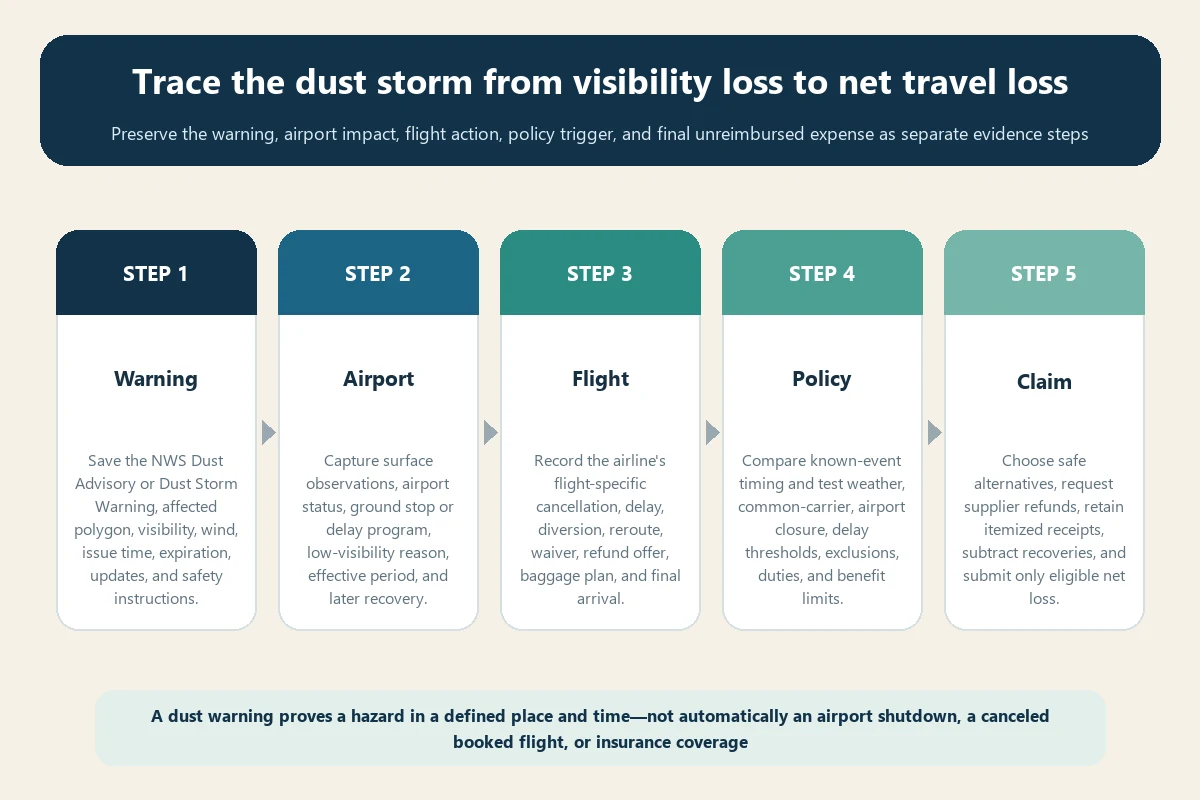
Travel insurance dust storm flight cancellation coverage usually turns on the operational consequence of reduced visibility, not the dramatic appearance of the storm. A National Weather Service warning can establish a hazard, but the claim still needs the airline’s action, applicable policy wording, purchase timing, and a documented expense that remains after refunds.
Dust storms and haboobs can arrive quickly, especially in the U.S. Southwest. They may stop airport arrivals, trigger an FAA ground stop, divert one flight, disrupt road access, or pass before the booked departure. This guide explains how U.S. travelers can separate those outcomes and build a professional claim record. It is educational, not meteorological, aviation, emergency, legal, medical, or insurance advice.
Dust storm cancellation coverage at a glance
- Follow official safety directions and never drive into near-zero visibility.
- Save the NWS warning, location, visibility, wind, and effective time.
- Preserve FAA or airport traffic actions and the airline’s flight-specific reason.
- Compare the first forecast or warning with policy purchase and effective times.
- Use airline rebooking or refunds before calculating an insurance loss.
- Match each remaining expense to the correct benefit and receipt.
Reviewed August 17, 2026.
What counts as a dust storm or haboob?
The National Weather Service explains in its dust storm and haboob safety guidance that strong winds can lift loose soil and drastically reduce visibility. A haboob is commonly produced by thunderstorm outflow. These events can occur anywhere in the United States but are most common in the Southwest.
Insurance documents may not use the word “haboob.” They may classify the event under weather, severe weather, natural disaster, common-carrier disruption, or an airport-related covered reason. Search the definitions as well as the list of covered events.
A weather warning is not a flight cancellation
An NWS Dust Advisory means potentially dangerous blowing dust is occurring or imminent and travelers should be prepared to delay or reroute. A Dust Storm Warning signals a more urgent threat and can involve visibility falling close to zero. The exact local criteria can vary, so preserve the actual bulletin rather than quoting a generic threshold.
The bulletin proves conditions within its polygon and time window. It does not prove that an airport inside or near that polygon stopped operating, that a particular route crossed the hazard, or that the airline canceled the booked flight. The claim needs a bridge between the warning and the itinerary.
Save the complete NWS bulletin
Capture the issuing forecast office, product type, issue and expiration times, affected counties or coordinates, motion, visibility, wind, source, impact statement, and updates. Keep the URL and an original screenshot or PDF. If the warning changes to an advisory or expires, preserve that update too.
Do not crop away the map legend, timezone, or timestamp. A social-media image without those fields can be hard to connect to the airport. If road access is affected, save the transportation or emergency-management closure notice separately; do not assume an aviation warning proves a highway closure.
Prove the airport or air-traffic action
Dust can reduce runway and approach visibility, but airport effects vary. Look for an FAA ground stop, ground delay program, arrival-rate reduction, airport closure, carrier station alert, or diversion record. Preserve the control element, impacting condition, start and end time, expected delays, extension notices, and recovery message.
A useful real-world example is an FAA Air Traffic Control System Command Center advisory for Phoenix that identified weather and low visibility, with “dust storm over the airport” as the ground-stop condition. Such an advisory is strong operational evidence, but it still must overlap the booked flight.
Our air traffic control delay coverage guide explains how to read ground stops and delay programs without treating every advisory as a complete airport closure.
Get the flight-specific reason from the airline
Save the original itinerary, confirmation, ticket number, flight number, scheduled times, boarding pass, app alerts, email, text messages, and airport display. Ask the airline whether the disruption was caused by low visibility, a dust storm, an FAA traffic restriction, airport conditions, aircraft positioning, crew displacement, or a wider network decision.
The final reason can differ from the first alert. A flight initially held for weather may later cancel because the aircraft or crew never arrived. Preserve both explanations. Record whether the carrier offered a same-day reroute, a later departure, an alternate airport, a waiver, a voucher, or a cash refund.
Airline remedies come before net-loss insurance
The U.S. Department of Transportation’s current airline refund guidance says a passenger is entitled to a refund if the airline cancels the flight and the passenger does not accept alternative transportation or other compensation. That rule applies regardless of why the airline canceled.
Ask the airline or merchant of record for the remedy first. If airfare is returned, it is not also an insurance loss. If the traveler accepts a safe reroute, the remaining issue may be eligible delay costs, a missed connection, or unused prepaid arrangements—subject to policy terms. Review our benefit-type comparison before filing.
Known-event timing can decide the claim
Build a timestamped timeline: trip deposit, each later nonrefundable payment, policy purchase, coverage effective time, first relevant forecast, NWS advisory or warning, FAA traffic action, airline notice, and actual departure or cancellation. Use the timezone shown by each source.
A policy purchased after the dust storm was forecast, warned, or already disrupting the airport may not cover that event. The contract’s foreseeable or known-event language controls; there is no universal number of hours that makes a storm unforeseen. See when to buy travel insurance for a purchase-timing checklist.
Read weather and common-carrier wording together
Search the policy for weather, inclement weather, severe weather, natural disaster, common carrier, airport closure, air traffic control, cessation of service, destination inaccessible, and evacuation. Then read definitions, exclusions, benefit schedules, waiting periods, and maximums.
Questions to answer include:
- Must the carrier cancel, or is a qualifying delay enough?
- How many consecutive hours must the delay last?
- Does cancellation require a complete cessation of service?
- Must the airport be closed, or can an ATC restriction qualify?
- Are road closures relevant only when the destination is inaccessible?
- What expenses require prior authorization or original receipts?
The broader weather delay coverage guide explains standard thresholds; this dust-storm guide supplies the hazard-specific evidence chain.
Choose the benefit that matches the sequence
Trip cancellation may apply when a covered event forces the insured to abandon the trip before departure. Trip delay can reimburse limited necessary expenses during a qualifying wait. Missed connection addresses a late arrival that breaks a scheduled onward connection. Trip interruption may apply after departure when a covered event changes or ends the trip.
A ground stop that lasts two hours is not automatically a cancellation. A flight that departs and lands elsewhere is a diversion. A traveler already at the destination when roads close may have an interruption or delay issue. Use our trip delay reimbursement guide to calculate permitted meals, lodging, and local transportation.
Handle missed connections and diversions correctly
If the dust storm delays the first segment, preserve its actual gate-departure and arrival times, the minimum connection, the missed onward flight, and the carrier’s reaccommodation. The missed connection insurance guide explains scheduled-connection requirements and evidence.
If the aircraft diverts, record the diversion airport, reason, landing time, time allowed to deplane, ground transport, baggage status, and final arrival. Do not label it a cancellation unless the airline actually cancels the remaining service. See flight diversion coverage for that workflow.
Do not drive into the dust to save the itinerary
NWS safety guidance warns that dust can cause a sudden, dangerous loss of roadway visibility. Follow official instructions. If dense dust is approaching, avoid entering it. A traveler should not attempt an unsafe drive to another airport merely because a replacement ticket is available.
If an alternate airport is proposed, confirm that the route is open, the warning area and motion do not threaten the drive, the airline will honor the change, and lodging or ground transportation is available. Contact the insurer’s assistance service before a major replacement purchase when conditions and time permit. Preserve the case number and advice.
Build a layered evidence packet
- Weather: NWS product, map, visibility, wind, polygon, issue time, expiration, and updates.
- Operations: FAA advisory, airport status, ground stop or delay program, and recovery time.
- Flight: itinerary, carrier reason, cancellation or delay notice, waiver, rebooking, and final arrival.
- Coverage: policy, schedule, purchase receipt, effective time, covered reason, threshold, and exclusion.
- Loss: supplier terms, refund request, response, itemized receipts, credits, and remaining amount.
Write a short chronology that cites each exhibit. Explain where the warning applied, how airport operations changed, what happened to the booked flight, what safe alternative was accepted or rejected, and how the final loss was calculated.
Calculate the net claim
Use a ledger with the supplier, original charge, service date, amount, currency, refund eligibility, refund received, voucher, card credit, replacement purchase, and net amount claimed. Keep airfare, lodging, meals, transport, and missed prepaid activities on separate rows.
Do not seek reimbursement twice. An airline refund, hotel refund, card benefit, or later supplier credit reduces the same loss. Our guide to supplier refunds and insurance recovery explains coordination and later adjustments.
Common dust storm claim mistakes
- Submitting a photograph of a dust wall without a location or timestamp.
- Assuming a highway warning proves the airport shut down.
- Using an FAA advisory that did not overlap the flight’s airport or time.
- Canceling voluntarily before confirming the airline’s operating plan.
- Ignoring the policy’s known-event rule or delay waiting period.
- Calling a short ground stop a full trip cancellation.
- Claiming costs already refunded, credited, or supplied by the airline.
- Taking an unsafe reroute or buying a premium replacement without documentation.
File and follow the claim
Notify the insurer within the required period and choose the benefit matching the actual sequence. Submit the certificate, purchase proof, timeline, itinerary, NWS warning, FAA or airport record, carrier explanation, supplier responses, receipts, and net-loss ledger. Keep the complete submission and claim number.
If the examiner requests more evidence, respond to the specific question. If the claim is denied, request the exact policy clause and factual basis, then compare them with the timeline. The step-by-step travel insurance claim guide can organize the package.
Bottom line
A dust storm can support travel insurance benefits when it causes the covered operational event described by the policy. Build the case in order: preserve the official visibility warning, establish the airport and flight consequence, confirm purchase timing and thresholds, use safe airline and supplier remedies, and claim only the documented loss that remains.
Dense fog needs a runway-visibility and flight-specific evidence chain. Use this fog flight cancellation travel insurance guide to distinguish an advisory from an operational shutdown, preserve airline remedies, test policy thresholds, and claim net loss.
