
Travel insurance airline cyberattack coverage depends on a verified incident, the affected system, policy definitions and exclusions, the flight-specific consequence, carrier remedies, and unrecovered expense. A slow app, error message, or social-media rumor does not prove a cyberattack.
A malicious intrusion can disrupt reservations, check-in, dispatch, baggage, payments, or a third-party vendor. It can also expose personal data without delaying a flight. This U.S. guide separates those problems and builds a document-first claim workflow. It is educational, not legal, cybersecurity, identity-theft, aviation, safety, or insurance advice.
Airline cyberattack coverage at a glance
- Wait for a credible carrier or authority statement before asserting attribution.
- Identify the affected airline, airport, vendor, or aviation function.
- Connect the incident to the booked flight with itinerary-specific evidence.
- Preserve airline refunds, rebooking, and promised care before insurance.
- Read cyber event, cyber terrorism, malicious act, war, and government-action language.
- Separate travel disruption expenses from data-theft or fraud losses.
Reviewed August 17, 2026.
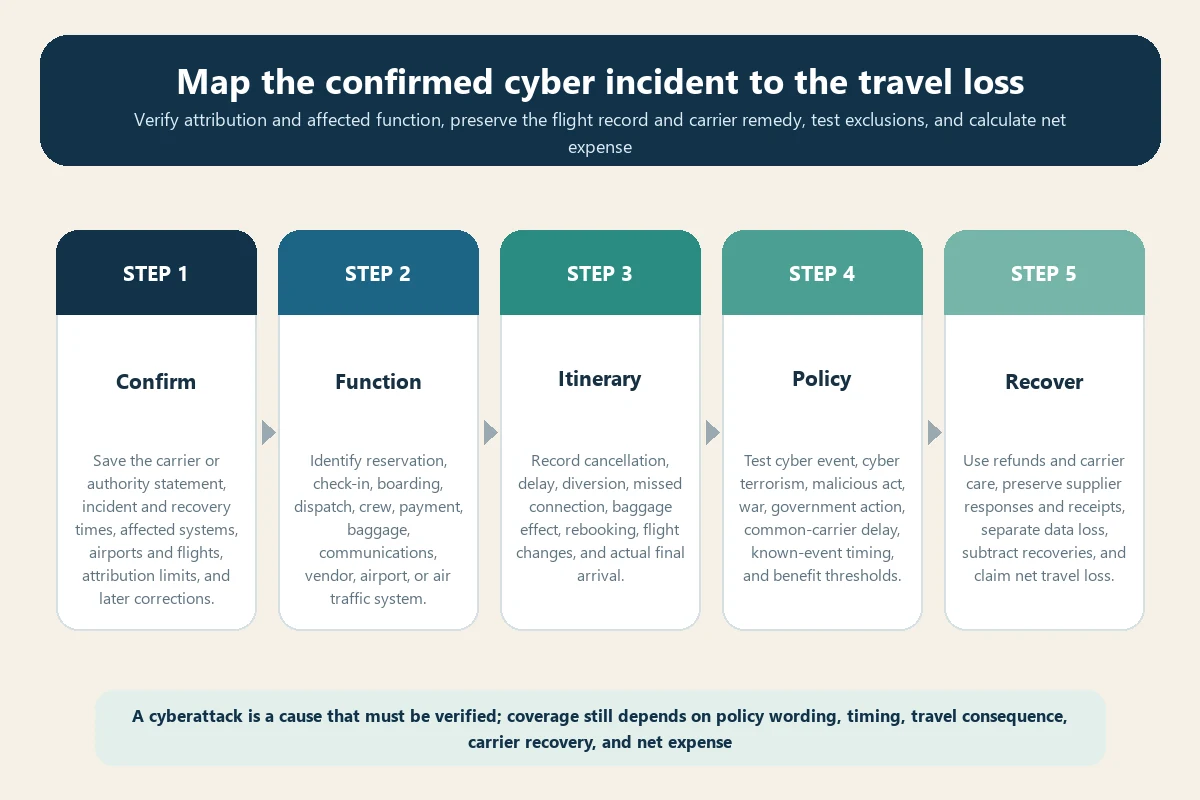
Do not label every outage a cyberattack
Airline systems fail because of faulty updates, vendor outages, internal software defects, hardware, communications, power, human error, security containment, and malicious activity. Early notices often say only “technology issue” while responders investigate. Preserve that wording rather than replacing uncertainty with a dramatic cause.
If the carrier later confirms unauthorized access, ransomware, denial-of-service activity, or another cyber incident, add the statement to the record. If attribution remains unconfirmed, the claim should say so.
Cyberattack versus ordinary computer outage
A computer outage describes a failed function; a cyberattack describes a suspected or confirmed cause. The distinction matters because some policies cover specified computer-system failure but exclude cyber events, cyber terrorism, malicious acts, or certain government responses.
Use the airline computer system outage guide when the operational failure is verified but malicious activity is not. This page addresses the additional attribution and exclusion questions raised by a confirmed or credibly reported cyber incident.
Identify whose system was attacked
The affected system may belong to the airline, airport, ground handler, reservation vendor, cloud provider, payment processor, baggage platform, fuel vendor, communications provider, or aviation authority. One incident can cascade across several organizations. Record the owner and failed function separately.
An attack on an airport shared-use check-in platform may affect multiple carriers. An airline reservation incident can follow passengers across airports. A vendor incident may be acknowledged by both the vendor and the carrier. Preserve each source.
Build the incident evidence file
Save the first carrier alert, later status updates, confirmed cause statement, incident start, containment and restoration times, affected systems, airports and flights, and any correction. Add screenshots from the app, website, airport board, email, text, and agent chat with timestamps.
Do not seek confidential technical details or interfere with response systems. Public operational evidence and the carrier’s flight record are normally more relevant to a traveler’s claim than speculation about the attacker.
Map the incident to the booked itinerary
Keep the original itinerary and every revision. Record whether the flight was canceled, delayed, diverted, renumbered, rerouted, or operated normally. Save scheduled and actual times, missed connections, baggage status, rebooking, and the flight-specific reason supplied by the carrier.
A widely reported cyber event does not prove that one flight was affected by it. Weather, crew, aircraft, or airport conditions can cause a concurrent disruption. Ask the airline to connect its reason to the itinerary.
Protect the airline refund first
The U.S. Department of Transportation states that a passenger is entitled to a refund when the airline cancels a flight and the traveler declines the alternative. Its refund guidance also explains defined significant changes, alternative flight offers, and refunds for applicable unused ancillary services.
The refund rule does not turn on whether the initiating event was malicious. Compare cash refund, free rebooking, voucher, route change, and alternate airport options. Insurance normally measures loss after the carrier or ticket seller returns what it owes.
Technology disruption and passenger rights
Following a large technology disruption, the DOT reminded airlines to notify passengers of refund rights and provide cash refunds when owed. Its technology-outage passenger notice also addresses promised rebooking, meals, hotels, and transport during airline-controlled problems.
A cyber incident may create debate about control or fault, but the traveler should still request the carrier’s written classification and available care. Refund rights and discretionary or committed amenities are separate questions.
Check airline care commitments
The DOT’s airline cancellation and delay dashboard shows commitments for qualifying controllable disruptions. Save the applicable carrier page and ask for rebooking, meals, lodging, and ground transport before paying privately.
Do not assume every cyberattack is controllable or uncontrollable. The carrier’s cause classification and customer-service plan matter, and an insurer may use different contract language.
Test the exact cyber wording
Search the certificate for cyber event, cyber incident, cyberattack, computer system, information system, malicious code, unauthorized access, denial of service, cyber terrorism, terrorism, sabotage, war, government action, and common carrier. Copy definitions, covered reasons, exclusions, exceptions, and endorsements.
A policy can exclude cyber loss broadly, restore limited travel-delay coverage, or never mention cyber at all. Do not import wording from another plan or a marketing page.
Cyber terrorism and ordinary cybercrime are not synonyms
Policy definitions may require motive, coercion, political purpose, certification, or another element before an act qualifies as terrorism or cyber terrorism. A criminal ransomware demand, hacktivist campaign, state-linked operation, and unknown intrusion should not be classified by the traveler without evidence.
If the administrator invokes an exclusion, request the definition and factual basis used. Attribution reported in the media may remain preliminary.
War and government-action exclusions
A cyber incident connected to armed conflict or state activity can raise war, hostile act, military action, sanctions, or government-response exclusions. The carrier may also suspend systems or flights under an official security directive. Preserve who ordered what, when, and why.
Use the flight cancellation due to war guide when the verified disruption is primarily a conflict cancellation rather than a standalone cyber event.
Known-event timing
Record the first public alert, policy purchase and effective times, trip booking, and each nonrefundable payment. Coverage bought after a public outage, security notice, or continuing incident may not protect related losses. A restored system that is attacked again can require a fact-specific timeline.
Do not use the flight date as the only cutoff. Known-event language usually examines when the event or threat became known relative to purchase.
Which travel benefit may respond?
Trip delay may reimburse additional meals, lodging, and local transport after a minimum waiting period and for a listed cause. Missed connection may cover catch-up costs. Trip interruption may address unused arrangements and additional transport after departure. Trip cancellation generally requires a covered reason before travel begins.
The benefit comparison guide helps assign each loss to the proper trip stage. Even when cyber failure is named, time and expense limits remain.
Delay expenses during system recovery
Ask what the carrier is providing before spending. Keep itemized receipts for reasonable meals, modest lodging, local transport, and essential communications. Record the delay interval and why an expense was necessary. A card statement alone may not identify the item or traveler.
Use the canonical trip delay reimbursement guide for waiting periods, daily caps, additional-expense tests, and duplicate recovery.
Missed connections and catch-up travel
Save the scheduled connection, actual arrival, boarding cutoff, protected-ticket status, carrier rebooking, and replacement cost. If the attack disabled check-in or boarding rather than delaying an inbound flight, preserve the error, queue, staff direction, and processing-restoration time.
The missed connection guide explains minimum delays, common-carrier requirements, cruises, tours, and separate tickets.
When the flight changes or diverts
Containment can move passengers to another date, airport, route, or flight number. Save the original and replacement itinerary, acceptance or rejection, baggage plan, and final arrival. If the aircraft lands elsewhere because systems at the destination are unavailable, document carrier transport onward.
Use the flight change coverage guide for revised itinerary evidence and the diversion guide for alternate landing and onward expense.
Personal data exposure is a separate problem
An incident may expose passport, loyalty, payment, contact, or travel information without disrupting the flight. Standard trip delay or cancellation benefits do not automatically reimburse identity monitoring, stolen funds, account recovery, device repair, or business cyber loss. Review any identity-theft, personal cyber, card, bank, or homeowner coverage separately.
Use official breach instructions, change compromised credentials, contact the financial institution, and preserve reports. Do not upload unredacted identity documents into an ordinary claim portal unless requested through a secure channel.
Fraud after a public incident
Attackers may send fake refund, rebooking, or credential-reset messages. Navigate through the airline’s known app or manually entered official address rather than an unexpected link. Verify payment requests and never disclose a one-time code to an unsolicited caller.
A fraudulent charge and a travel-delay receipt belong in different recovery files. Mixing them can obscure the insurance claim and banking dispute.
Replacement tickets and self-help
Before buying another flight, ask whether the airline will rebook on its own or another carrier, whether the original fare is refundable, and whether the insurer authorizes replacement cost. Preserve the quoted options and why the chosen route was reasonable and time-sensitive.
Cancel refundable backups when no longer needed. Premium upgrades, speculative bookings, and duplicated transport may not qualify.
Calculate net travel loss
Create a ledger with vendor, date, purpose, currency, paid amount, receipt, airline request, supplier response, refund, voucher, card benefit, and balance. Separate unused prepaid arrangements from delay expenses and replacement transport. Keep fraud or identity loss in a separate ledger.
The supplier refund and subrogation guide explains how later recovery changes the final amount.
Airline cyberattack claim checklist
- Policy certificate, schedule, purchase date, and effective time.
- Original itinerary, ticket receipts, and every revision.
- Carrier or authority confirmation, incident updates, and timestamps.
- Flight-specific cancellation, delay, diversion, or connection record.
- Refund, rebooking, meal, hotel, transport, and voucher responses.
- Supplier terms, refund requests, credits, and retained amounts.
- Itemized receipts, approvals, payment proof, and net-loss ledger.
Common mistakes
- Calling an unconfirmed technical failure a cyberattack.
- Using a global headline instead of flight-specific evidence.
- Ignoring cyber, terrorism, war, or government-action exclusions.
- Self-canceling while the airline still plans to operate.
- Buying replacement travel before comparing carrier remedies.
- Combining identity theft with the travel expense claim.
How to file and appeal
Submit a concise chronology: verified incident, affected function, outage timing, flight consequence, carrier remedy, supplier recovery, policy benefit, and net amount. Attach evidence by expense. The claim filing guide provides a document-first structure.
If denied, request the exact clause, factual finding, attribution basis, selected benefit, missing proof, and appeal deadline. Correct an unsupported cyber or terrorism classification with primary records. Coverage may still be unavailable if the cause is omitted, excluded, known, below threshold, or fully recovered.
Bottom line
An airline cyberattack must be verified before it becomes a coverage fact. Identify the affected system, connect the incident to the flight, preserve carrier refunds and care, test cyber-related wording and timing, separate personal-data harm, and claim only reasonable net travel expense. That sequence avoids turning an alarming headline into an unsupported insurance claim.
