
Travel insurance airport security incident coverage depends on what authorities ordered, which airport area was affected, how the booked flight changed, what the airline offered, and whether the policy names or excludes the verified cause. A slow checkpoint line is not automatically a covered security event.
A terminal evacuation, screening shutdown, airfield restriction, false alarm, credible threat, and passenger arriving too late for a normal queue require different evidence. This U.S. guide explains the recovery workflow without speculating about sensitive operations. It is educational, not legal, security, aviation, emergency, terrorism, or insurance advice.
Airport security incident coverage at a glance
- Follow official safety and evacuation instructions before handling the claim.
- Record the issuing authority, affected zone, start time, and reopening time.
- Distinguish a routine queue from an official checkpoint stop, evacuation, or closure.
- Obtain the airline’s flight-specific cancellation, delay, or missed-departure reason.
- Test security, terrorism, government-action, civil-disorder, and airport-closure wording.
- Preserve airline and supplier recovery and claim only documented net loss.
Reviewed August 17, 2026.
What counts as an airport security incident?
Relevant events can include an official terminal evacuation, checkpoint closure, shelter instruction, access restriction, security breach, law-enforcement operation, airfield closure, or carrier cancellation tied to a confirmed security action. Record what officials required, not the rumor that circulated while the response unfolded.
The event may affect one checkpoint, concourse, terminal, runway area, or the whole airport. Scope determines whether the traveler could use another checkpoint or terminal and whether the flight continued.
A routine security queue is different
Long screening lines, staffing congestion, ordinary re-screening, and arriving without enough processing time are commonly treated as passenger timing problems unless the policy expressly provides otherwise. Save the airline’s check-in and boarding deadlines, airport arrival time, queue evidence, and any official processing interruption.
If the checkpoint remained open and the flight operated, a missed flight may be analyzed as missed departure rather than a security incident. The missed departure coverage guide explains arrival evidence, transport delay, carrier cutoff, and self-caused lateness.
Safety instructions come before insurance
Leave, shelter, move, or remain in place as directed by airport, airline, screening, emergency, and law-enforcement personnel. Do not return to a restricted area to collect receipts, baggage, or a vehicle. Do not photograph sensitive response activity when prohibited.
Once safe, write a timeline from memory and save public notices. Immediate compliance is more important than obtaining perfect documentation in real time.
Verify the official action
Record the airport code, terminal or zone, instruction, issuing authority, effective time, duration, reopening, and exceptions. Save airport and airline alerts, public authority statements, and the flight board. A screenshot should show the source and time.
The FAA explains that a NOTAM communicates abnormal National Airspace System status involving a facility, service, procedure, or hazard. A relevant notice can document an operational restriction, but it does not by itself establish insurance coverage.
FAA guidance on restrictive-use NOTAMs says an airport closure or access restriction should be tied to a safety condition and limited in duration. For a claim file, preserve the actual notice and its scope rather than assuming every public-area disruption closed the airfield.
Preserve uncertainty about the cause
Early reports may describe an unattended item, suspicious activity, breach, threat, investigation, or precaution. The event may later be cleared as a false alarm. Do not upgrade a precaution into a confirmed attack or terrorism determination.
Keep the initial notice and later correction. The policy analysis can change if the confirmed event is ordinary criminal activity, terrorism as defined, civil disorder, government action, or a safety response with no named cause.
Terminal closure versus airport closure
A terminal can be evacuated while other terminals and runways remain open. An airport can also close to all operations. Record whether passengers were bused, walked, re-screened, moved to another terminal, or prevented from reaching the airfield.
Use the airport closure coverage guide when the facility formally closes. This page focuses on the security action and its effect even when some airport operations continue.
Connect the incident to the booked flight
Save the original itinerary and every revision. Record whether the airline canceled, delayed, diverted, changed terminal, held boarding, re-screened passengers, or operated normally. Keep scheduled and actual times, boarding cutoff, baggage status, rebooking, and final arrival.
A security event at the airport does not prove that one flight was affected by it. Ask the carrier for the flight-specific reason rather than relying on a general news report.
Protect airline refund rights
The U.S. Department of Transportation states that a passenger is entitled to a refund when the airline cancels a flight and the traveler declines the offered alternative. Its refund guidance also explains defined significant changes, rebooking offers, and applicable unused ancillary services.
Refund treatment for a canceled flight is separate from responsibility for the security event. Compare cash refund, free rebooking, voucher, alternate airport, and revised itinerary before accepting. Insurance normally reviews what remains unrecovered.
Airline care may depend on cause classification
Meals, hotel, and local transport during a disruption can depend on the carrier’s customer-service plan and whether it classifies the cause as within its control. A security action by an authority may not be treated the same as an airline operational failure.
Ask the airline what it will provide before spending and save the response. Refund rights, carrier commitments, discretionary assistance, and insurance benefits are four separate layers.
Test the exact policy language
Search for security event, airport closure, common-carrier delay, terrorism, civil disorder, riot, malicious act, sabotage, government action, evacuation, travel advisory, inaccessible destination, and missed departure. Copy the definitions, covered reasons, exclusions, exceptions, waiting periods, and endorsements.
Do not assume that a general “travel disruption” label appears in the certificate. Some plans require full airport closure, a minimum common-carrier delay, or an event within a defined distance of the destination.
Terrorism coverage is definition-driven
A credible threat, precautionary evacuation, crime, and act of terrorism are not synonyms. Policies can require an official designation, occurrence within a specified location and time, or absence of prior terrorism at the destination. War and military-action exclusions may apply separately.
If an administrator invokes terrorism or war wording, request the definition and factual basis. Preserve the authority’s public classification without adding motive or attribution.
Government-action exclusions and exceptions
A checkpoint closure, access order, evacuation, or airfield restriction can involve government action. Some policies exclude government regulation broadly; others cover a specified airport closure or terrorism event. The more specific provision may still contain conditions.
Record who ordered the restriction, its scope, and when it ended. A carrier voluntarily changing its schedule is not necessarily the same as an official closure.
Known-event timing
Save the first public warning, incident time, policy purchase and effective times, trip booking, and each nonrefundable payment. Insurance purchased after a known threat, closure, or continuing incident may not protect related loss.
A general heightened alert is not automatically the same as the specific event, but policy foreseeability language can be broader. Use exact timestamps and wording.
Choose the correct policy benefit
Trip delay may reimburse additional meals, lodging, and local transport after a waiting period and for a listed cause. Missed departure may address catching up after a specified event. Missed connection can apply to an ongoing itinerary. Trip interruption and cancellation address different trip stages and loss types.
The benefit comparison guide helps assign each expense. The same incident can touch several benefits, but the same receipt cannot be recovered twice.
Delay expenses during evacuation or re-screening
Ask what the airline and airport are providing before spending. Keep itemized receipts for reasonable meals, modest lodging, local transport, and essential communications. Note the delay interval and why the expense was necessary.
The trip delay reimbursement guide explains minimum hours, daily caps, additional expense, and duplicate recovery.
Missed departure after a checkpoint stop
Record airport arrival, check-in completion, queue entry, official checkpoint stop and restart, boarding cutoff, gate closure, airline response, and catch-up cost. A traveler who arrived after the published deadline has a different record from one trapped by an official closure after timely arrival.
If another checkpoint was available, document whether officials directed passengers there and whether reaching it was reasonably possible.
Missed connections and secure-side evacuation
A connecting passenger may be forced landside and required to clear screening again. Save inbound arrival, connection time, evacuation instruction, re-screening interval, gate cutoff, and rebooking. Protected through-tickets and separate tickets can receive different carrier treatment.
Use the missed connection insurance guide for minimum delay, common-carrier, cruise, tour, and separate-ticket wording.
Baggage left in a restricted area
Follow instructions and do not retrieve property from a closed zone. Ask the airline or airport how checked and carry-on items will be secured, transferred, or delivered. Preserve bag tags, incident reports, delivery records, and reimbursement.
The baggage delay and lost luggage guide explains essential purchases, airline recovery, ownership proof, and timing.
Replacement flights and alternate airports
Before buying a new ticket, ask whether the carrier will rebook, transfer the ticket, use another airport, or refund the original fare. Ask the insurer whether major replacement spending needs approval. Document why the selected option was safe, reasonable, and time-sensitive.
Do not travel through a restricted area or ignore authority guidance to save money. Safety controls the route; coverage review follows.
Calculate net loss
Create a ledger with vendor, date, purpose, currency, paid amount, receipt, airline request, supplier response, refund, voucher, card benefit, and balance. Separate unused prepaid arrangements from delay expenses, catch-up transport, and baggage purchases.
The supplier refund and subrogation guide explains why later recovery changes the final claim.
Security incident claim checklist
- Policy certificate, schedule, purchase date, and effective time.
- Original itinerary, ticket receipts, and every revision.
- Official instruction, affected zone, issuer, start, and reopening time.
- Carrier’s flight-specific cancellation, delay, or missed-departure reason.
- Refund, rebooking, meal, hotel, transport, and baggage responses.
- Supplier terms, refund requests, credits, and retained amounts.
- Itemized receipts, approvals, payment proof, and net-loss ledger.
Common mistakes
- Calling a routine screening queue a security incident.
- Calling a precaution or false alarm confirmed terrorism.
- Ignoring terminal scope and alternative checkpoint availability.
- Using news coverage instead of flight-specific evidence.
- Buying replacement travel before comparing airline remedies.
- Claiming gross expenses without subtracting refunds and vouchers.
How to file and appeal
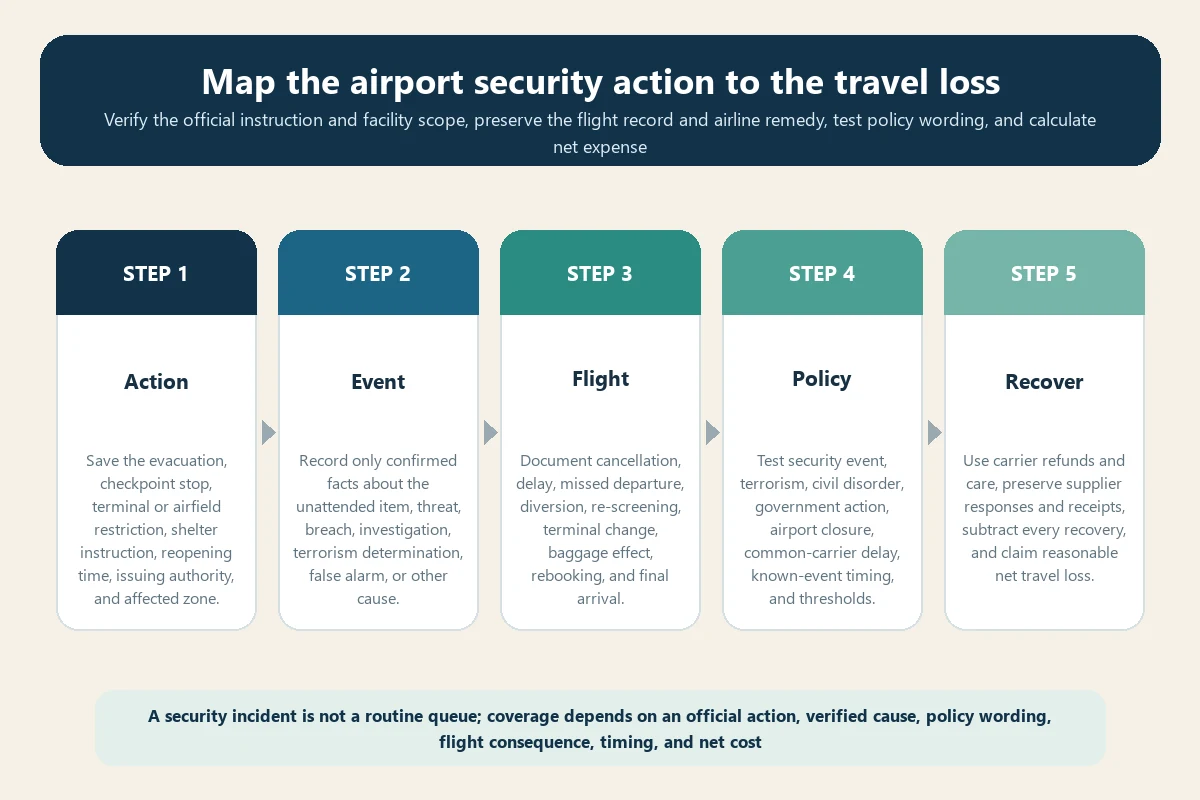
Submit a short chronology: official action, confirmed cause, facility scope, flight consequence, carrier remedy, supplier recovery, policy benefit, and net amount. Attach evidence by expense. The claim filing guide provides a document-first format.
If denied, request the exact clause, factual finding, event classification, selected benefit, missing proof, and appeal deadline. Correct a routine-queue, closure-scope, or terrorism error with primary records. Coverage may still be unavailable when the event is omitted, excluded, known, below threshold, or fully recovered.
Bottom line
An airport security incident is not synonymous with a long checkpoint line. Verify the official action and affected zone, preserve the carrier’s flight record and remedies, test the exact security and exclusion language, follow safety instructions, and claim only reasonable net loss. That chain separates a covered disruption candidate from ordinary airport congestion or unsupported rumor.
