
Travel insurance missed departure coverage asks why the traveler failed to board the first scheduled flight, train, ferry, or cruise and what reasonable action was taken afterward. Oversleeping, a highway crash, a broken-down car, a canceled train, illness, and an unusually long security screening do not receive one automatic answer.
This U.S. guide focuses on missed outbound flights and the evidence needed for replacement travel. It is educational, not legal or insurance advice.
Missed departure is not missed connection
A missed departure usually occurs before the traveler begins the relevant journey. A missed connection occurs after an earlier segment fails to deliver the traveler in time for the next segment.
Policies can define and cover them differently. Use our missed-connection insurance guide when an operating flight, train, or cruise segment caused the problem.
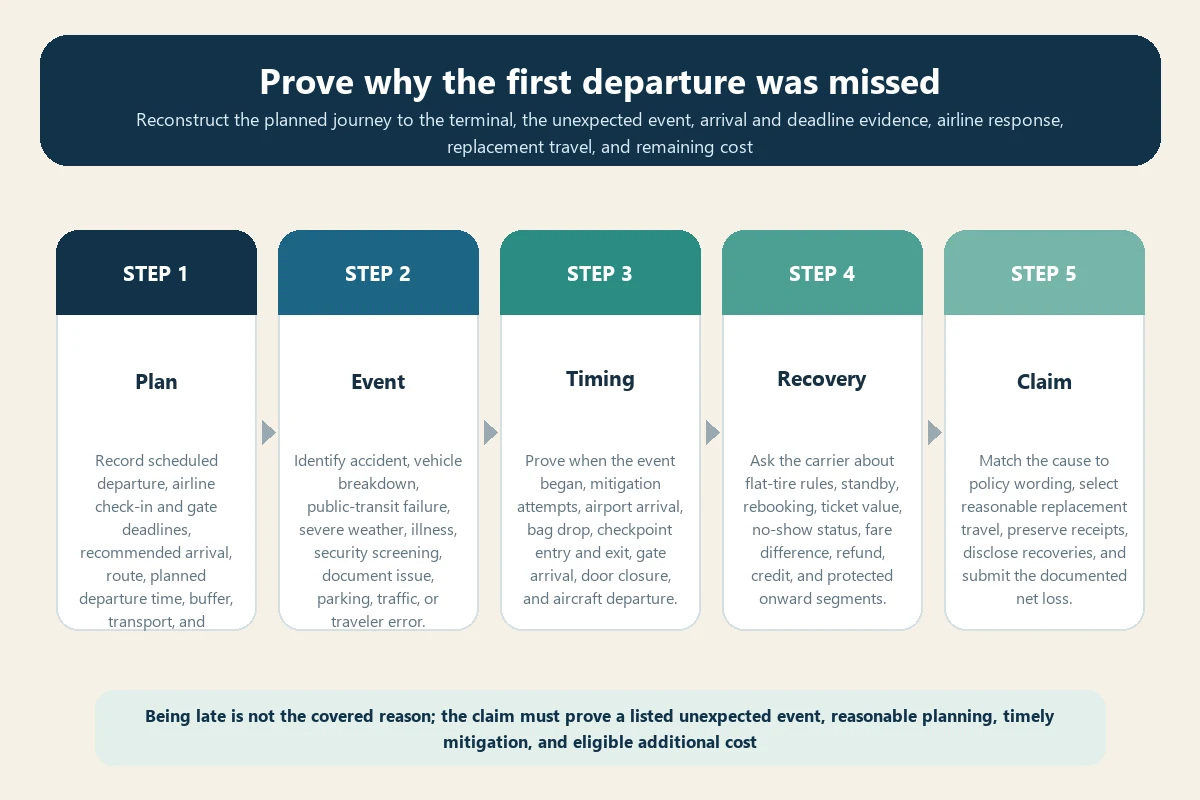
Being late is not itself a covered reason
The policy may require a listed event such as a traffic accident, documented vehicle breakdown, public-transport failure, severe weather, or illness. The definition can specify whose vehicle, which public transport, what distance, and what proof is required.
Quote the covered reason. Do not submit “missed flight” as both cause and loss.
Read check-in and gate deadlines before travel
Airlines set deadlines for check-in, baggage acceptance, document verification, security completion, and gate arrival. These can differ by airport, route, international status, and special assistance.
The DOT’s Fly Rights guide warns that missing a check-in deadline can result in loss of the reservation. Save the carrier’s applicable deadlines as they existed for the booked flight.
Build the planned-arrival baseline
Record when the traveler intended to leave home or the hotel, the normal route, expected duration, selected transport, planned buffer, parking plan, terminal, and baggage needs. Keep a map estimate or transport schedule captured before departure when available.
A claim is stronger when the plan would ordinarily satisfy the airline deadline and airport advice. Leaving no reasonable buffer can break the causal chain even if congestion occurs.
Use TSA arrival guidance as planning, not a guarantee
TSA’s travel tips encourage travelers to arrive two hours before scheduled departure. Particular airports, airlines, international flights, holidays, disabilities, checked bags, or identity verification may require more time.
Arriving two hours early does not guarantee boarding or insurance payment. It is one planning fact to compare with the carrier’s binding deadlines and actual conditions.
Document a traffic accident
Record the exact location, time, direction, blockage, and effect on the route. Preserve police or highway-agency records, photographs taken safely, navigation history, rideshare timestamps, toll records, witness details, and contemporaneous alerts.
Distinguish involvement in the accident from delay caused by an accident ahead. Policies may word these events differently.
Document vehicle breakdown
Save towing, roadside-assistance, repair, diagnostic, rental, and rideshare records. Identify the vehicle owner, driver, location, failure, time assistance was requested, arrival time, and whether another route or vehicle was reasonably available.
A fuel shortage, poor maintenance, known warning light, or unroadworthy vehicle may be treated differently from a sudden mechanical failure. Report facts without upgrading them.
Document public-transport failure
Preserve the original timetable, ticket, service alert, cancellation or delay notice, station arrival, revised times, and operator confirmation. Identify whether it was scheduled public transportation or a private shuttle.
Show why a taxi, rideshare, alternate line, or earlier service was unavailable or unreasonable. The claim should demonstrate mitigation, not only the failure.
Handle ordinary traffic separately
Routine rush-hour congestion, roadworks, parking queues, and predictable holiday traffic may not be unexpected covered events. A navigation screenshot after the flight does not prove conditions or reasonable planning before travel.
Check airport and road advisories, add seasonal buffer, and record any extraordinary closure or incident that changed the expected journey.
Prove airport arrival and checkpoint timing
Useful evidence includes parking entry, rental return, train-platform time, rideshare drop-off, bag-drop receipt, kiosk timestamp, checkpoint queue entry, screening completion, lounge entry, purchases, gate arrival, and airline scan logs.
Use time zones consistently. Ask the airline to record when the traveler presented at check-in or the gate and why boarding was refused.
Long security lines require careful evidence
A crowded checkpoint alone may not satisfy policy wording. Identify whether the provision covers security delay, public-transport delay, airport closure, or another listed cause. Document arrival, queue entry, checkpoint lane, published wait information, interruptions, officer instructions, screening completion, and gate cutoff.
If additional screening resulted from missing or unacceptable identification, prohibited property, or failure to prepare, exclusions or causation issues may arise.
Recognize common situations that may remain uncovered
Oversleeping, confusing a.m. and p.m., going to the wrong airport, forgetting a passport, waiting at the wrong gate, ignoring a boarding announcement, underestimating parking, stopping for a nonessential errand, or arriving after a published cutoff may be traveler error rather than an insured event. A general “I thought I had enough time” statement does not replace a documented plan.
Likewise, the airline moving the departure earlier or changing airports may be an airline-initiated itinerary change rather than missed-departure coverage. Preserve the original notification and compare the remedy using our flight-change coverage guide. If several causes overlap, build the chronology honestly and identify which event directly prevented boarding.
Some policies offer no missed-departure benefit at all, while others restrict it to an outbound international journey or require travel from a specified home location. Confirm scope before relying on the label.
Identity problems are a separate risk
TSA publishes its current acceptable identification requirements and notes that unverified identity can prevent checkpoint entry. A forgotten, expired beyond acceptance, damaged, or mismatched document is not automatically insured.
Preserve the identification presented, airline reservation name, TSA outcome, additional-screening timeline, and attempts to obtain acceptable documents.
Illness before departure may use another benefit
If sudden illness prevents timely arrival, trip cancellation or interruption wording may be more relevant than a missed-departure benefit. Obtain timely clinical documentation stating symptoms, assessment, treatment, and travel advice.
Feeling unwell without seeking care can be difficult to prove. A later note should not imply the clinician observed an earlier event that was never documented.
Contact the airline immediately
Before buying a new ticket, ask about same-day standby, rebooking, fare difference, change fee, preservation of ticket value, waiver, later flight, nearby airport, and protection of return or onward segments. Some airlines apply an informal “flat tire” approach, but it is not a universal legal right.
Obtain the agent’s name, time, case number, no-show status, offered itinerary, price, and ticket disposition in writing.
Protect the rest of the itinerary
A no-show on the first segment can cause later segments to be canceled under fare rules. Confirm the status of connections, return flights, codeshares, separate tickets, baggage, hotel, cruise, rental car, and tours.
Do not assume buying a replacement outbound ticket preserves the return. Ask the ticketing carrier to document every active coupon.
Airline refund rights may not apply
The DOT’s refund guidance explains that a traveler with a nonrefundable ticket who arrives late is not entitled to a refund when the flight operates as scheduled. This differs from an airline cancellation or significant change.
Insurance may still respond if a separate covered reason caused the missed departure, but it should calculate only the eligible remaining loss.
Choose reasonable replacement travel
Compare the airline’s rebooking offer, same-day options, nearby airports, rail, bus, and next-day travel. Consider safety, accessibility, visa rules, baggage, companions, and the event’s urgency.
Preserve price screenshots at the decision time. A premium-cabin replacement or private car may exceed the amount the policy considers reasonable and necessary.
Separate replacement transport from delay expenses
Use different rows for the new ticket, fare difference, change fee, hotel, meals, ground transport, communication, unused booking, and additional baggage. Benefits and limits may differ.
Our trip delay, interruption, and cancellation comparison helps prevent one expense from being submitted under the wrong section.
Coordinate every recovery source
Record airline ticket credit, fee waiver, employer reimbursement, card benefit, public-transport refund, roadside benefit, hotel refund, and insurance payment. Identify whether a credit is transferable and when it expires.
Use our supplier-refund and recovery guide to calculate the remaining loss without duplicate recovery.
Prepare a missed-departure claim packet
- Policy and exact missed-departure or related provision
- Original itinerary, ticket, fare rules, and deadlines
- Planned route, timing, transport, and reasonable buffer
- Covered-event evidence and contemporaneous alerts
- Airport, check-in, checkpoint, and gate timestamps
- Airline refusal, no-show status, and rebooking offers
- Protected status of onward and return segments
- Replacement options and price evidence
- Itemized receipts and proof of payment
- Supplier, card, employer, and insurance recovery ledger
Submit cause, timing, and cost together
Follow our travel insurance claim filing guide. State the planned arrival, unexpected covered event, mitigation, actual arrival, missed deadline, carrier response, replacement decision, and net cost.
If denied, request the relied-on definition, exclusion, planning standard, deadline, evidence gap, expense rule, and calculation. Correct factual errors with indexed source records.
Bottom line
Travel insurance missed departure coverage is not a general rescue for lateness. The claim must connect a listed unexpected cause to a reasonably planned airport journey, prove every critical timestamp, preserve the original ticket and onward segments, choose reasonable replacement travel, and reconcile all recoveries.
Being present at the gate but refused a seat requires a different analysis. Use this travel insurance denied boarding coverage guide to identify the airline’s stated reason, preserve passenger rights, test policy benefits, and calculate the remaining net loss.
A security disruption needs evidence of the official action and flight consequence—not just a long line. Use this airport security incident travel insurance guide to distinguish routine queues from evacuation or closure, preserve carrier remedies, test exclusions, and document net loss.