
Travel insurance volcanic ash flight cancellation coverage depends on the official aviation hazard, the carrier’s flight-specific action, policy language, purchase timing, and unrecovered expense. An eruption near the destination does not automatically mean the booked flight is canceled or insured.
Volcanic ash can close a route, restrict altitude, divert an arrival, disrupt an airport, or leave flights operating on revised paths. This U.S. guide explains how to preserve the evidence and recovery sequence. It is educational, not geological, meteorological, aviation, safety, legal, or insurance advice.
Volcanic ash cancellation coverage at a glance
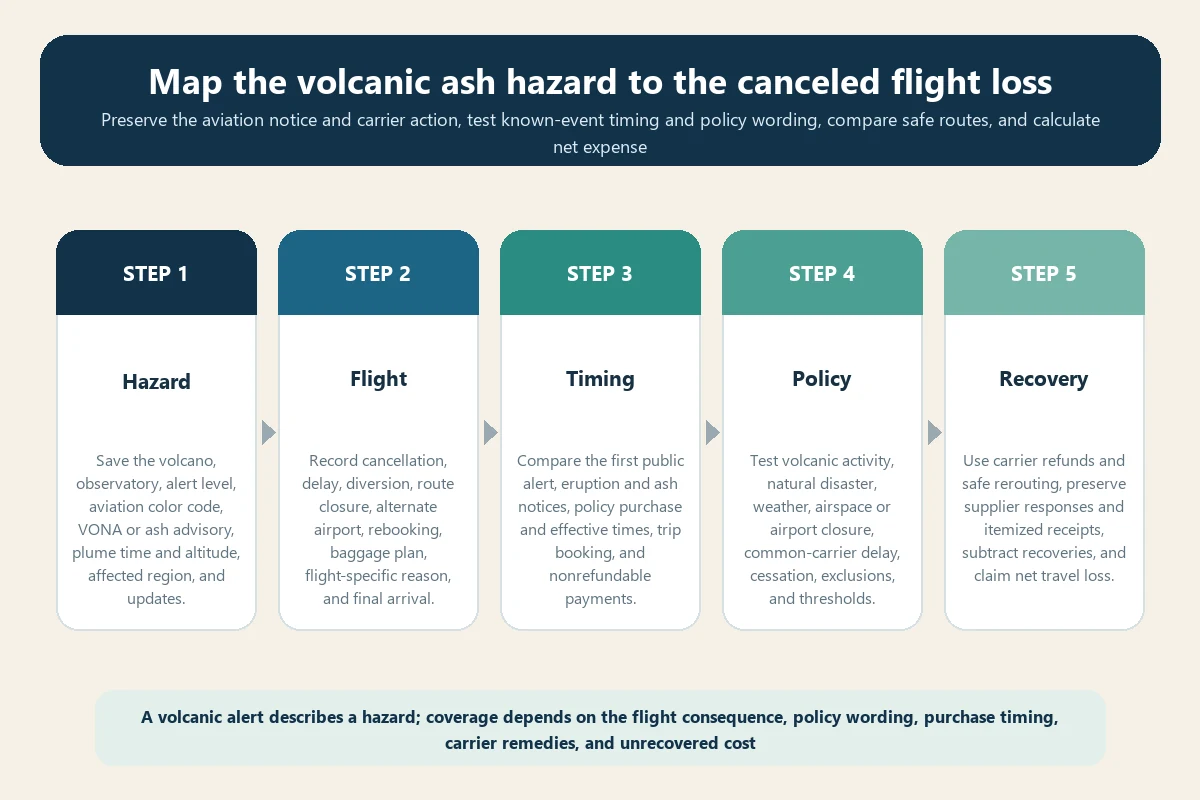
- Save the volcano notice, aviation color code, ash advisory, and updates.
- Obtain the airline’s flight-specific cancellation or rerouting reason.
- Compare the first public alert with policy and booking timestamps.
- Read volcanic activity, natural disaster, weather, closure, and common-carrier wording.
- Use airline refunds and safe rebooking before insurance.
- Claim only reasonable, documented loss remaining after recovery.
Reviewed August 17, 2026.
Volcanic activity and airborne ash are different facts
A volcano can be restless or erupting without emitting ash that affects a booked route. Ash can also drift far from the source, affect certain altitudes, and disrupt airports hundreds of miles away. Record both the volcano’s status and the aviation impact.
The U.S. Geological Survey’s volcano alert-level system separates ground-hazard terms from aviation color codes. The aviation code specifically communicates airborne ash hazards and changes through a Volcano Observatory Notice for Aviation.
Understand the aviation color code
USGS uses Green, Yellow, Orange, and Red to communicate increasing aviation concern. Orange can indicate an eruption underway with no or minor ash emissions, while Red concerns significant ash emission that is likely, underway, or suspected. A color code is operational evidence, not an insurance determination.
Save the notice text, time, volcano, observatory, plume description, altitude, drift direction, and later changes. Do not treat Red as proof that every flight in the country is canceled.
Preserve the VONA and ash advisory
The USGS Volcano Notifications for Aviation database publishes aviation notices and color-code changes for U.S. volcanoes. For an overseas event, preserve the corresponding official observatory and aviation-weather notices used by the airline.
Live notices change as the plume evolves. Save the version that applied at the scheduled flight time and the subsequent downgrade or cancellation. A later Green or Yellow notice does not erase an earlier restriction.
Connect the ash hazard to the booked flight
Keep the original itinerary and every revision. Record whether the flight was canceled, delayed, diverted, rerouted, moved to another airport, or operated normally. Save scheduled and actual times, flight numbers, carrier messages, baggage treatment, rebooking, and final arrival.
A general eruption story does not prove that the airline canceled for ash. Ask for a flight-specific reason. Weather, crew, aircraft, or airport conditions can cause a concurrent disruption.
Volcanic ash versus airspace closure
The ash plume is the hazard; an airspace restriction or carrier route avoidance is an operational response. Identify whether an authority closed or restricted airspace, an airport closed, or the airline chose a safer route. These records can invoke different policy terms.
Use the airspace closure coverage guide for the issuing authority, coordinates, altitude, effective time, affected operators, and exclusions.
Volcanic ash versus airport closure
Ashfall can close runways or reduce airport operations, while an airport outside the ashfall zone may remain open even though routes are unavailable. Save the airport status, runway notices, cleaning or inspection updates, and reopening time.
If the facility formally closes, use the airport closure coverage guide to separate facility status from the flight consequence and carrier remedy.
Known-event timing decides many claims
Record the first eruption or unrest notice, aviation color-code change, ash advisory, route warning, policy purchase and effective times, trip booking, and each nonrefundable payment. A policy bought after a public eruption or ash disruption may not cover related loss.
Do not use the cancellation date as the only cutoff. The event can become known days before the airline finalizes its schedule. The travel insurance purchase-timing guide explains how benefit start dates and deposit windows differ.
Read the policy’s hazard wording
Search for volcanic eruption, volcanic activity, natural disaster, natural catastrophe, weather, common-carrier delay, airport closure, airspace closure, cessation of service, inaccessible destination, evacuation, and pollution or contamination. Copy the covered reasons, definitions, exclusions, waiting periods, and endorsements.
Some plans expressly name volcanic eruption; others rely on natural-disaster or common-carrier wording. Do not assume “weather” includes every geological event.
Natural disaster definitions vary
A plan may require physical damage at the destination, uninhabitability, mandatory evacuation, cessation of common-carrier service, or a specified delay. An ash plume that causes a route change can be serious without meeting a property-damage definition.
If the policy uses an undefined term, ask the administrator which provision and factual threshold it applies. Avoid importing a definition from another insurer.
Protect the airline refund first
The U.S. Department of Transportation states that a passenger is entitled to a refund when the airline cancels a flight and the traveler declines the alternative. Its refund guidance also explains defined significant changes, rebooking offers, and refunds for applicable unused ancillary services.
The cause does not remove the ticket-refund analysis. Compare cash refund, free rebooking, voucher, alternate airport, and revised route. Insurance normally addresses what remains after the carrier or merchant of record returns amounts owed.
Airline care and extraordinary hazards
Meals, hotel, and ground transport can depend on the carrier’s contract, jurisdiction, and cause classification. Ash is commonly outside airline control, so U.S. care may be discretionary even when the ticket refund is due. Ask before spending and save the response.
For an international itinerary, passenger rights may differ by departure, arrival, and carrier. Do not assume U.S. rules or another region’s compensation regime applies to every segment.
Choose the correct insurance benefit
Trip cancellation may address prepaid nonrefundable arrangements when a covered reason prevents departure. Trip delay may reimburse additional meals, lodging, and local transport after a waiting period. Missed connection, trip interruption, and baggage benefits respond to different consequences.
The benefit comparison guide helps classify the trip stage and expense. One ash event can touch several benefits, but a receipt cannot be recovered twice.
If the flight is delayed rather than canceled
Save the scheduled and actual departure and arrival times, cause, carrier care, and receipts. The delay benefit may require a minimum number of consecutive hours and a listed cause. A significant operational disruption can still fall below the policy threshold.
The trip delay reimbursement guide explains waiting periods, daily caps, additional expense, and duplicate recovery.
When the aircraft diverts
A plume can change after takeoff or make the planned airport unsafe, sending the aircraft to an alternate. Record the carrier explanation, landing airport, deplaning time, baggage release, onward transport, revised connection, and final arrival.
The flight diversion coverage guide maps the alternate landing to delay, interruption, missed connection, and net additional cost.
Missed connections after rerouting
Preserve the original connection, revised route, actual arrival, boarding cutoff, protected-ticket status, carrier rebooking, and catch-up expense. Separate tickets may receive different assistance from a through-ticket.
Use the missed connection insurance guide for minimum delays, common-carrier wording, cruises, tours, and separate tickets.
Safe alternative routes
Do not attempt to bypass an aviation restriction or travel into a hazardous ashfall area to save a booking. Follow aviation, emergency-management, public-health, airport, and carrier instructions. Compare lawful routes, alternate airports, surface transport, and later travel dates.
Before buying a replacement ticket, ask whether the airline will rebook, whether the original fare is refundable, and whether the insurer authorizes major additional transport. Save quoted alternatives and why the selected route was reasonable.
Destination closures and unused arrangements
Contact each hotel, tour, transfer, cruise, and rental provider promptly. Request refund, date change, credit, or partial recovery. Preserve the original terms and response. A flight cancellation does not automatically make every destination booking an insured loss.
If a property is physically affected by ash, obtain its closure or habitability statement. Keep that evidence separate from the airline cancellation.
Medical and ash exposure concerns
Follow official health guidance and seek urgent care when needed. Do not delay appropriate treatment for insurance approval. A medical claim requires clinical evidence and policy eligibility separate from the trip cancellation claim.
Do not self-diagnose ash exposure or travel against official restrictions. Preserve medical records securely and submit only through approved channels.
Calculate net travel loss
Create a ledger with vendor, date, purpose, currency, paid amount, receipt, airline request, supplier response, refund, voucher, card benefit, and balance. Separate unused prepaid costs from delay expenses and replacement transport. Report later refunds.
The supplier refund and subrogation guide explains how overlapping recovery changes the final amount.
Volcanic ash claim checklist
- Policy certificate, schedule, purchase date, and effective time.
- Original itinerary, ticket receipts, and every revision.
- VONA, aviation color code, ash advisory, plume data, and updates.
- Carrier’s flight-specific cancellation, delay, diversion, or reroute reason.
- Refund, rebooking, meal, hotel, transport, and baggage responses.
- Supplier terms, refund requests, credits, and retained amounts.
- Itemized receipts, approvals, payment proof, and net-loss ledger.
Common mistakes
- Treating volcanic unrest as proof of an affected flight.
- Using a current alert instead of the notice at the scheduled flight time.
- Ignoring the policy purchase and known-event timeline.
- Confusing an ash hazard with a formal airspace or airport closure.
- Buying replacement travel before comparing carrier remedies.
- Claiming gross cost without subtracting refunds and credits.
How to file and appeal
Submit a concise chronology: volcanic notice, aviation impact, flight action, purchase timing, carrier remedy, supplier recovery, policy benefit, and net amount. Attach evidence by expense. The claim filing guide provides a document-first structure.
If denied, request the exact clause, factual finding, known-event cutoff, selected benefit, missing proof, and appeal deadline. Correct a hazard, closure, or flight-cause error with primary records. Coverage may still be unavailable when the event is omitted, excluded, known, below threshold, or fully recovered.
Bottom line
Volcanic ash coverage begins with aviation evidence, not the eruption headline. Preserve the color code and VONA, connect the plume to the booked flight, compare airline refunds and safe alternatives, test exact natural-disaster and timing language, and claim only documented net expense. That chain distinguishes a covered cancellation candidate from an unrelated or already-known volcanic event.
