
Travel insurance airport closure coverage is not decided by the word “closed” alone. The traveler must identify the exact airport facility, the closure’s verified cause and timing, the airline’s response, the applicable policy benefit, and the money that remains unrecovered.
A runway disabled by snow, a terminal evacuated for security, a coastal airport shut for a hurricane, and a carrier that merely stops serving an open airport create different evidence and policy questions. This U.S. guide explains the workflow. It is educational, not legal, aviation, safety, or insurance advice.
Airport closure coverage at a glance
- Confirm the airport code, affected facility, start time, scope, and issuing authority.
- Separate a full airport closure from a runway closure, ground stop, terminal disruption, or carrier cancellation.
- Obtain the airline’s flight-specific reason and every refund or rerouting option.
- Match the underlying cause—not a headline—to named policy wording and exclusions.
- Ask before changing airports or buying replacement transport when safety permits.
- Claim reasonable, documented net loss after refunds, vouchers, and other benefits.
Reviewed August 17, 2026.
What counts as an airport closure?
A full closure normally means the airport is unavailable for operations during a defined period. But travelers commonly use the phrase for narrower events: one runway is closed, arrivals are stopped, departures are held, a terminal is inaccessible, public ground access is blocked, or one airline suspends service. Record what actually stopped and what remained available.
The FAA’s National Airspace System status summary includes an airport-closures section and warns that it is not a complete runway or equipment list. The operational record may therefore require both the status display and the current notice.
Closure, ground stop, and airspace restriction are different
A ground stop controls departures to an airport and may leave the airport itself open. An airport closure concerns the facility. An airspace restriction concerns a geographic volume or route. The distinction matters because the airline’s alternatives, the delay clock, and the policy’s covered-reason wording may differ.
Use the dedicated airspace closure coverage guide when the central fact is an order affecting a route or region. Use the air traffic control delay guide when the airport remains operational but traffic management slows the flight.
Build the official facility-status record
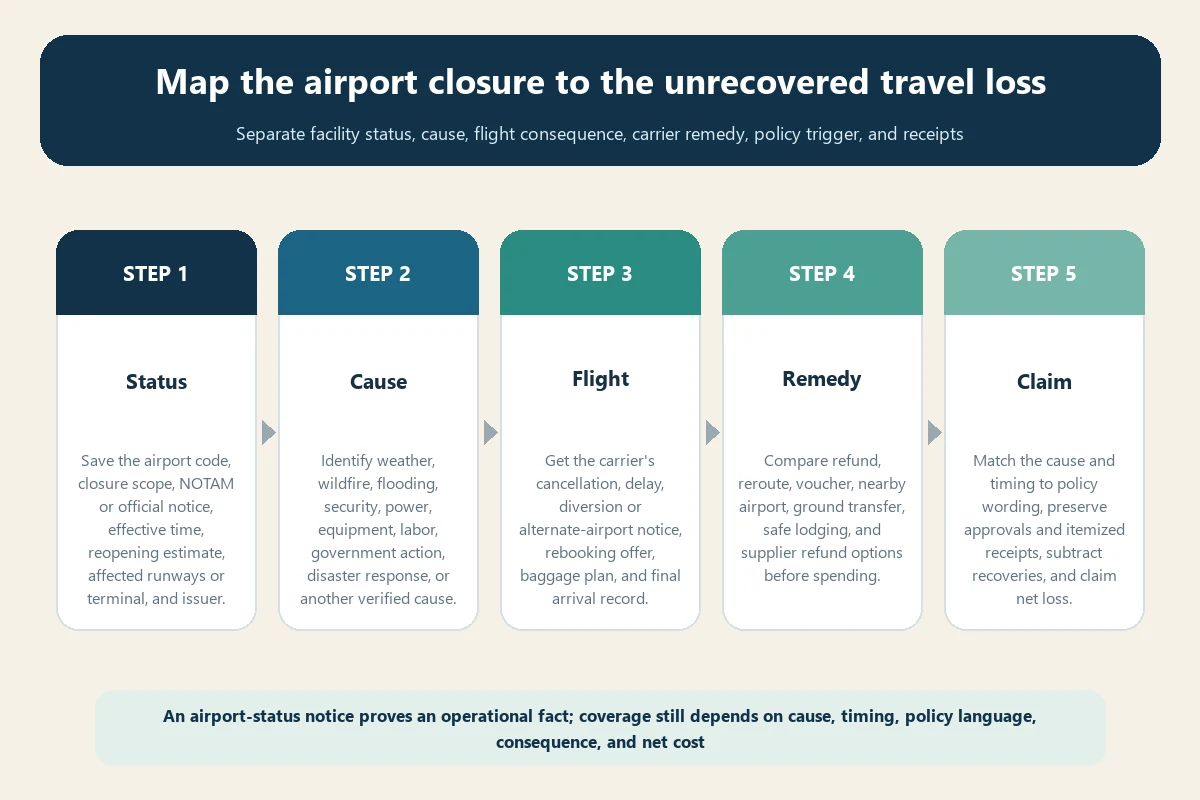
Save the three-letter airport code, date and local time, affected runway or terminal, whether arrivals and departures are both stopped, known exceptions, reopening estimate, and the organization issuing the notice. Preserve a screenshot or PDF with its timestamp and URL; live operational pages change as conditions improve.
The FAA explains that NOTAMs and temporary flight restrictions communicate temporary aviation information. A relevant NOTAM can document runway closure, equipment failure, procedure change, or another limitation. It does not automatically establish an insurance benefit.
Identify the underlying cause
Ask whether the closure arose from severe weather, flooding, wildfire, volcanic ash, earthquake damage, snow removal, electrical failure, navigation equipment, a security event, labor action, government order, military activity, accident investigation, or another cause. A policy may name one and omit or exclude another.
Keep the airport notice and the airline explanation as separate exhibits. The first proves facility status. The second ties that status to the insured itinerary. If they use different descriptions, ask the carrier for clarification rather than choosing the more favorable label yourself.
Check whether the event was already known
Record when the first official warning or closure notice became public, when the policy became effective, when the trip was booked, and when each nonrefundable payment was made. Insurance generally addresses uncertain future events. A policy purchased after a named storm warning, announced strike, evacuation order, or published closure may not protect losses arising from that event.
Do not reduce timing to the date the airport finally shut. The relevant known-event language may point to an earlier forecast, notice, order, or public announcement. Save the actual wording and timestamps.
Get the flight-specific consequence in writing
The same closure can cancel one flight, delay another, divert an arrival, or move a departure to a nearby airport. Save the original itinerary, carrier messages, cancellation or delay reason, revised flight number, alternate airport, additional connections, scheduled and actual times, and final arrival. Record what happened to checked baggage and paid extras.
A generic news article cannot prove that a particular flight was affected for a covered reason. Ask for a carrier statement or retain the app and email notices that identify the itinerary.
Use airline remedies before insurance
For flights to, from, or within the United States, the DOT’s airline refund guidance says a passenger is entitled to a refund when the airline cancels the flight and the passenger chooses not to travel or accept the offered alternative. A change in origin or destination airport can also qualify as a significant change when the traveler declines the changed trip.
Compare the carrier’s refund, rebooking, nearby-airport, ground-transfer, meal, hotel, and baggage proposals before accepting. A voucher can carry expiration rules or waive a cash path. Insurance normally calculates what remains after carrier and supplier recovery.
Changing to another airport
A nearby airport may restore the trip, but it can add rail, rental car, taxi, parking, toll, hotel, and baggage-transfer costs. Ask the airline whether it will move the ticket, provide ground transport, protect onward segments, and transfer checked bags. Ask the insurer whether self-arranged transport needs advance approval and whether the replacement is reasonable under the policy.
Do not enter a closed, evacuated, hazardous, or restricted area to retrieve a vehicle or bag. Follow airport, emergency-management, carrier, and law-enforcement directions.
Test the correct insurance benefit
Trip delay may reimburse additional meals, lodging, and local transport after a minimum waiting period and for a listed cause. Missed connection may help catch up with an itinerary. Trip interruption may address unused arrangements and additional transport after departure. Trip cancellation applies when a covered reason prevents the trip before departure.
The delay, interruption, and cancellation comparison helps select the benefit by travel stage and loss type. One closure can touch several benefits, but the same expense cannot be paid twice.
Weather and natural-hazard closures
Weather may be covered when the certificate names it and the threshold is met, but “weather” is not a universal approval. Determine whether the airport was closed, the carrier canceled, the route became unsafe, or the traveler decided not to go while the flight still operated. Each is different.
Use the weather delay coverage guide for waiting periods and cause evidence. Preserve storm notices, airport status, airline messages, and receipts without treating a forecast alone as a cancellation.
Security, government, and conflict events
A terminal evacuation or government closure may involve exclusions for war, military action, civil disorder, government regulation, or security events. Do not assume that every threat has the same classification. Capture the authority’s public wording and the airline’s reason, then compare them with definitions and exclusions.
If armed conflict caused the canceled flight, follow the separate flight cancellation due to war guide for refund, safety, CFAR, and interruption paths.
When the flight diverts
An arrival airport can close after takeoff, sending the aircraft to an alternate. Record the diversion reason, landing airport, time on board, deplaning time, carrier transport to the original destination, baggage delivery, and revised connection. The closure may create delay, interruption, missed-connection, or baggage issues rather than cancellation.
The flight diversion coverage workflow explains how to connect the alternate landing and final arrival to specific additional costs.
Missed connections after reopening
A traveler can depart after the airport reopens yet miss a later flight. Preserve the original minimum connection time, actual arrival, boarding cutoff, protected-ticket status, carrier rebooking, and cost of catching up. If separate tickets were used, document both carriers’ responses.
Use the missed connection insurance guide to test minimum delay, common-carrier, cruise or tour, and catch-up wording.
Reasonable expenses while stranded
Ask what the airline and airport are providing before spending. Keep itemized receipts for modest meals, safe lodging, airport-hotel transport, required communications, and essential items. A card statement alone may not show what was purchased. Record why an option was necessary and why a cheaper safe alternative was unavailable.
Premium hotels, alcohol, entertainment, speculative bookings, and unnecessary upgrades may not qualify. Benefit limits can apply per day, per person, and per trip.
Nonrefundable hotels, tours, and transfers
Contact each supplier promptly and request cancellation, date change, credit, or partial refund. Save the original terms, your request, the response, and the amount retained. If the airport reopens but the trip’s purpose or prepaid sequence is lost, ask how the policy defines interruption or cancellation rather than assuming the entire trip is covered.
The supplier refund and subrogation guide shows how later recoveries affect the final claim amount.
Calculate net loss by line item
Create a ledger with date, vendor, purpose, amount, currency, receipt, requested recovery, refund or credit, other insurance, and balance. Separate unused prepaid cost from new transportation and from delay expenses. If a supplier refunds money after the insurer pays, notify the administrator.
A clear ledger prevents duplicate recovery and lets the examiner apply the correct benefit limit to each expense rather than treating the trip as one unexplained total.
Documents for an airport closure claim
- Policy certificate, schedule, purchase confirmation, and effective date.
- Original itinerary, tickets, paid extras, and all revisions.
- Airport-status record, relevant NOTAM, and official closure notice.
- Carrier’s flight-specific reason, refund notice, and rerouting offer.
- Supplier cancellation terms, requests, responses, refunds, and credits.
- Itemized receipts, payment proof, currency conversion, and expense ledger.
- Insurer notifications, approvals, claim number, and correspondence.
What to do during the disruption
- Follow safety and evacuation instructions.
- Confirm the facility scope and flight status through official channels.
- Save time-stamped notices before live pages update.
- Ask the airline for refund, rebooking, and care options.
- Call the assistance administrator before major replacement spending when feasible.
- Notify hotels, tours, and transfer providers.
- Keep itemized receipts and a chronological event log.
Common claim mistakes
- Calling a ground stop or one-airline cancellation a full airport closure.
- Submitting a news headline without the official notice or carrier reason.
- Buying a new ticket before comparing refund and rerouting options.
- Changing airports without checking baggage, onward tickets, or approval.
- Claiming gross cost without subtracting refunds and credits.
- Ignoring the waiting period, named-cause list, or known-event clause.
How to file and escalate
File under the benefit that matches the trip stage and expense. Use a short chronology, closure evidence, flight consequence, airline remedy, supplier response, receipt ledger, and net amount. The travel insurance claim filing guide provides a document-first structure.
If denied, ask for the exact clause, factual finding, missing evidence, benefit selected, exclusion, and appeal deadline. Correct a mistaken closure scope or cause with primary records. An unfavorable outcome alone does not prove mishandling; the policy text and supported facts control.
Bottom line
Airport closure is an operational condition, not a universal insurance trigger. Verify the facility and cause, preserve the airline’s flight-specific response, compare safe remedies before spending, map the loss to the correct benefit, and submit only documented net cost. That sequence creates a stronger claim and avoids confusing an airport closure with airspace, ATC, or carrier-only disruption.
A blackout needs system-specific evidence even when it does not close the entire airport. Use this airport power outage travel insurance guide to locate the failure, verify its cause, preserve airline remedies, test policy wording, and document net loss.
A security disruption needs evidence of the official action and flight consequence—not just a long line. Use this airport security incident travel insurance guide to distinguish routine queues from evacuation or closure, preserve carrier remedies, test exclusions, and document net loss.
Volcanic ash needs hazard-specific aviation evidence and a flight-cancellation recovery sequence. Use this volcanic ash flight cancellation travel insurance guide to verify alerts, preserve airline refunds, test natural-disaster wording and timing, and claim net loss.
Wildfire smoke requires separate hazard, aviation, and flight-specific evidence. Use this wildfire smoke flight cancellation travel insurance guide to distinguish AQI from an operational disruption, preserve airline remedies, test policy wording and claim net loss.
Tornado disruption needs separate warning, shelter, operational, damage, and flight evidence. Use this tornado flight cancellation travel insurance guide to distinguish a watch from a shutdown or physical loss, preserve remedies, test timing and thresholds, and claim net loss.
Flash-flood disruption needs separate warning, access, airport-operation, and carrier evidence. Use this flash flood flight cancellation travel insurance guide to connect the hazard to the booked trip, preserve remedies, test policy terms, and calculate net loss.
