
Travel insurance arbitration ratification disputes arise when someone allegedly affirms an unauthorized contract, transaction, or act after learning what happened. The theory may be used to argue that a traveler, insurer, platform, administrator, or principal accepted an arbitration obligation through later words or conduct.
This U.S. consumer guide explains how to audit authority, knowledge, intent, benefits, objections, claim timing, contract scope, and defenses. It is not legal advice.
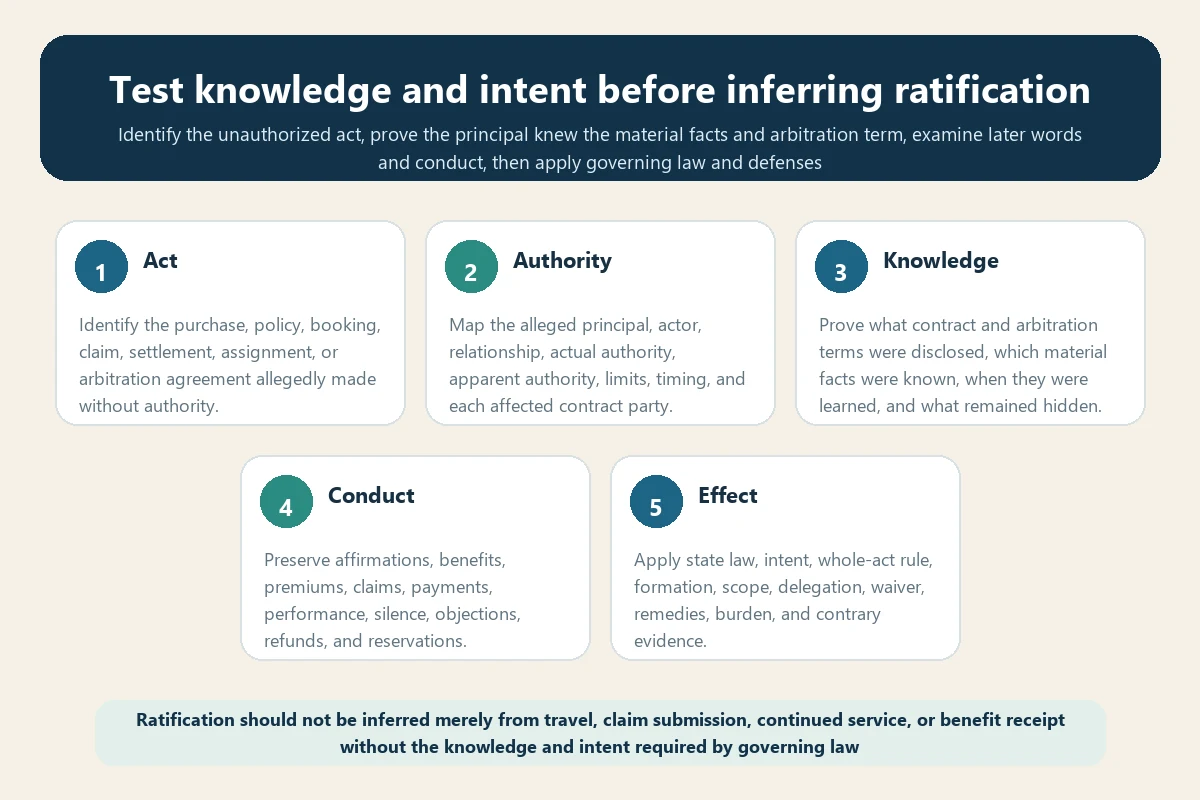
Identify the exact act allegedly ratified
State whether the disputed act was a policy purchase, booking, enrollment, endorsement, claim, settlement, assignment, representation, release, or arbitration agreement. Identify the actor and the alleged principal by full legal name.
Do not describe the entire relationship as ratified when the evidence concerns only one payment, service, or claim submission.
Start with authority at the time of the act
Determine whether the actor already had actual or apparent authority. Preserve powers of attorney, agency agreements, family relationships, corporate roles, booking permissions, account controls, insurer appointments, and administrator contracts.
If valid authority existed, ratification may not be the central issue. If authority was limited, identify the precise boundary allegedly exceeded.
Map the alleged principal
Ratification ordinarily concerns a principal’s later adoption of another person’s act. Record whose legal rights were affected and who possessed power to approve or reject the act.
A purchaser, insured traveler, policyholder, beneficiary, parent, spouse, employer, insurer, producer, platform, and administrator may hold different roles. Do not collapse them.
Preserve the operative contract
Collect the policy, certificate, booking terms, checkout screen, confirmation, disclosures, endorsement, claim forms, settlement, incorporated rules, and every relevant version. Record parties, dates, governing law, arbitration text, scope, and delegation language.
Use the clickwrap agreement guide when online notice and assent are disputed.
Apply the Federal Arbitration Act carefully
Section 2 of the Federal Arbitration Act generally makes written arbitration provisions involving commerce enforceable on ordinary contract footing. It does not create a nationwide ratification test.
State contract and agency law ordinarily supplies the elements, burden, knowledge rule, and consequences. Identify choice-of-law language and controlling authority before drawing conclusions.
Use Arthur Andersen as a boundary
In Arthur Andersen LLP v. Carlisle, the U.S. Supreme Court explained that traditional state-law principles may allow arbitration agreements to be enforced by or against nonparties.
The case rejects a categorical nonsignatory bar. It does not establish ratification, knowledge, authority, or intent in any individual travel transaction.
Read the Ninth Circuit’s 2026 evidence lesson
In a February 2026 Ninth Circuit memorandum, the court found assumption unavailable where nonsignatories had not signed a document assuming duties or showing an intent to affirm the original contract containing the arbitration provision.
The decision illustrates a practical point: identify concrete evidence connecting the person to the specific agreement and clause. General involvement is not a substitute for intent.
Prove knowledge of material facts
Create a chronology of what the alleged principal learned, from whom, and when. Include the identity of the actor, transaction, price, benefits, exclusions, affected parties, dispute terms, and claimed lack of authority.
Ratification should not be inferred from conduct occurring before the principal knew the material facts required by governing law.
Prove knowledge of the arbitration term
Identify whether the principal received the arbitration clause, policy, linked terms, or notice that disputes would be arbitrated. Preserve delivery logs, email, mail, portal access, downloads, screen captures, and acknowledgments.
Knowledge that insurance existed is not necessarily knowledge of an arbitration clause hidden in a different document.
Separate actual knowledge from imputed knowledge
Determine whether governing law permits knowledge held by an agent to be attributed to the principal, and whether an exception applies when the agent exceeded authority or acted adversely.
State the asserted attribution rule and evidence. Do not simply assume that a booking companion’s knowledge binds every insured traveler.
Find objective words of affirmation
Search correspondence and signed documents for approve, affirm, adopt, accept, authorize, confirm, agree, release, ratify, or similar language. Read the full context, conditions, reservations, and referenced documents.
An affirmation of coverage, a claim decision, or a settlement amount may not affirm every booking term or arbitration obligation.
Evaluate conduct after knowledge
Record premiums paid or retained, benefits requested or accepted, claim forms submitted, performance directed, documents signed, refunds sought, objections made, and rights exercised after disclosure.
Conduct is meaningful only when tied to knowledge, choice, and the legal standard. Continued travel may simply reflect practical necessity.
Analyze benefit acceptance carefully
Identify the exact benefit, its source, the contract under which it was paid, and whether the recipient had a meaningful ability to reject or return it. Separate medical assistance, reimbursement, refund, credit, and claim payment.
Accepting one policy benefit does not automatically prove knowing adoption of unrelated platform terms or a broader arbitration clause.
Record prompt objections
Preserve emails, calls, complaints, cancellation requests, chargebacks, appeals, regulator filings, litigation positions, and written reservations made after learning the facts.
Timing matters. A prompt and consistent objection may contradict an inference of affirmation, while unexplained delay may be argued differently under governing law.
Check whether rejection was practical
Consider whether an insured faced an emergency abroad, needed medical assistance, lacked an alternative, or could not unwind a completed trip. Document the circumstances rather than treating continued performance as freely chosen.
Economic or medical necessity may affect the inference drawn from conduct even when it does not create a standalone defense.
Distinguish ratification from assumption
Assumption focuses on whether a party adopted contractual rights or duties. Ratification often focuses on a principal affirming an act performed on its behalf without authority. The doctrines can overlap but should not be merged.
The assumption theory guide provides a separate agreement-and-performance checklist.
Distinguish ratification from agency
Actual or apparent authority concerns power at the time of the act. Ratification concerns later affirmation. Identify the timeline and evidence for each theory separately.
Use the arbitration agency guide to map manifestations, reasonable reliance, authority limits, and actor-principal relationships.
Distinguish ratification from novation
Novation is asserted to replace and extinguish an existing obligation through a new agreement. Ratification affirms an earlier unauthorized act. Later documentation may do one, both, or neither depending on text and law.
The novation guide helps compare old and new contracts, assent, consideration, replacement intent, and extinction.
Distinguish ratification from waiver
Waiver concerns intentional relinquishment of a known right under the applicable standard. Ratification concerns adoption of an unauthorized act. Specify which right or act is at issue.
Silence or delay should not be treated as a universal substitute for the elements of either doctrine.
Test the whole-act principle
Some state-law formulations may limit a principal’s ability to accept favorable parts of an unauthorized transaction while rejecting burdens tied to the same act. Identify the jurisdiction’s actual rule and its unit of analysis.
The relevant act may be narrower than the entire commercial relationship. Define it before arguing that benefits and burdens travel together.
Separate multiple contracts
A booking, insurance policy, producer disclosure, assistance agreement, and supplier terms may be separate contracts with different parties. Ratifying one does not necessarily ratify all.
If a clause depends on linked rules or another document, use the incorporation-by-reference guide to test identification and availability.
Analyze scope after ratification
Even if a party ratified a contract, determine whether the clause covers the specific denial, refund, statutory claim, misrepresentation, injury, or post-agreement conduct. Review temporal reach, named parties, exclusions, forum, and remedies.
Ratification of an act should not be used to expand clause scope beyond its text.
Address delegation separately
If a party argues that an arbitrator must decide ratification, identify the exact delegation language and any incorporated rules. Determine whether the challenge concerns formation, party status, the delegation clause itself, or the broader agreement.
Preserve objections specifically directed to delegation rather than relying only on a challenge to the contract as a whole.
Build a ratification evidence matrix
Create rows for the unauthorized act, alleged principal, actor, authority limit, material facts, clause disclosure, knowledge date, affirmation, benefits, performance, objections, ability to reject, governing elements, scope, delegation, and defenses.
For every row, record supporting and contrary evidence, source, custodian, date, and authenticity. This prevents one claim form or payment from carrying the whole theory.
Preserve reasonable defenses
Potential defenses include no unauthorized act, wrong principal, no full knowledge, no clause notice, no intent to affirm, timely objection, benefit from a different contract, inability to reject, partial or conditional conduct, no authority to ratify, claim outside scope, invalid delegation, or contrary statutory rules.
A party asserting ratification should address refunds, reservations, complaints, hidden terms, separate contracts, and emergency circumstances rather than omitting contrary facts.
Use a disciplined decision sequence
- Identify the exact unauthorized act and alleged principal.
- Map actual and apparent authority at the time.
- Preserve every relevant contract and arbitration provision.
- Determine governing law and required elements.
- Prove knowledge of material facts and the clause.
- Evaluate later words, benefits, conduct, and objections.
- Test scope, delegation, remedies, and defenses separately.
Bottom line
Travel insurance arbitration ratification should not be inferred merely because a traveler continued a trip, submitted a claim, used assistance, or accepted a payment. The reliable approach is to identify the unauthorized act, prove the relevant knowledge and authority, and connect later words or conduct to an objective intent to affirm under governing law.
Only then should anyone decide whether a particular contract and arbitration clause became enforceable against the alleged principal.
