
Travel insurance arbitration assumption theory asks whether a person or company that did not originally sign an agreement later accepted its obligations through a writing, conduct, performance, or another contract. The focus is intentional adoption of the relevant agreement.
This U.S. consumer guide explains how to audit parties, contracts, intent, conduct, accepted benefits, performance, transactions, claims, state law, and defenses. It is not legal advice.
Do not confuse two meanings of assumption
In insurance, an insurer may “assume risk.” In nonsignatory contract law, assumption concerns whether a party took on contractual obligations, potentially including arbitration. These are not the same proposition.
State the asserted doctrine and agreement clearly before collecting evidence.
Identify who allegedly assumed what
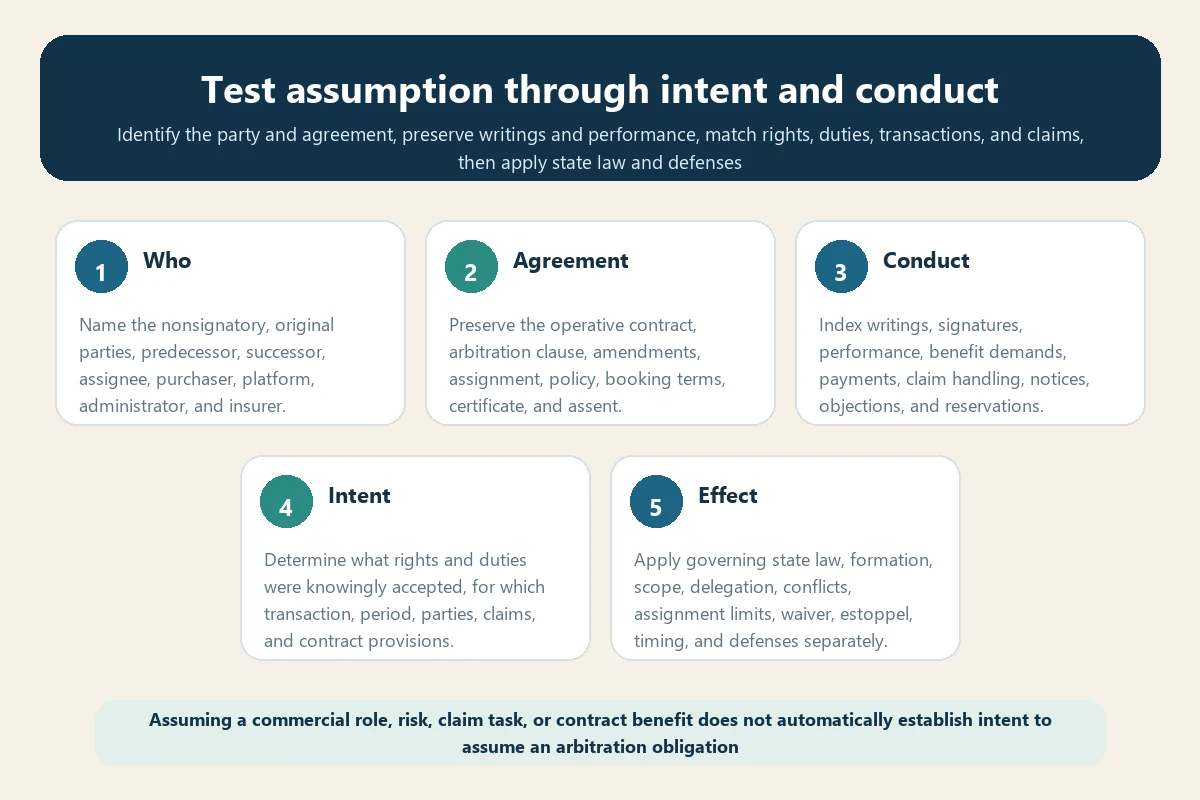
Name the nonsignatory, original contracting parties, predecessor, successor, assignee, purchaser, traveler, platform, supplier, producer, administrator, and insurer. Specify which entity asserts assumption and against whom.
Then identify the exact contract, version, clause, transaction, rights, and duties allegedly adopted. A broad claim that someone “assumed the contract” is not enough for a reproducible analysis.
Map the enforcement direction
Record whether the alleged assuming party seeks to compel arbitration, is being compelled, or raises assumption as a defense. Direction may affect the governing state test and evidence.
Do not assume that conduct sufficient to claim one contractual benefit necessarily allows enforcement in every direction.
Preserve every relevant agreement
Collect platform terms, booking rules, policy, certificate, assignment, acquisition agreement, administration contract, assistance agreement, checkout screen, confirmation, amendments, and arbitration rules.
Mark parties, dates, versions, signatures, assent, governing law, assignment language, entire-agreement clauses, dispute terms, and exclusions.
Prove the original agreement first
Assumption normally presupposes an identifiable agreement. Reconstruct notice, assent, purchaser attribution, and the operative version before asking whether another party adopted it.
Use the clickwrap agreement guide to preserve the purchase interface and formation record.
Apply governing state contract law
Identify choice-of-law language, forum rules, transaction contacts, and controlling state appellate decisions. Record the required intent, conduct, knowledge, and burden for assumption by a nonsignatory.
Do not import a test from another jurisdiction or treat the doctrine’s name as a substitute for its elements.
Use federal arbitration law accurately
Section 3 of the Federal Arbitration Act addresses stays for issues referable to arbitration under a written agreement. State contract law helps determine whether a nonsignatory may enforce or be bound by that agreement.
The federal policy favoring arbitration does not itself establish that a particular party assumed a particular contract.
Read Arthur Andersen as a boundary
In Arthur Andersen LLP v. Carlisle, the U.S. Supreme Court recognized that traditional state-law principles can allow arbitration agreements to be enforced by or against nonparties, including through assumption.
The decision rejects a categorical nonsignatory bar. It does not decide whether assumption is proven in an individual travel-insurance record.
Look first for an express writing
Search for joinders, adoption agreements, assignments, novations, merger documents, account transfers, policy endorsements, assumption certificates, amendments, signed acknowledgments, and correspondence.
Quote language stating which rights and obligations are accepted. Check effective dates, conditions, exceptions, signatures, authority, and whether arbitration is included or excluded.
Analyze conduct only under the correct test
If assumption by conduct is asserted, create a chronology of performance, payments, notices, claims, benefit requests, policy administration, account access, litigation positions, and objections.
Ask whether the conduct objectively shows intent to adopt the whole agreement or only a separate role. Routine performance may have several explanations.
Separate benefit receipt from contractual adoption
A traveler may receive coverage without accepting platform terms. An administrator may receive fees while acting under its own service contract. An insurer may accept a premium without adopting supplier rules.
Identify the precise benefit, its source, whether it was knowingly claimed under the disputed contract, and what obligation allegedly accompanied it.
Match performance to the contract
For each act, record actor, date, transaction, legal duty, document invoked, communication, payment, and alternative explanation. Performance under one agreement should not automatically prove adoption of another.
The incorporation by reference guide helps determine whether an outside document became part of the accepted contract.
Analyze current platform terms carefully
Travelocity’s current official terms illustrate arbitration language addressing assigns and a separate assignment provision governing transfer of rights, duties, and obligations.
Those clauses demonstrate why assignment language and assumed obligations must be read together. Current terms do not prove the version used for a historical booking.
Distinguish assumption from assignment
Assignment commonly concerns transfer of rights, while delegation or assumption may concern duties. State law and contract language determine what moves and what consent is required.
Identify assignor, assignee, assigned right, delegated duty, assumed obligation, consideration, consent, effective date, and any anti-assignment provision.
Separate successor status from assumption
An acquisition, merger, name change, asset purchase, or corporate reorganization may raise successor-liability questions. Do not conclude that every successor assumed every arbitration clause.
Preserve transaction documents, retained liabilities, excluded obligations, notices, continuity evidence, governing statutes, and post-closing conduct.
Audit insurance claim handling
Processing documents, issuing a denial, paying benefits, or communicating under a policy can reflect an administrator’s own contract or delegated task. Identify the authority and agreement supporting each act.
Do not treat handling a claim as automatic adoption of platform, supplier, or traveler account terms.
Match every claim to the right transaction
A traveler may have multiple trips, policies, premiums, companions, cancellations, and claims. Assign identifiers and link every alleged assumption act to the correct contract and loss.
Conduct after one claim cannot establish assumption for unrelated bookings without additional proof.
Test contract scope after assumption
Even if assumption is established, read covered claims, parties, dates, products, exclusions, carve-outs, remedies, survival, and venue. Adoption does not expand the clause beyond its terms.
Use the arbitrability guide to separate formation, delegation, scope, procedural conditions, and merits.
Address delegation without circularity
Preserve any delegation clause and incorporated rules. Identify who allegedly adopted delegation and whether a court or arbitrator decides the particular assumption, formation, or scope dispute.
Do not assert that an arbitrator decides assumption solely because the nonsignatory supposedly assumed a provision whose adoption remains disputed.
Keep estoppel and beneficiary theories separate
Equitable estoppel may focus on contract-dependent claims or intertwined conduct. Third-party-beneficiary doctrine focuses on contracting-party intent. Assumption focuses on the nonsignatory’s adoption of obligations.
Compare the equitable estoppel guide and third-party beneficiary guide without blending their elements.
Preserve objections and reservation of rights
Collect letters, emails, pleadings, claim notices, payment explanations, and agreements stating that conduct occurs without accepting other obligations. Record timing and who received each notice.
A reservation is not automatically decisive, but it may contradict an inference that conduct objectively manifested full contractual adoption.
Treat silence and continued performance cautiously
A party may continue processing claims, honoring bookings, collecting agreed fees, or communicating during a transition without intending to adopt a separate arbitration clause. Identify whether governing law permits silence or performance to manifest assent in the circumstances.
Record what notice the party received, whether it had a duty to object, how quickly it responded, which obligations it performed, and whether performance was required by another agreement or law. Compare conduct before and after actual knowledge of the disputed terms.
Test partial adoption and contract severability
A writing or course of conduct may accept specified operational duties while excluding liabilities, dispute procedures, past claims, or unrelated transactions. Quote schedules, retained-obligation clauses, exceptions, and effective dates.
Do not convert limited adoption into acceptance of the entire contract without applying state law, the document hierarchy, and any severability or integration language.
Build an assumption evidence matrix
Use one row per asserted act. Include party, date, transaction, source, contract invoked, right exercised, duty performed, knowledge evidence, intent inference, contrary explanation, state-law element, clause scope, and result.
Cite the exact page, email, screen, or database record so another reviewer can reproduce the conclusion.
Avoid common mistakes
- Confusing assumption of insurance risk with assumption of a contract.
- Treating any benefit, payment, or performance as full adoption.
- Failing to identify the exact agreement and operative version.
- Merging assignment, delegation, successor liability, agency, and assumption.
- Skipping transaction matching, scope, delegation, or contrary evidence.
- Using current terms to prove earlier conduct or intent.
Use a disciplined review sequence
- Identify the nonsignatory, original parties, agreement, and enforcement direction.
- Prove the operative contract and original formation.
- Apply governing state law and list assumption elements.
- Preserve express writings, conduct, knowledge, benefits, and performance.
- Match every act to the transaction, contract, right, and duty.
- Test scope, delegation, conflicts, timing, objections, and defenses.
- Record the result in a reproducible evidence matrix.
Know when legal review matters
Prompt legal review is important when corporate transactions are involved, contracts conflict, substantial deadlines are running, multiple entities seek arbitration, authority is disputed, or litigation and arbitration overlap.
Qualified counsel can determine governing law, evidence burdens, procedural deadlines, and whether the proven conduct constitutes assumption of the arbitration agreement.
Final takeaway
Travel insurance arbitration assumption theory is an intent-and-conduct inquiry tied to a specific agreement and transaction. Performing a task, accepting payment, or receiving a benefit does not automatically adopt every contractual obligation.
Preserve writings, conduct, knowledge, rights, duties, objections, scope, and defenses separately. That approach produces a defensible nonsignatory arbitration analysis.
