
Travel insurance claim document redaction should protect unrelated sensitive information without hiding the fields needed to verify the insured person, trip, transaction, loss, refund, medical event, authority, or payment. A blacked-out account number may be appropriate; a hidden merchant, date, amount, or statement owner can make the same page unusable.
Do not apply one redaction rule to every insurer or document. Ask what the administrator needs, preserve the untouched source securely, create a separate submission copy, and explain any redaction that could affect review.
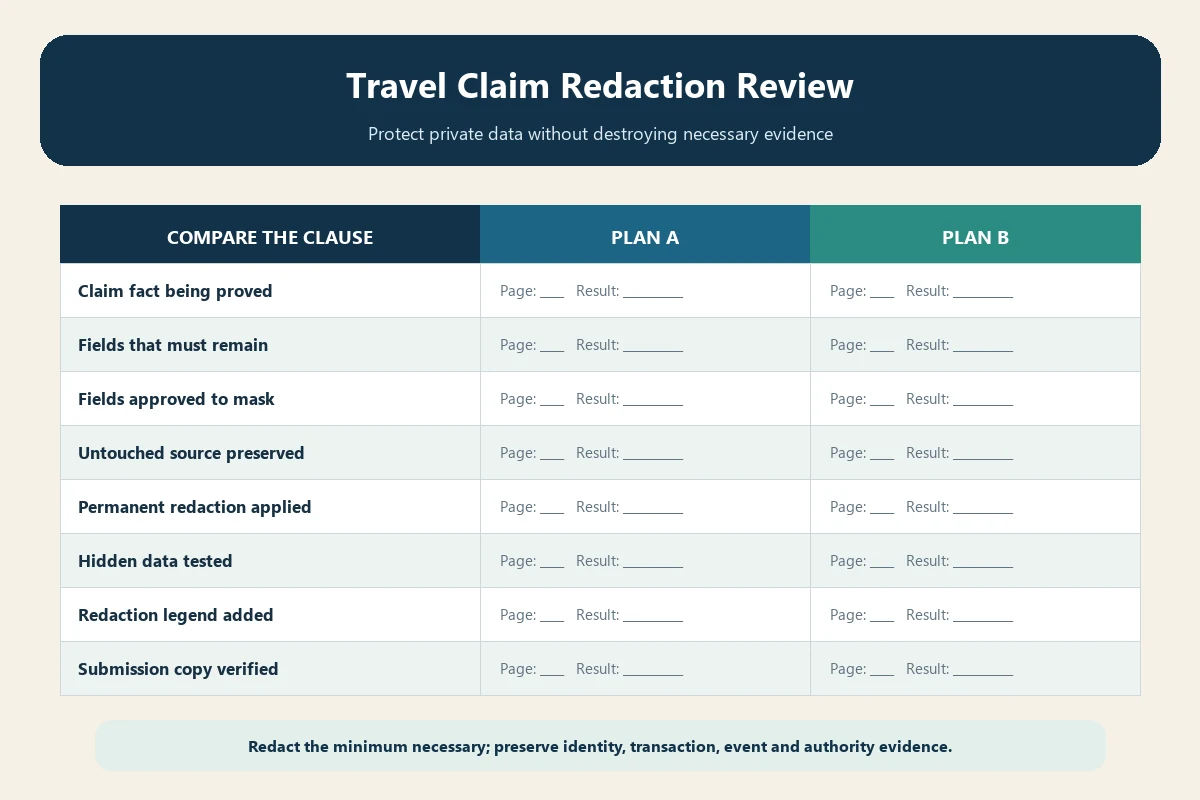
Use a four-part redaction workflow
- Identify the fact: What claim question must the document answer?
- Mark necessary fields: Which names, dates, amounts, issuers, and references prove that fact?
- Limit exposure: Which unrelated sensitive fields can be masked under current instructions?
- Validate the output: Is the redaction permanent, the evidence readable, and the source preserved?
Preserve an untouched source before editing
Save the original download, scan, photo, or issued PDF in a restricted folder. Record its filename, date, issuer, page count, and hash if your workflow uses one. Never overwrite it with the redacted copy.
Name the working file clearly, such as bank-statement-redacted-for-claim.pdf. Our original-versus-copy guide explains version control for claim evidence.
Ask for document-specific instructions
Request the exact fields needed and whether partial masking is accepted. Do not rely on a generic privacy article when the administrator has issued a current checklist. Record the representative, date, claim number, and written answer.
Berkshire Hathaway Travel Protection instructs claimants submitting a card or bank statement as proof of payment to black out or redact the credit-card or bank-account number for privacy protection. That is a useful U.S. example, not a universal instruction for every field or insurer.
Bank statements: preserve the transaction chain
Keep the statement owner, financial institution, statement period, transaction date, merchant or payee, amount, currency where shown, posting status, and enough account identifier to connect the page to the claimant when required. Mask the full account number under the administrator’s instructions.
Do not hide all other lines in a way that removes running totals, headers, page numbers, or context the insurer specifically requested. If you limit the page range or unrelated transactions, say so in a cover note.
Credit-card statements: show the charge and card link
Retain cardholder name, issuer, billing period, transaction, date, merchant, amount, and last digits where requested. Hide the full card number and security code; a CVC should not appear on an ordinary statement submission.
Revolut’s U.S. travel claim guidance gives an example of requesting a statement showing the last four digits and the common-carrier charge. Use the actual benefit administrator’s requirements for your claim.
Receipts and invoices: do not hide the purchase facts
Preserve vendor, date, location, item or service description, quantity, taxes, currency, total, payment status, refund, invoice number, and traveler or patient where present. Loyalty numbers or unrelated contact details may sometimes be masked, but ask first.
A cropped receipt that removes the vendor header or total can look cleaner while proving less. If no receipt exists, use our claim without receipts guide instead of manufacturing a substitute.
Medical records require relevance and continuity
Do not redact diagnosis, symptom dates, treatment, clinician identity, medical advice, service date, or patient identifiers needed for the specific claim unless the administrator agrees. Unrelated conditions or third-party data may raise legitimate privacy questions, but unilateral removal can prevent a pre-existing-condition or medical-necessity review.
Ask the examiner to define the medical question and date range. Use our medical records authorization guide to address scope before sending a broad chart.
Protect third-party information carefully
Police reports, group itineraries, family statements, witness records, and shared invoices can contain addresses, phone numbers, passport data, medical facts, or account details belonging to others. Identify which third-party fields are necessary to establish the event, relationship, allocation, or witness.
Do not remove a companion’s name if the policy benefit depends on that person’s identity and relationship. Ask how to handle irrelevant third-party identifiers.
Government IDs and passports
Submit only the requested page or fields. The insurer may need the insured’s name, photograph, date of birth, nationality, issue or expiration date, passport number, residency, stamps, or visa evidence depending on the claim. Do not assume every field may be masked.
Watermarking a working copy may be allowed in some workflows, but it can obscure machine-readable zones, stamps, or authenticity features. Obtain permission and keep the watermark away from required data.
Death and estate records
A death certificate, Consular Report of Death Abroad, letters testamentary, or court order can contain sensitive identifiers and family details. The administrator may need the deceased person, date, place, issuing authority, cause where relevant, representative, court, case, and effective appointment.
Use the deceased traveler estate guide to map authority and payee before redacting probate records.
Payment instructions are not proof-of-loss pages
Banking details required to receive an approved payment should go through the designated secure form or portal. Do not place a full routing and account number in an evidence index, narrative, or ordinary email merely because the claim also includes a bank statement.
Follow our claim payment method guide and keep the redacted payment confirmation separate from the full secure instruction.
Never use a visual overlay alone
Drawing a black rectangle over PDF text may leave the underlying text selectable, searchable, or recoverable. Use a trusted redaction function that removes the content, then save a new file. Flattening can help in some workflows but is not a substitute for validating the result.
Test the final copy by searching, selecting, copying, inspecting comments and layers, and reopening it in another viewer. Do not publish the file to an online redaction service without evaluating confidentiality and authorization.
Remove hidden metadata only with care
Comments, revision history, embedded attachments, form data, filenames, author names, GPS coordinates, and thumbnails can expose information. But metadata can also support authenticity or chronology. Preserve the source and ask whether a sanitized submission copy is appropriate.
Do not change creation dates, signatures, issuer metadata, or content to make a record appear more favorable.
Do not alter a completed signature package
Redacting a form after the claimant, physician, representative, witness, or notary signs it can change the document the person approved and may break an electronic audit trail. Identify privacy concerns before signature whenever possible. If the signed original contains information that should not travel through the ordinary evidence channel, ask the administrator whether to submit the intact document through a more secure route and a labeled redacted reference copy through the portal. Preserve both versions and never paste a signature from the source onto a newly edited page.
Explain material redactions
Add a short legend: “Full account number masked; last four digits retained. Unrelated transactions on pages 2–3 masked. Statement owner, period, bank, claimed merchant, date, and amount remain visible.” Avoid vague labels such as “private.”
If the examiner needs an unredacted field, ask for the minimum field and secure channel. Maintain a log of the request, reason, response, version, and delivery.
Compare redaction with cropping
Cropping removes context and may hide page boundaries. Redaction shows that content existed but was intentionally removed. Extracting one page can be appropriate when the administrator requests it, but preserve the statement header and page number and disclose the limited page range.
Never stitch unrelated fragments into a page that looks like an original statement.
Match the evidence to the claim question
| Question | Usually visible | Potential masking subject to instruction |
|---|---|---|
| Who paid? | Owner, issuer, last digits, transaction | Full account number |
| What was bought? | Vendor, item/service, date, amount | Unrelated loyalty details |
| Who was treated? | Patient, provider, dates, relevant clinical facts | Unrelated third-party data |
| Who may sign? | Person, capacity, issuing authority, effective date | Unrelated estate details |
| Where should payment go? | Secure payee form fields | Redacted confirmation outside secure channel |
Validate the submission copy
Compare page count, names, dates, amounts, totals, signatures, seals, and identifiers against the source. Confirm every claimed line remains readable. Search for masked text and inspect the file on another device.
Then follow the portal upload troubleshooting guide to verify format, size, indexing, and receipt.
Respond to an over-redaction request
Ask which missing field prevents review and what claim issue it addresses. Provide a narrower replacement or the requested unredacted page through the approved secure channel. Label the new file as superseding the earlier version.
Travel Guard’s required-document page demonstrates why core facts must remain: it requests proof of payment, bills, invoices, relevant card or bank statements, and refund information for various benefits.
Redaction checklist
- Untouched source preserved securely
- Claim fact and required fields identified
- Administrator instructions obtained
- Only unnecessary sensitive data masked
- Permanent redaction tool used
- Hidden layers, comments, and metadata reviewed
- Material redactions explained
- Final copy compared with source and reopened
- Secure submission and receipt retained
Bottom line
Good redaction is not maximum black ink. It is a documented, field-level decision that protects unnecessary sensitive data while preserving every fact the insurer needs to evaluate identity, coverage, event, expense, refund, authority, and payment. Keep the source, submit a validated copy, and ask before hiding a field that may be material.
