
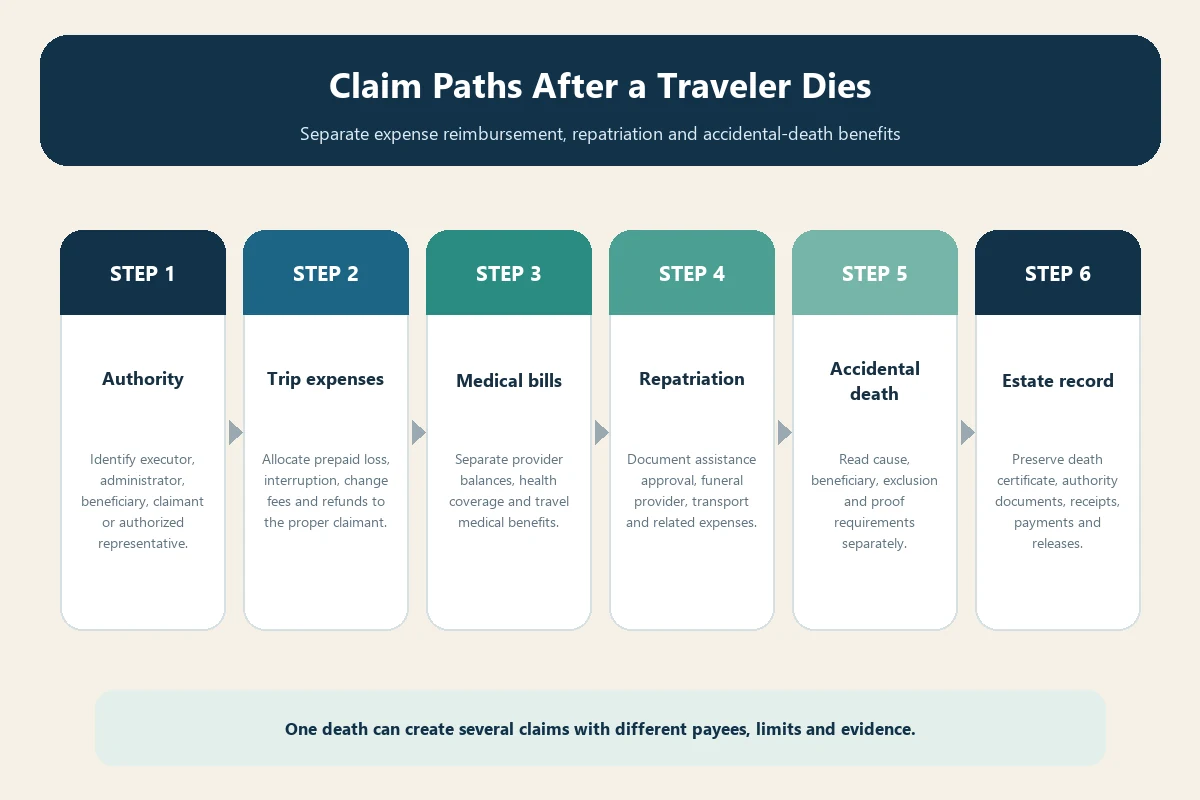
A travel insurance claim after a deceased traveler’s death can involve several separate benefits, payees, and legal roles. Medical expenses, trip interruption, repatriation of remains, local burial, baggage, and accidental death benefits are not one claim. A named beneficiary may receive an accidental death benefit, while reimbursement for an expense may be payable to the person who paid, a provider, or the estate under the contract and law.
Contact the insurer’s emergency assistance and claims teams promptly. Ask for written instructions that identify each possible benefit, required documents, claimant, and payment recipient. Do not assume that being next of kin, holding a prior power of attorney, or paying an expense automatically gives authority over every benefit.
Key takeaways
- Open separate claim lanes for expenses, repatriation, and any accidental death benefit.
- Confirm who has authority to act and who is entitled to payment for each lane.
- A foreign death may require local records and a Consular Report of Death Abroad.
- Preserve itemized invoices, proof of payment, supplier refunds, and assistance approvals.
- Power of attorney commonly ends at death; estate or beneficiary authority must be documented separately.
First response: assistance before paperwork
When a traveler dies abroad, contact local authorities, the treating facility, the U.S. embassy or consulate when applicable, the tour or cruise operator, and the policy’s emergency assistance number. The assistance company may coordinate funeral homes, documentation, transport, local burial, or return of remains under the policy.
Do not independently authorize expensive transport based only on an assumption of coverage when assistance coordination is reasonably possible. At the same time, follow urgent local legal and public-health requirements. Record every call, representative, case number, instruction, and reason the family could not contact the carrier sooner.
Identify every policy and benefit
Locate the declarations, certificate, endorsements, assistance card, booking protection, credit-card benefits, health coverage, and any separate life or accident policy. Verify the insured traveler, coverage dates, trip, beneficiary designation, and benefit limits.
Create a benefit table for emergency medical, evacuation, repatriation of remains, local burial, trip interruption, companion return, family visit, baggage, accidental death and dismemberment, and other listed benefits. Do not infer a benefit from the policy name.
Expense reimbursement versus death benefit
Expense benefits reimburse eligible costs under the contract. The proper recipient can depend on who incurred or paid the expense, direct-billing arrangements, assignment, estate rules, and policy language. A funeral home or hospital may be paid directly, or a family member may seek reimbursement with proof of payment.
An accidental death benefit is different. It can pay a stated amount to a named beneficiary when the death fits the covered accident definition and exclusions. It is not automatically equal to funeral or trip cost. Natural-cause death may trigger trip or repatriation benefits without triggering accidental death coverage.
Who can submit the claim?
The insurer may communicate with the named beneficiary, executor, administrator, court-appointed personal representative, surviving joint insured, authorized family contact, or person who paid an expense, depending on the benefit. Ask which status is required and which document proves it.
A relative’s closeness does not automatically establish legal authority. The named beneficiary for one benefit does not necessarily control the estate’s reimbursement claim. Multiple beneficiaries, minors, trusts, and contested estates require special handling.
Power of attorney after death
A power of attorney generally authorizes an agent to act during the principal’s life and commonly terminates at death, subject to applicable law. Do not continue signing as agent without confirming authority. After death, authority can shift to an executor, administrator, personal representative, trustee, beneficiary, or another legally recognized person.
Ask the carrier what estate documents it accepts. For material or disputed matters, consult probate or insurance counsel in the relevant jurisdiction.
Core identity and authority documents
- certified or official death record accepted by the insurer;
- policy and claim number;
- deceased traveler’s identifying information;
- claimant’s government identification and contact details;
- beneficiary designation when an accidental death benefit is claimed;
- will, letters testamentary, letters of administration, small-estate affidavit, trust record, or court order when applicable;
- marriage, birth, guardianship, or representative documents when required; and
- tax or payment forms requested by the carrier.
Do not send original irreplaceable documents unless required and a safe return process is confirmed. Ask whether certified copies or secure digital copies are accepted.
Death certificate and cause documentation
The insurer can require an official death certificate and may need cause, manner, date, and place of death for the benefit claimed. Accidental death review can require police, coroner, medical examiner, toxicology, autopsy, or incident records. Repatriation claims can require funeral-home and transport documents.
If a cause is pending, submit notice and available proof, state which authority is completing the record, and ask to supplement. Do not speculate or pressure a certifying official to use insurance terminology.
Death abroad and consular records
For a U.S. citizen who dies abroad, a U.S. embassy or consulate can assist families and may prepare a Consular Report of Death Abroad based on local documentation. It is an important U.S. record, but the insurer can still request local death, medical, police, or transport records.
Names, dates, and places can appear differently across languages and systems. Preserve originals, obtain required translations, and create a discrepancy note rather than altering a record.
Repatriation of remains
Repatriation can involve preparation, embalming or cremation, local permits, a hermetically sealed container, funeral-home coordination, cargo booking, ground transfers, consular documents, and public-health requirements. Coverage depends on the certificate, limits, exclusions, and assistance process.
Use our repatriation of remains process guide. Keep itemized invoices and assistance approvals. A local burial benefit can have a different limit and is not automatically interchangeable with repatriation.
Commercial transport and cremated remains
Airlines and cargo operators have their own acceptance, packaging, documentation, and routing rules. Transportation of cremated remains can also involve security screening and carrier requirements. Check the operating carrier and current government guidance before travel.
Our commercial-flight repatriation guide addresses medical passenger transport, but deceased-remains transport is a different operational process. Do not use a patient escort workflow for human remains.
Medical bills before death
Separate each hospital, physician, ambulance, pharmacy, and assistance charge. Obtain itemized bills, clinical records, translations, proof of payment, and any health-plan EOB. Identify who paid and whether the provider seeks a balance from the estate.
Follow the foreign medical bill claim guide. Do not combine medical treatment with funeral or repatriation expenses in one total.
Trip cancellation or interruption expenses
If death occurred before departure, another insured traveler may have a cancellation claim when the event fits the covered-reason and relationship definitions. If death occurred during travel, unused arrangements, new transportation for companions, and other interruption costs need separate proof.
Obtain original bookings, payments, cancellation or interruption dates, supplier statements, refunds, credits, and new travel receipts. The policy’s definition of family member, traveling companion, and trip start controls.
Supplier refunds after death
Airlines, cruise lines, hotels, and tour operators may issue compassionate refunds or credits after the insurance file opens. Report every recovery. A nontransferable credit in a deceased traveler’s name presents a different issue from cash, but it still must be disclosed with its terms.
Use our supplier refund statement guide and later recovery guide. Do not assume death automatically cancels or transfers a supplier credit.
Accidental death benefit review
Read the covered accident definition, exclusions, conveyance or common-carrier terms, coverage period, beneficiary provision, and proof requirements. A death that happens while traveling is not automatically accidental, and an accident benefit can have narrower conditions than medical or repatriation coverage.
Provide official factual records and let the carrier make the contractual decision. If a denial cites an exclusion or beneficiary issue, request the precise wording and evidence used.
Payment and multiple claimants
Do not ask the insurer to split funds informally among relatives. Provide the beneficiary or estate documentation it requests. If beneficiaries disagree, the carrier may require additional releases, court direction, or another formal process.
For expense reimbursement, show the payer on each receipt. A family member who paid a funeral home may have a different claim position from the estate or named beneficiary. Request a written payment allocation.
Privacy and communications
Death does not make all medical and claim records public. Providers, insurers, estates, and representatives must follow applicable privacy and authority rules. Use secure portals and limit group emails containing passports, death records, medical files, or banking information.
Keep a communication log and designate one authorized family contact when possible. Ask the insurer to confirm whom it may speak with and obtain necessary consents or authority documents.
Deadline management
Death investigations and estate appointments can take time. Give prompt notice, open every relevant benefit, submit available proof, identify pending official records, and request written supplementation instructions. Follow our notice and proof-of-loss guide.
Do not assume probate, consular processing, or a pending autopsy extends insurance deadlines. Calendar appeal and legal-action periods separately.
Claim packet structure
- Cover sheet listing policy, deceased insured, claimant, authority, and benefits claimed.
- Certificate, declarations, and beneficiary record.
- Official death and cause records, with translations.
- Authority documents for each claimant or representative.
- Assistance, consular, police, coroner, and funeral-home records.
- Separate medical, repatriation, burial, interruption, and baggage expense schedules.
- Proof of payment, supplier refunds, other insurance, and reconciliation.
- Secure payment and tax forms requested by the carrier.
FAQ
Does the beneficiary receive every claim payment?
No. A beneficiary designation can govern a specific death benefit, while expense reimbursements may be payable differently.
Can a power of attorney keep handling the claim?
It commonly ends at death. Confirm post-death authority with the insurer and applicable law.
Is a Consular Report of Death Abroad enough?
It is important, but the insurer may require local death, medical, incident, or expense records for the claimed benefit.
What if the final death certificate is delayed?
Give notice, submit available records, identify the issuing authority, and request written permission to supplement.
Bottom line
After a traveler dies, separate assistance, expense reimbursement, repatriation, and accidental death benefits. Confirm who has authority and who may be paid for each claim, preserve official death and financial records, disclose refunds, and protect deadlines while consular or estate documents are pending. Compassionate handling still requires precise benefit and payee documentation.
Sources
- U.S. Department of State — Death Abroad
- U.S. Department of State — Consular Report of Death Abroad
- CDC — Importation of Human Remains
- TSA — Cremated Remains
- NAIC — What to Know About Travel Insurance
- New York DFS — Travel Insurance
Reviewed August 16, 2026. This article is general educational information, not legal, probate, tax, medical, funeral, or coverage advice. Requirements vary by policy and jurisdiction.