
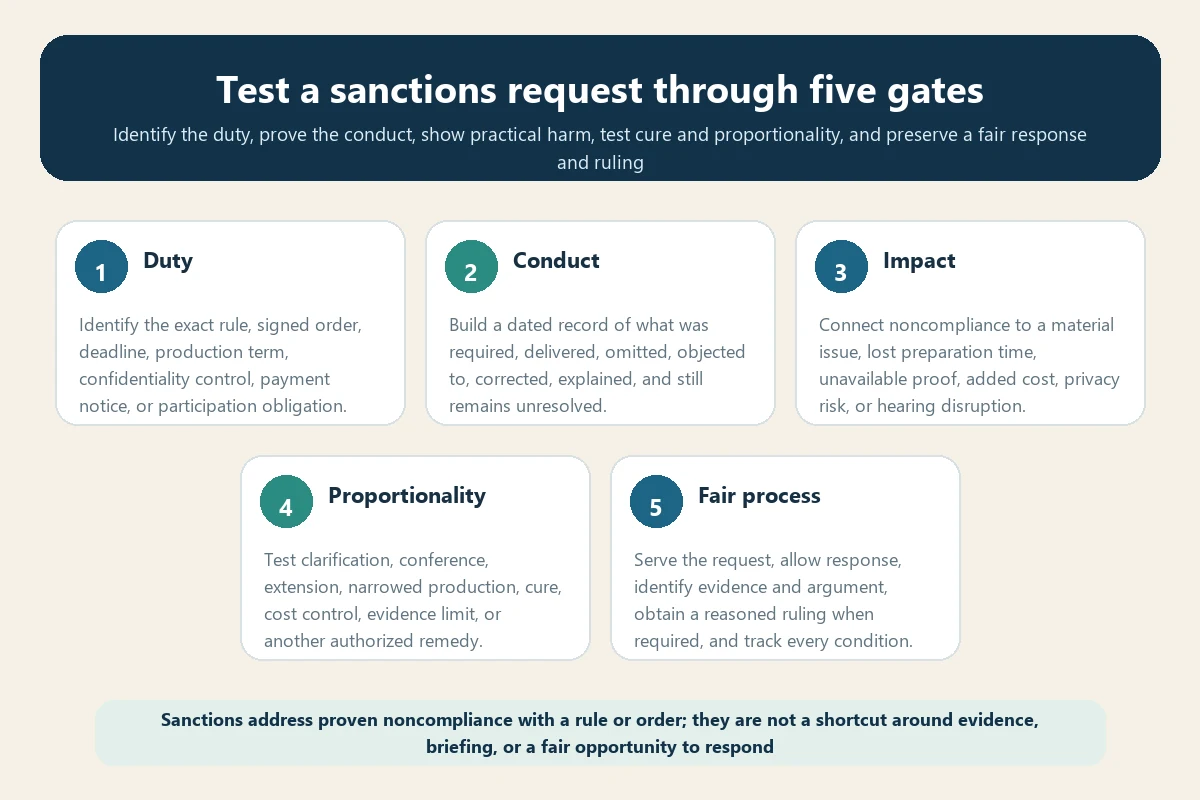
A travel insurance arbitration sanctions request asks the arbitrator to address a party’s failure to comply with an obligation under the governing rules or an arbitrator’s order. It should identify the exact duty, prove the conduct, explain practical harm, document cure attempts, and request proportionate relief.
Sanctions are not a substitute for an evidence objection, ordinary merits argument, deadline request, or disagreement over policy coverage. The arbitration agreement, current provider rules, case orders, and applicable law control. This U.S. consumer guide provides general information, not legal advice.
Confirm that a sanctions rule governs the case
Current AAA Consumer Arbitration Rules permit the arbitrator, on a party request, to order appropriate sanctions against a party that fails to comply with obligations under the rules or an arbitrator’s order. Verify the rule edition applicable when the case was filed and any agreement or order that changes procedure.
AAA’s official 2024–2025 rule changes summary explains that sanction authority was added to the Consumer Rules. That timing makes the applicable filing date and rule version especially important.
Do not use an archived consumer rule, commercial rule, employment rule, court rule, or another arbitration forum’s sanctions provision without authority. The word “arbitration” does not make procedures interchangeable.
Identify the exact duty allegedly violated
Quote the operative language and cite the rule or signed order. Identify the responsible party, required act, deadline, format, scope, service method, confidentiality term, and any stated consequence. If the order is ambiguous, seek clarification before asserting willful defiance.
Common disputes can involve information exchange, exhibit delivery, confidentiality, witness availability, motion limits, hearing conduct, payment, or compliance with a corrective instruction. Different rules may govern each.
Separate noncompliance from a good-faith dispute
A party may object to scope, privilege, burden, relevance, privacy, cost, format, or authority. Determine whether the objection was timely, specific, supported, and presented through the authorized process. An unresolved objection is not automatically misconduct.
Use the arbitration motion practice guide to obtain a ruling when the parties genuinely disagree. Sanctions become a different question after the governing duty is clear and noncompliance remains.
Build a neutral compliance chronology
| Date | Record | Control question |
|---|---|---|
| Order date | Signed order and transmitted copy | What exactly was required? |
| Notice date | Portal receipt, email, or service proof | Did the responsible party receive it? |
| Due date | Calendar and time zone | Was the deadline modified? |
| Response | Production, objection, explanation, or silence | What was delivered or disputed? |
| Cure effort | Conference, deficiency notice, extension | Could the problem be corrected? |
| Current gap | Itemized unresolved requirement | What remains material now? |
A dated chronology is more reliable than adjectives such as “repeated,” “deliberate,” or “bad faith.” Use those characterizations only when supported and legally relevant.
Prove receipt and operative notice
Confirm the correct party, representative, address, portal account, delivery method, sent time, receipt status, attachments, and later corrections. Check whether counsel withdrew, an address changed, a file was inaccessible, or the order was superseded.
Do not seek severe relief on the assumption that a person saw an informal message. Preserve the administrator’s transmission and the actual operative order.
Define the unresolved item precisely
For document disputes, identify request number, ordered scope, custodian, date range, format, production reference, missing item, and why the existing response is deficient. Avoid claiming “nothing was produced” when partial production exists.
The document exchange checklist helps compare requests, responses, objections, versions, metadata, privilege logs, and receipt proof. A sanctions record should use the same stable identifiers.
Connect the conduct to material impact
Explain how the noncompliance affects a policy element, defense, witness examination, exhibit authentication, damages calculation, hearing preparation, privacy protection, or scheduled event. Quantify extra review time or vendor cost when reliable.
Do not inflate inconvenience into case-ending prejudice. If the missing item is duplicated elsewhere or no longer material, disclose that fact and narrow the request.
Attempt an authorized cure first
When appropriate, send a focused deficiency notice, confer, clarify scope, offer a secure method, propose a short extension, request a status conference, or ask for a staged production. Record the response and remaining gap.
A cure effort can protect hearing time and show proportionality. It does not require waiving the original deadline, privilege, or objection. State any reservation clearly and professionally.
Choose relief that fits the problem
Start with the smallest authorized measure that can restore fairness and move the case forward. Depending on the governing authority and facts, a party might request compliance by a firm date, clarification, narrowed exchange, secure access, supplemental response, revised questioning, cost control, an evidence-related limitation, or another tailored order.
Do not present every possible sanction as automatically available. Explain the authority for the specific remedy and why a less restrictive step would not cure the demonstrated harm.
Distinguish sanctions from evidence objections
An evidence objection asks whether and how a document, answer, or demonstrative should be considered. A sanctions request addresses failure to comply with a rule or order. Late evidence can raise both questions, but each needs its own standard, facts, and remedy.
Use the evidence objections guide for relevance, duplication, privilege, source, completeness, translation, privacy, and timing. Do not call exclusion a sanction when it is simply an admissibility ruling.
Distinguish sanctions from nonpayment remedies
Current AAA consumer rules contain a separate nonpayment provision addressing unpaid administrative fees or arbitrator compensation. It includes notice, response opportunities, possible participation limits, suspension, termination, and business-payment consequences under stated conditions.
Check the arbitration cost guide and current fee schedule. Do not recast every payment dispute as a general sanctions application or assume the consumer owes a business allocation.
Request permission and follow motion procedure
Determine whether the arbitrator requires advance permission, a conference, letter request, page limit, exhibit limit, response period, reply, or oral argument. A sanctions rule does not erase the general motion process.
State the requested ruling at the beginning, then organize authority, duty, chronology, unresolved conduct, impact, cure efforts, proportionality, and proposed order. Keep the merits case separate except where necessary to show material effect.
Use controlled exhibits
Attach the operative rule, order, service proof, request and response, production index, deficiency notice, conference record, cost evidence, and proposed order as authorized. Use stable page labels and redact unrelated private information.
Coordinate attachments with the arbitration exhibit list. A motion attachment is not automatically a hearing exhibit or admitted evidence.
Provide the required opportunity to respond
Current AAA Rule R-57 requires the party subject to the sanctions request to have an opportunity to respond before the arbitrator decides the application. Serve every party as required and follow the ordered response time.
Do not request immediate adverse relief through a private message. If urgent protection is necessary, identify the emergency, authority, temporary measure, notice provided, and requested response process.
Answer a sanctions request issue by issue
Identify whether the cited duty applies, the order was clear and received, the deadline remained operative, compliance occurred, an objection or extension was pending, substantial justification exists, a cure is available, and the requested remedy is authorized and proportionate.
Attach a clean compliance matrix and missing files rather than relying only on argument. If an error occurred, acknowledge it precisely, explain the cause, complete the cure, and propose safeguards against recurrence.
Protect privilege and confidential information
A sanctions response should not reveal privileged advice merely to explain conduct. Identify the privilege issue, preservation step, log, and requested review process without disclosing protected substance beyond what is necessary.
Use the arbitration confidentiality guide for redaction, restricted access, secure transfer, trade secrets, medical information, and third-party data.
Understand limits on participation sanctions
Under current AAA Rule R-57, when a sanction limits a party’s participation or causes an adverse determination of an issue, the arbitrator must explain the order in writing and require evidence and legal argument before making an award. The rule also states that a default award may not be entered as a sanction.
That means the requesting party still needs a sufficient record. The default hearing guide explains why absence or participation limits do not replace proof.
Preserve the written ruling
Record the request, response, reply, evidence, hearing, ruling date, findings, relief granted and denied, conditions, cure deadline, cost allocation if authorized, evidence effects, participation limits, and downstream schedule changes.
If the order is unclear, request clarification through the approved channel. Do not privately expand a narrow ruling into a broader exclusion, adverse finding, or claim dismissal.
Compare another forum carefully
FINRA Rule 12511 contains specific discovery-sanctions authority for FINRA customer arbitration, including provisions tied to noncooperation, frivolous objections, and intentional material failure after prior measures. Those securities rules do not govern an AAA travel insurance dispute.
FINRA’s sanctions examples can illustrate why forum identification matters, not supply authority. Use only the rule set incorporated into or otherwise applicable to the actual case.
Avoid common sanctions-request mistakes
- Citing no exact rule or operative order.
- Treating a timely good-faith objection as automatic misconduct.
- Using conclusions instead of a dated compliance record.
- Ignoring partial compliance or a practical cure.
- Seeking case-ending relief for a narrow correctable problem.
- Combining nonpayment, evidence, and sanctions standards.
- Submitting uncontrolled private or privileged information.
- Denying the targeted party a response opportunity.
- Assuming a sanction eliminates the need for evidence.
- Importing a remedy from another arbitration forum.
Final sanctions request checklist
- Verify the governing agreement, rule edition, and motion procedure.
- Quote the exact obligation and operative order.
- Prove notice, deadline, conduct, and unresolved gap.
- Separate noncompliance from an unresolved good-faith dispute.
- Connect the conduct to material and documented impact.
- Attempt clarification or cure when appropriate.
- Request the narrowest authorized effective remedy.
- Serve every party and allow the required response.
- Preserve evidence and legal argument despite any sanction.
- Track the written ruling, conditions, and revised schedule.
A professional sanctions request is an evidence-based compliance application, not a punishment narrative. Prove the governing duty, create a neutral chronology, show material impact, test a workable cure, request proportionate relief, and protect the other party’s opportunity to respond.
