
Travel insurance arbitration confidentiality is not automatic or unlimited. An arbitration hearing may be private, and an arbitrator or administrator may owe confidentiality duties, while the parties remain able to discuss or use some information unless an agreement, rule, order, or law restricts them.
Separate privacy, confidentiality, privilege, sealing, and data security. They protect different interests and have different exceptions. Read the arbitration agreement, governing rules, case orders, applicable law, and later court requirements. This guide provides general information, not legal advice.
Start with the complaint vs arbitration comparison if a state insurance department record is also involved, because the two tracks can follow different disclosure and public-record rules.
Private is not the same as confidential
A private hearing excludes the general public from attending. Confidentiality controls whether information may be disclosed or used and by whom. A proceeding can be private without imposing a blanket gag rule on every participant.
The Consumer Financial Protection Bureau’s official Arbitration Study discusses the distinction between arbitration as a private process and confidentiality. Use that distinction as a starting point, then identify the actual terms governing the case.
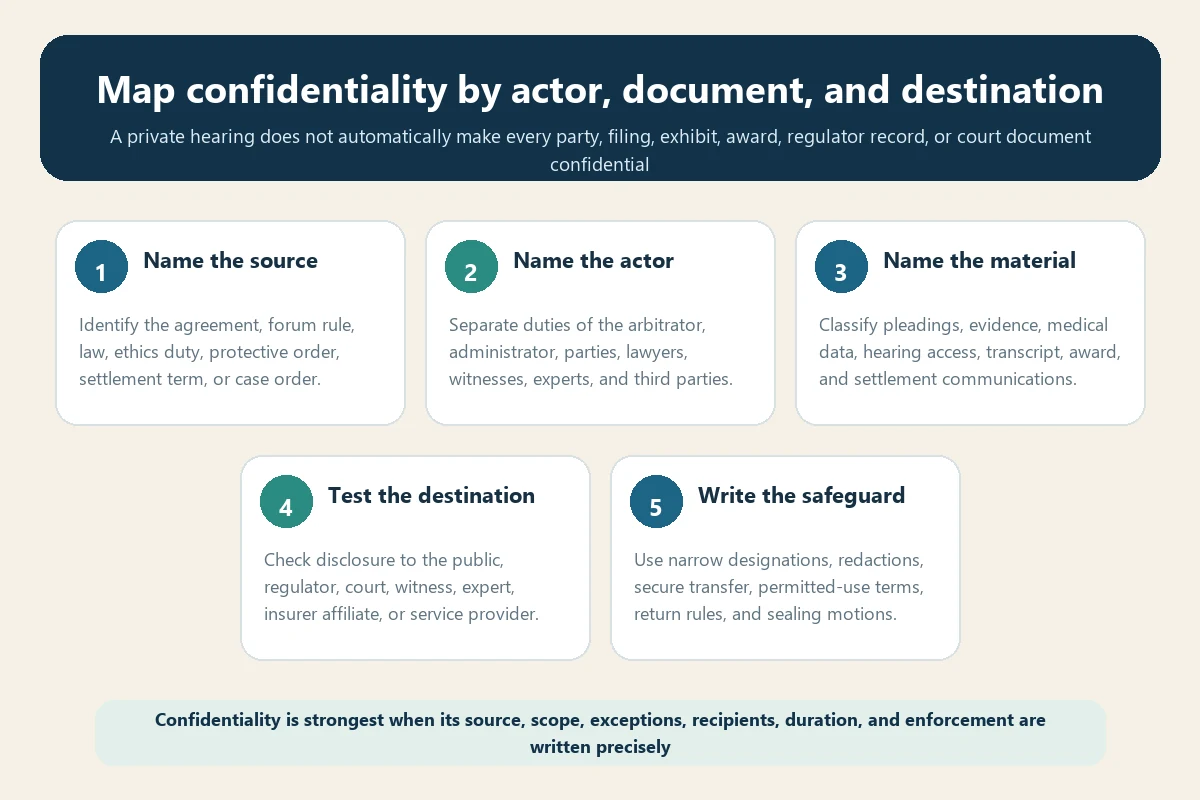
Build a confidentiality source hierarchy
Collect and compare:
- The travel insurance policy and arbitration clause.
- Any incorporated forum rules and their effective date.
- The case administrator’s notices and portal terms.
- The arbitrator’s confidentiality or protective order.
- A separate nondisclosure or settlement agreement.
- Applicable federal and state law.
- Professional ethics or privilege rules.
- Court filing, redaction, access, and sealing rules.
- State insurance department confidentiality and public-record rules.
When sources conflict, do not choose the broadest promise. Obtain qualified advice about hierarchy, enforceability, and exceptions.
Identify who owes the duty
Create rows for the arbitrator, administrator, claimant, insurer, attorneys, representatives, witnesses, experts, vendors, interpreters, court reporters, and third-party record holders. A duty binding one actor may not bind another.
California’s official Ethics Standard 15, for example, restricts an arbitrator’s use or disclosure of information received in confidence and bars advance disclosure of the award. It does not by itself create a universal confidentiality contract binding every party in every jurisdiction.
Read the current forum rule
If AAA administers the matter, review the current AAA Consumer Arbitration Rules. The rules address confidentiality disputes, privileges, hearings, evidence, awards, and case administration.
AAA’s official consumer arbitration overview explains that AAA and arbitrators have confidentiality obligations under applicable rules and ethics standards, while parties generally may disclose details unless they have a confidentiality agreement. Confirm the exact current rule and any case-specific order.
Classify the material
Do not label the entire case “confidential” without categories. Separate:
- Demand, answer, defenses, and counterclaims.
- Policy, claim file, and ordinary business records.
- Medical, financial, identity, and minor information.
- Document exchange and privilege logs.
- Witness statements, expert reports, and subpoenas.
- Hearing access, recording, transcript, and exhibits.
- Interim orders and final award.
- Settlement communications and signed settlement.
- Regulator submissions and complaint records.
- Later court petitions, exhibits, orders, and judgment.
Each category may have a different source, exception, and retention rule.
Distinguish confidentiality from privilege
Privilege can protect defined communications, such as attorney-client communications under applicable law. Confidentiality may limit disclosure or use of material without making it privileged. A confidential business document is not automatically immune from ordered exchange.
The arbitrator may be required to consider applicable privilege principles. Record the protection asserted, jurisdiction, holder, document, participants, purpose, waiver concern, and log requirement rather than using “confidential” as a substitute.
Use a protective order for specific risks
A protective order can define protected material, permitted recipients, use limited to the case, designation method, challenges, redaction, secure transfer, hearing treatment, court filing, return or destruction, exceptions, and duration.
Ask for terms proportionate to actual medical, identity, financial, proprietary, or third-party information. An order that marks everything confidential can create unnecessary disputes and make compliance unclear.
Draft clear designation levels
One level may cover ordinary confidential information available to parties and their case teams. A narrower level may apply to highly sensitive material with limited access. Define objective criteria and avoid labels based only on embarrassment or litigation strategy.
Specify how designations appear in file names, page headers, transcripts, native files, physical exhibits, and later replacements.
Define permitted recipients
List parties, counsel, named employees, arbitrator, administrator, experts, witnesses, interpreters, vendors, and court reporters as appropriate. State whether each recipient must sign an acknowledgment and what may be shown before acknowledgment.
Consider insurer affiliates, reinsurers, regulators, auditors, tax advisers, healthcare providers, law enforcement, and courts. Do not assume they are automatically included or excluded.
Limit use, not only disclosure
A useful order states whether protected material may be used only to prosecute, defend, settle, enforce, or review the arbitration. Address training, marketing, unrelated claims, model development, public relations, and competitive use if relevant.
Separate use of facts already known independently from use of documents produced under the order.
Protect medical records proportionately
Limit the medical date range and subject matter to the claimed condition, event, causation, treatment, expense, or policy issue. Redact unrelated diagnoses, account details, identity numbers, and third-party information where allowed.
Use the arbitration document exchange checklist to index redactions, privilege assertions, secure delivery, and production receipts.
Secure electronic delivery
Follow the authorized portal or transfer method. Verify recipients, access expiration, multifactor authentication, encryption, download controls, password channel, file inventory, and breach reporting. Preserve delivery and access records.
Confidentiality language does not prevent a misaddressed email or compromised link. Data security requires operational controls.
Address hearing attendance and recording
Confirm who may attend, whether witnesses are excluded until testimony, whether support persons are allowed, and how interpreters or technical staff participate. Ask whether audio, video, screenshots, photography, transcription, or automated note tools are prohibited or require permission.
For a virtual hearing, confirm private rooms, headphones, visible participants, screen sharing, exhibit access, and what happens if an unauthorized person appears.
Handle transcripts and recordings
Identify who may order a transcript, who pays, who receives it, how corrections occur, where it is stored, and which portions receive designations. If no official record is made, do not create a private recording in violation of rules, orders, platform terms, or law.
State how a transcript may be used in post-hearing submissions, award review, enforcement, or related proceedings.
Do not assume the award remains secret
Review the forum’s award-publication, redaction, data-reporting, and disclosure rules. Determine whether the award identifies parties, amounts, findings, or arbitrator. A contract may require confidentiality while a law or court procedure creates another disclosure route.
Ask whether the arbitrator may include sensitive medical or identity facts in the award and request focused anonymization or redaction where authorized.
Court proceedings create a separate access problem
A party may ask a court to compel arbitration, stay litigation, confirm an award, vacate it, modify it, or enforce judgment. Court filings can be publicly accessible unless sealed or redacted under applicable rules.
Under 9 U.S.C. §13, a party seeking an order confirming, modifying, or correcting an award files specified papers including the agreement, award, notices, affidavits, and related orders. Do not assume the arbitration’s private status automatically seals those judicial papers.
Plan court redactions before filing
Identify protected identifiers, minors, medical details, account information, sealed exhibits, and confidential business records. Read the specific court’s redaction and sealing rules, filing procedures, public-access standard, and motion requirements.
A confidentiality agreement between parties may not bind the court. Seek sealing or restricted access with the required showing rather than filing confidential material publicly and trying to retract it later.
Keep regulator records separate
A state insurance department complaint can have its own confidentiality, retention, disclosure, and public-record rules. Sending an arbitration document to the regulator may create a distinct agency record.
The travel insurance complaint privacy guide explains how to minimize unnecessary sensitive data in that separate track. Do not tell a regulator that a document cannot be disclosed without first checking the agency’s governing law.
Coordinate testimony and witnesses
Tell witnesses what order applies, what documents they may see, whether they may retain copies, and what communications are prohibited during testimony. Obtain required acknowledgments before disclosure.
Do not coach a witness to call ordinary facts confidential. The order protects defined material and use, not truth from scrutiny.
Address experts and service providers
Experts, e-discovery vendors, translators, medical reviewers, demonstrative designers, and technology providers may receive sensitive information. Define their access, security, permitted use, subcontractors, retention, return, destruction, and incident notice.
Use only the minimum material necessary for the assigned task.
Protect settlement communications separately
Settlement offers, mediation communications, and signed settlements may be governed by different rules from merits evidence. Identify admissibility, confidentiality, permitted recipients, no-admission language, tax or regulatory disclosures, and enforcement exceptions.
The travel insurance settlement checklist helps evaluate release scope, payment, withdrawal, confidentiality, and default provisions.
Write exceptions that allow necessary action
Consider disclosures required by law, subpoena, regulator, tax authority, professional adviser, insurer audit, law enforcement, emergency, court filing, award enforcement, or defense against another claim. Define notice and protective steps where legally permitted.
An agreement without workable exceptions can force a party to choose between incompatible obligations.
Define challenge and de-designation procedures
State how a party challenges a designation, whether the material remains protected during review, who bears what burden, and how the arbitrator resolves the dispute. Encourage issue-specific discussion before motion practice if the order requires it.
Record final designation changes in the production index and replace mislabeled files where needed.
Plan return, destruction, and retention
Specify the triggering event, deadline, certification, backup treatment, legal holds, counsel archive, insurer retention duties, regulator obligations, and exceptions for award enforcement. Deleting a working copy does not necessarily erase backups or court records.
Do not promise destruction that conflicts with law, professional duties, or required business retention.
Track confidentiality in a matrix
For each material category, record the source, designation, actor bound, permitted recipients, allowed use, exceptions, storage, hearing treatment, court treatment, challenge status, and end-of-case disposition. Update the matrix after every order.
At the arbitration preliminary hearing, use the matrix to request concrete procedures rather than a vague declaration that “everything is confidential.”
Common mistakes
- Equating a private hearing with blanket confidentiality.
- Assuming the arbitrator’s duty automatically binds the parties.
- Using confidentiality as a substitute for privilege.
- Marking every document confidential without criteria.
- Ignoring witnesses, experts, vendors, and insurer affiliates.
- Sending sensitive files through an insecure channel.
- Recording a hearing without authorization.
- Assuming an award or later court filing stays sealed.
- Transferring arbitration records to a regulator without checking agency rules.
- Promising destruction that conflicts with retention duties.
Final confidentiality checklist
- Agreement, rules, law, and case orders collected.
- Every covered actor identified.
- Material categories classified separately.
- Privilege and confidentiality distinguished.
- Designation, recipients, use, and exceptions written clearly.
- Medical and identity data minimized and secured.
- Hearing attendance, recording, and transcript rules confirmed.
- Award and court-filing risks assessed.
- Regulator and settlement records treated as separate tracks.
- Challenge, return, destruction, and retention procedures documented.
Bottom line
Travel insurance arbitration can be private without making the entire matter confidential. Determine exactly which source binds which actor, protects which material, permits which use, and applies at which stage.
Use narrow protective terms, secure delivery, consistent designations, necessary exceptions, and a plan for awards, regulator records, and court filings. Obtain qualified advice when privilege, sealing, public access, legal reporting, enforcement, or incompatible confidentiality obligations could affect the case.
