

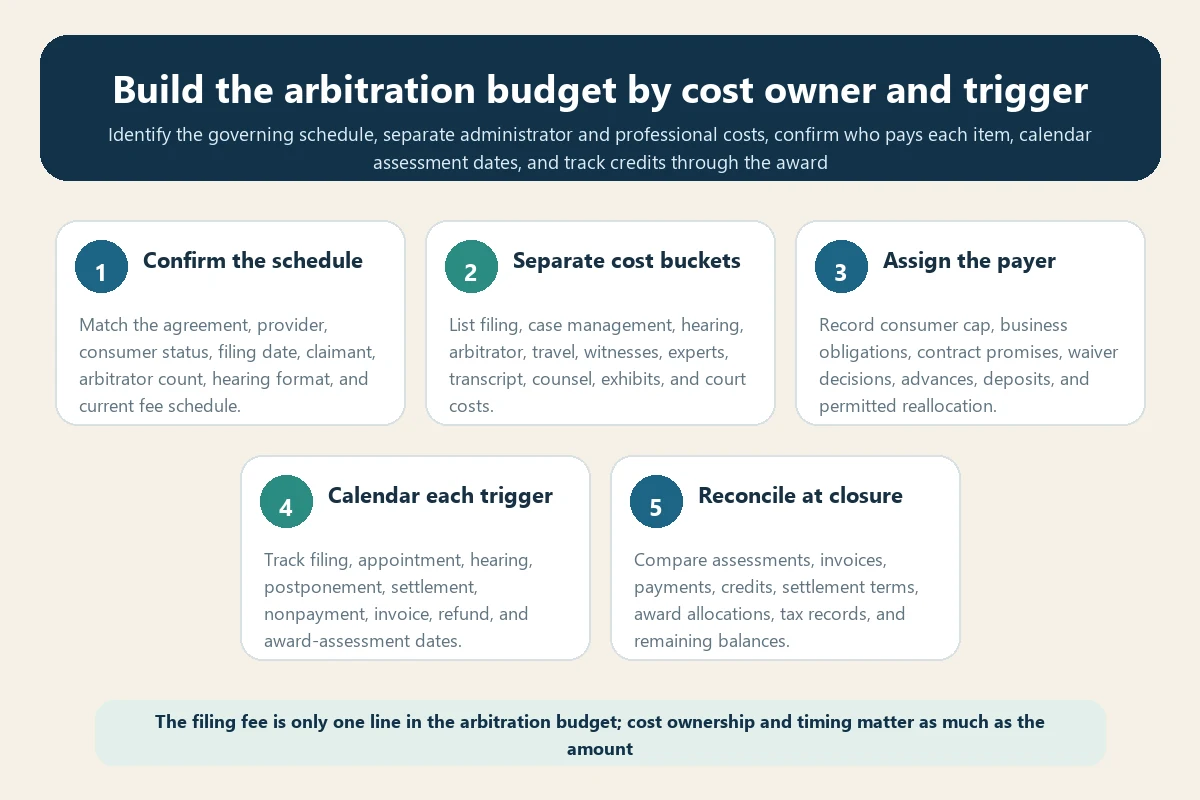
Travel insurance arbitration cost depends on the provider, governing rules, consumer status, filing date, agreement, number of arbitrators, hearing format, professional help, evidence, and case length. The filing fee is only one line. Attorney, expert, transcript, witness, travel, document, and court costs can exceed the amount paid to the arbitration administrator.
Use the current fee schedule for the actual case and obtain written assessments from the provider. This guide uses the AAA individual consumer framework as a current U.S. example, not a universal price list. It provides general information, not legal, financial, tax, insurance, or arbitration advice.
Confirm that consumer rules apply
Read the policy’s arbitration clause, incorporated rules, amendments, provider name, filing date, and administrator classification. A dispute involving a personally purchased travel policy may be treated differently from a commercial policy, employer arrangement, group contract, mass filing, international case, or post-dispute submission.
The complaint-versus-arbitration guide explains why a free state complaint and binding arbitration are not interchangeable. Confirm the forum before budgeting it.
Use the current official fee schedule
The official AAA consumer costs schedule is the source for current administrative charges under that framework. AAA retains discretion to interpret and apply its schedule to particular cases.
Do not copy a number from an old blog, prior case, commercial schedule, or another provider. Save the version and effective date used when the case is filed and compare later assessments with it.
Current AAA consumer filing fee snapshot
As reviewed August 17, 2026, the published AAA schedule lists a $225 filing fee for an individual filing a consumer arbitration and $0 for the individual when the business files. The agreement may require the consumer to pay less or require the business to cover the entire fee.
These figures can change. Confirm the live schedule and the administrator’s invoice before filing. The arbitration demand guide explains how the fee fits into a complete filing package.
Do not confuse the consumer fee with total case cost
The published schedule also lists business filing, case-management, hearing, and arbitrator charges. In the current individual consumer framework, the business generally bears much of the administrator and arbitrator cost.
That allocation does not make the consumer’s entire case free. Counsel, experts, transcripts, travel, copying, records, translation, notarization, service, technology, lost time, and later court work can remain separate.
Build a provider-fee table
| Provider charge | Trigger | Budget evidence |
|---|---|---|
| Consumer filing fee | Demand filed by individual | Schedule, invoice, receipt |
| Business filing fee | Consumer filing requirements met or business files | Administrator assessment |
| Case-management fee | Arbitrator presented or appointed under schedule | Case notice and due date |
| Hearing fee | Eligible telephone, virtual, or in-person hearing held | Hearing notice and invoice |
| Arbitrator compensation | Compensable work performed | Rate, time, assessment |
| Additional services | Service beyond ordinary administration | Written quotation or assessment |
Know what the current business charges show
As of the review date, the AAA schedule displays separate business filing amounts based on who files and whether one or three arbitrators are involved. It also publishes case-management fees, a hearing fee, and hourly arbitrator compensation.
Do not add every displayed figure automatically. Identify the actual claimant, number of arbitrators, case stage, services performed, and assessment trigger. Ask AAA to explain any line that does not match the case posture.
One arbitrator versus three can change cost
Three arbitrators multiply compensation and can increase administrative, scheduling, travel, and hearing complexity. Review the clause before assuming the panel size. Ask whether the agreement, rules, claim value, or party stipulation controls.
Compare the disputed amount and complexity with the incremental cost. A larger panel is not automatically better, and a single arbitrator is not automatically appropriate.
Budget attorney fees separately
Attorney fees are not the same as filing fees or arbitrator compensation. Ask about consultation, limited scope, full representation, retainer, hourly rate, flat stages, travel, experts, vendors, paralegal time, costs, replenishment, withdrawal, settlement, hearing, award review, and court enforcement.
Do not assume the insurer, AAA, arbitrator, or losing party will pay the consumer’s lawyer. Identify the contract, statute, rule, or settlement term that could authorize a fee award and the proof required.
Separate recoverability from cash flow
A party may need to pay a lawyer or expert now even if it later requests reimbursement. A potential fee award is not financing. Build a cash-flow calendar for retainers, invoices, deposits, hearing preparation, and post-award work.
Ask what happens if the matter settles early, ends on documents, expands, or continues to court. Obtain invoices detailed enough to support any permitted fee request without exposing privileged strategy unnecessarily.
Budget evidence and hearing expenses
- Medical, supplier, carrier, bank, and policy records.
- Certified copies, notarization, translation, and interpretation.
- Expert review, report, deposition, preparation, and testimony.
- Witness travel, lodging, mileage, and legally permitted fees.
- Transcript, reporter, recording, exhibit platform, and hearing room.
- Scanning, redaction, secure file transfer, printing, and shipping.
- Attorney travel, technology, demonstratives, and hearing support.
Ask who authorized each expense and who bears it under the current rules. Do not order a transcript or expert report before confirming purpose, scope, price, format, and deadline.
Documents-only procedure can change the budget
A documents-only process may avoid live-hearing logistics, witness travel, and some preparation, but it can increase the importance of a complete written record. Confirm eligibility, agreement, deadline, page limits, exhibit format, and whether testimony by declaration is allowed.
Do not choose documents-only solely because it appears cheaper. Evaluate credibility issues, expert testimony, cross-examination needs, accessibility, and the amount at stake.
Virtual hearings still have costs
A virtual hearing can reduce travel and room expense while adding platform, equipment, connectivity, scanning, digital exhibit, interpreter, technical-support, and private-space needs. Test every device and backup connection.
Current AAA consumer rules generally use virtual hearings as the default, subject to agreement or arbitrator decision under the applicable framework. Save the hearing-format order before estimating costs.
Request a hardship waiver correctly
AAA’s consumer rules, forms, and fees page provides access to consumer fee-waiver materials. The AAA about page also describes reduction or waiver processes based on financial hardship.
Use the current form, provide required income or hardship evidence securely, meet the deadline, and preserve the decision. A waiver of AAA administrative charges does not automatically waive attorney, expert, transcript, travel, court, or opposing-party costs.
California can have a specific waiver rule
The current AAA schedule references a California statutory consumer waiver for qualifying income and describes its scope. Do not apply that standard to every state or assume it covers arbitrator compensation.
Confirm residence, venue, applicable law, income calculation, proof, timing, excluded charges, and the administrator’s current instructions with qualified advice.
Read the agreement for a better consumer allocation
The policy or arbitration clause may state that the business pays all filing, administration, hearing, or arbitrator charges, reimburses the consumer’s filing fee, or advances specified amounts. Copy the exact promise.
A clause may also refer to a superseded fee or another provider. Ask the administrator how the clause and current schedule interact. Do not pay a higher charge without requesting a written basis.
Understand limited fee reallocation
The current AAA schedule states that arbitrator compensation, expenses, and administrative fees are not reallocated except as required by applicable law or upon a determination that a claim or counterclaim was filed for harassment or is patently frivolous.
Do not threaten routine fee shifting or assume the losing consumer repays the business’s arbitration bill. Conversely, do not ignore a specific statute, contract, sanction rule, or case order that may affect another cost category.
Distinguish arbitration costs from attorney-fee awards
Provider administrative fees, arbitrator compensation, party witness expenses, attorney fees, expert fees, and taxable court costs are separate categories. The authority to award one does not automatically authorize all others.
In the demand and any brief, identify each requested category, legal basis, amount, evidence, and calculation. Avoid a single undifferentiated “fees and costs” number.
Track nonpayment notices immediately
If AAA reports that a required payment was not made, record the assessed party, amount, invoice, due date, notice, rule, opportunity to advance, suspension, and possible closure. Do not assume the case continues automatically.
The rejected arbitration demand guide helps distinguish a filing defect from later nonpayment. Ask what cure is allowed and what rights exist if the business fails to pay.
Do not advance another party’s fee casually
A rule may permit one party to advance a missing payment to keep the case moving. Before doing so, confirm the amount, deadline, refundability, credit, possible recovery, effect on other rights, and whether advancing is strategically and financially sensible.
Obtain a written receipt and ledger entry. An advance should not be mistaken for accepting ultimate responsibility.
Budget settlement and consent-award costs
Settlement can reduce future hearing and professional expense, but it may create drafting, mediation, neutral-review, tax, lien, payment-security, and enforcement costs. The arbitration settlement guide explains private dismissal and consent-award choices.
Check the current schedule for any special settlement-approval service rather than assuming ordinary case fees cover it. Allocate remaining administrator and arbitrator charges expressly in the agreement.
Reconcile costs in the final award
The award may assess administrative fees, arbitrator compensation, and expenses under the applicable rules. Compare the award with every invoice, payment, advance, refund, waiver, and settlement credit.
Use the arbitration award guide to separate the merits recovery from fee and cost allocations. Request permitted correction promptly if an objective assessment or calculation error appears.
Create a live cost ledger
| Date | Category | Assessed to | Paid by | Status |
|---|---|---|---|---|
| Filing | Consumer filing fee | Individual or business per schedule | Receipt holder | Paid, waived, pending |
| Appointment | Case management | Named party | Payer | Due or paid |
| Hearing | Provider and professional costs | By rule or engagement | Payer | Estimated or final |
| Closure | Award or settlement allocation | As ordered or agreed | Final payer | Credit or balance |
Attach the schedule version, invoice, waiver decision, receipt, engagement letter, and award citation. Keep privileged legal narratives outside a shared cost spreadsheet.
A prefiling cost checklist
- Confirm provider, rule set, consumer classification, and filing date.
- Save the current official fee schedule and agreement allocation.
- Identify consumer filing fee and waiver eligibility.
- Estimate business charges without treating them as consumer liability.
- Quote attorney, expert, transcript, translation, travel, and technology costs.
- Compare documents-only, virtual, and in-person process needs.
- Calendar every assessment and nonpayment consequence.
- Maintain a live ledger through settlement or award.
Bottom line
Travel insurance arbitration cost should be budgeted by category, payer, trigger, and timing. Confirm the current consumer schedule, agreement promises, hardship options, professional expenses, and nonpayment rules before filing.
The $225 AAA individual filing fee is a dated current example, not the total cost or a permanent quote. A disciplined ledger separates what the consumer pays, what the business pays, what may be awarded, and what remains a personal expense.