

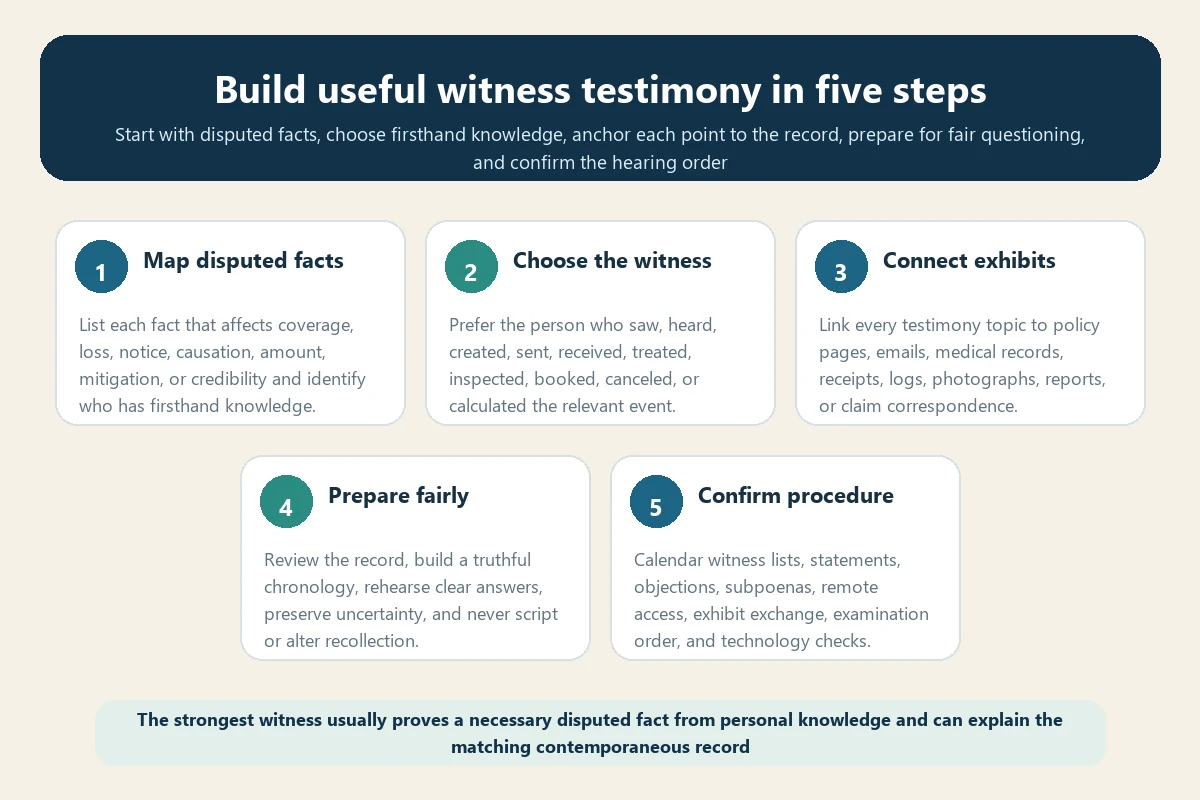
Travel insurance arbitration witness testimony should prove a disputed fact that matters to coverage, causation, notice, loss amount, mitigation, or credibility. A large witness list is not automatically persuasive. One person with firsthand knowledge and a matching contemporaneous record may be more useful than several witnesses repeating the same story.
Start with the arbitration agreement, incorporated rules, preliminary order, and later case orders. They control disclosure dates, written statements, remote appearances, exhibit exchange, examination, subpoenas, and hearing logistics. This U.S. consumer guide provides general information, not legal advice.
Begin with the facts you must prove
Write each disputed proposition as a short sentence: the traveler canceled on a particular date; a physician advised against travel; the airline issued only a partial credit; the policy was purchased before a known event; the claimant notified the administrator; or an expense was actually paid and not reimbursed.
Next to each proposition, record the policy provision, burden issue, supporting exhibit, opposing position, and person with firsthand knowledge. This prevents a witness from becoming a general narrator who adds length without resolving a material dispute.
Build a fact-witness matrix
| Disputed fact | Possible witness | Matching record | Risk to test |
|---|---|---|---|
| What happened during the trip | Traveler or companion | Photos, messages, itinerary | Memory and personal knowledge |
| Medical restriction | Treating clinician or records custodian | Chart, note, test result | Hearsay, privacy, scope |
| Cancellation or delay | Carrier or supplier representative | Notice, log, refund record | Availability and authorization |
| Claim handling event | Claims representative | File note, letter, call log | Employer control and privilege |
| Amount of loss | Traveler, merchant, or custodian | Receipt, statement, credit record | Duplicate or reimbursed amount |
Use the matrix with the arbitration document exchange checklist. A document may support a fact, while a witness explains its source, context, accuracy, and connection to the claim.
Prefer personal knowledge over repetition
A fact witness should generally describe what the person personally saw, heard, did, created, sent, received, or recorded. Identify the boundary between direct knowledge and information learned from someone else. If a traveler did not attend a medical examination or hear a supplier conversation, the traveler should not present assumptions as personal observation.
Do not multiply witnesses merely to repeat an uncontested point. Current AAA Consumer Arbitration Rules give the arbitrator authority to decide relevance and materiality and to exclude cumulative or irrelevant evidence. Check the rule version governing the case rather than assuming the newest rules automatically apply.
Separate fact witnesses from expert opinions
A treating clinician may testify about examination, treatment, instructions, and records personally created. A retained expert may instead offer specialized opinions based on reviewed materials. Those roles can carry different disclosure, report, fee, qualification, and examination requirements.
Do not ask an ordinary witness to speculate about medical causation, insurance standards, accounting, engineering, or another technical subject beyond the witness’s knowledge. If expert evidence may be necessary, raise format, report, rebuttal, availability, and cost in the preliminary schedule.
Choose the smallest complete witness set
For every proposed witness, ask four questions: Which necessary fact does this person prove? Is the point disputed? Is the evidence available through a simpler reliable record? What problem remains if this witness does not appear?
Create a primary and backup proof route. For example, a carrier representative may explain a cancellation record, but an authenticated business record or stipulated fact may make live testimony unnecessary. Any substitution must comply with the case order and allow the other side a fair opportunity to respond.
Prepare a truthful chronology, not a script
Preparation should refresh genuine recollection and make the process understandable. Review the witness’s prior statements, messages, forms, records, dates, names, and relevant exhibits. Mark uncertainty and inconsistent details instead of hiding them.
Practice listening to the complete question, answering only what is known, distinguishing memory from inference, asking for clarification, and saying “I do not know” or “I do not remember” when accurate. Never tell a witness what facts to remember, destroy conflicting material, or coordinate a false account.
Make an exhibit map for each witness
Give each exhibit a stable number, short description, source, date, author or custodian, relevant policy issue, and witness. Confirm that the copy is complete and legible. Preserve native electronic files and metadata when they matter.
The official AAA guide to preparing for arbitration recommends organized, labeled evidence and careful witness selection. The goal is retrieval and clarity: the witness and arbitrator should be able to locate the cited page without delay.
Follow witness-list and statement deadlines
The preliminary order may require names, contact information, topics, expected time, expert status, remote status, or written statements by a fixed date. Record the exact disclosure requirement, service method, amendment procedure, objection window, and consequences of a late change.
Link these dates to the master travel insurance arbitration timeline. If a witness becomes unavailable, notify the proper recipients promptly and request any needed relief rather than silently changing the presentation.
Understand written witness statements
Under current AAA consumer Rule R-33, an arbitrator may receive witness evidence through written statements and decide the weight it deserves, considering objections. A written statement is not automatically equal to live testimony.
A useful statement identifies the witness, basis of knowledge, relevant events in chronological order, attached records, and limits of recollection. Confirm signature, date, required declaration, service, and whether the witness must remain available for questioning. Do not use a statement to bypass an order requiring disclosure or attendance.
Plan direct questioning around necessary facts
Organize questions by topic: identity and role, source of knowledge, event chronology, specific records, disputed fact, and resulting action. Use clear questions that let the witness explain. Avoid spending hearing time on biography or uncontested background that can be stipulated.
For every topic, note the document to display and the page to cite. The witness should not memorize a performance; the outline is a navigation tool for complete, accurate testimony.
Prepare for opposing questions and arbitrator questions
Identify weak dates, inconsistent descriptions, missing documents, financial interests, prior statements, uncertain memory, and alternative explanations. Review them directly. A witness who acknowledges a real limitation usually appears more reliable than one who argues with every premise.
The arbitrator may ask questions to understand the record. Listen carefully, answer the question, and request clarification if needed. If a document is necessary, identify it precisely rather than guessing.
Do not assume courtroom evidence rules apply unchanged
Arbitration is generally more flexible than a court trial, but flexibility does not make every statement persuasive. Current AAA Rule R-32 allows the arbitrator to determine admissibility, relevance, materiality, and weight while considering applicable privilege.
Raise objections concisely under the governing rules and order. Explain the practical problem—lack of personal knowledge, unfair surprise, missing context, unreliable source, privilege, duplication, or inability to question—then state the requested remedy.
Handle remote testimony as evidence and technology
Confirm permission, platform, time zone, identity verification, oath or affirmation, camera position, private setting, document access, screen sharing, interpreter, recording rule, backup telephone number, and reconnection procedure. Test sound, camera, bandwidth, and exhibit display with the witness before the hearing.
Ask whether the witness may have notes, who may be present, and how excluded witnesses will be kept from observing other testimony. Follow the arbitrator’s instructions; do not improvise private communications during testimony.
A subpoena is not merely a form
For a reluctant nonparty witness or needed records, identify the governing arbitration law, seat, hearing location, issuing authority, service rule, territorial limit, reasonable time, fees, objections, and enforcement forum. Section 7 of the federal Federal Arbitration Act addresses an arbitrator’s authority to summon a person to attend and bring material evidence.
Federal appellate courts do not treat every pre-hearing nonparty document demand the same way, and state law may matter. Obtain case-specific legal advice early. Do not promise that an arbitrator’s signature alone guarantees service, compliance, or judicial enforcement.
Protect medical, financial, and claim information
Limit disclosure to material information and follow protective orders, redaction requirements, privilege rules, and secure-transfer instructions. A witness should not display unrelated records, passwords, full account numbers, or other travelers’ private information on screen.
Use the arbitration confidentiality guide to distinguish private administration from a blanket guarantee of secrecy. Confirm who may attend and how exhibits, recordings, transcripts, and written statements may be used.
Coordinate testimony with the full claim record
Before the hearing, compare every planned answer with the policy, application, proof-of-loss materials, denial letter, appeal, demand, answer, exchanged exhibits, and prior testimony. Investigate discrepancies and correct genuine mistakes through the proper process.
The travel insurance claim filing guide helps reconstruct the original claim record. The claim denial reasons guide helps identify which policy issue the testimony must actually address.
Hearing-day witness checklist
- Confirm the latest order, start time, time zone, platform or location.
- Confirm witness identity, contact method, availability, interpreter, and accommodations.
- Use the final disclosed exhibit set with stable page references.
- Keep the fact-and-exhibit outline concise and accessible.
- Follow sequestration, confidentiality, recording, and communication instructions.
- Record admitted, limited, excluded, or reserved exhibits and any follow-up deadline.
Common witness-testimony mistakes
- Calling multiple witnesses to repeat the same uncontested fact.
- Using a witness with no firsthand knowledge of the disputed event.
- Failing to disclose a witness or written statement on time.
- Showing a witness a different exhibit version from the exchanged record.
- Presenting expert opinions through an undisclosed fact witness.
- Scripting answers or ignoring genuine inconsistencies.
- Assuming remote testimony will work without permission and a technology test.
- Waiting until hearing week to investigate subpoena requirements.
Final quality-control questions
Can each witness be tied to a necessary disputed fact? Does the witness have personal knowledge? Is the matching record complete and exchanged? Are statement, appearance, objection, and technology requirements satisfied? Have weaknesses been reviewed honestly? Is private information protected?
Use the broader arbitration hearing preparation checklist for openings, exhibits, logistics, and closing presentation. A focused witness plan does not guarantee an outcome, but it gives the arbitrator a clearer, testable path from the testimony and records to the requested decision.
