
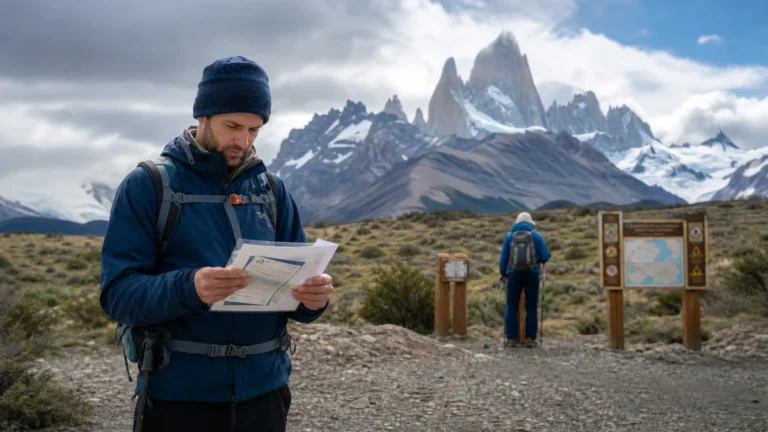
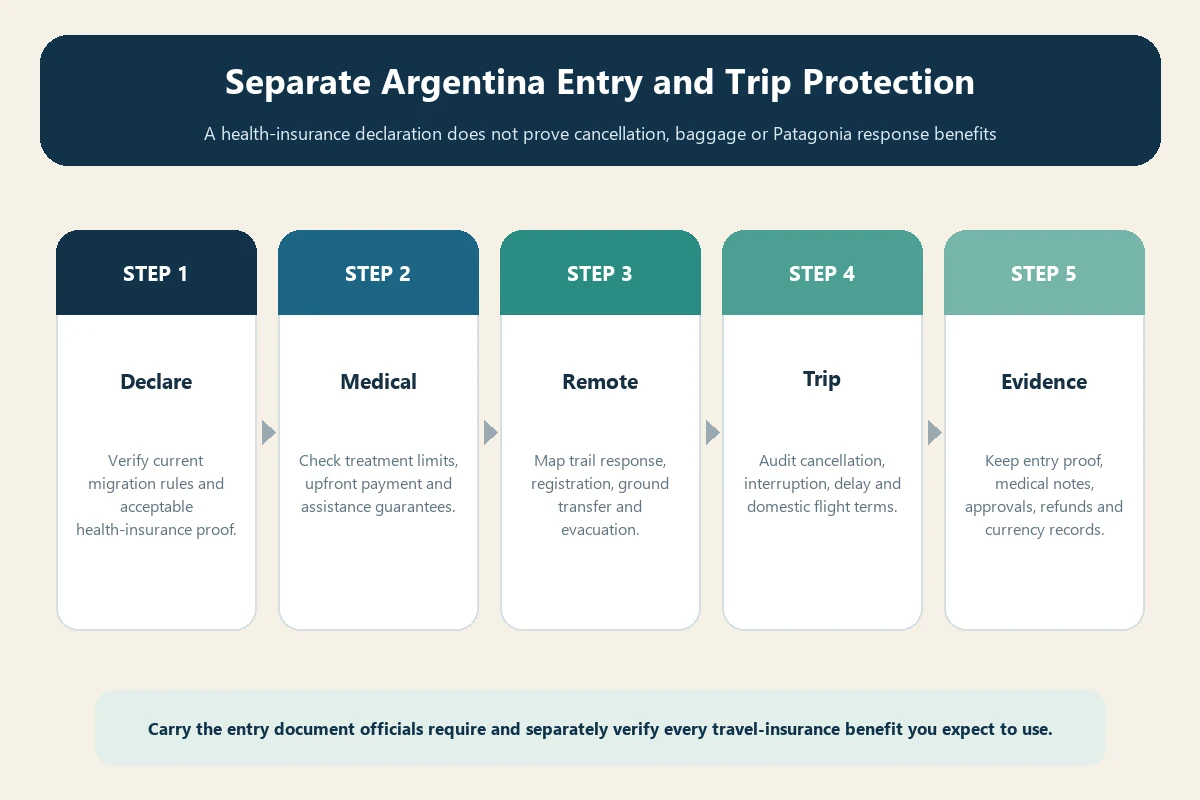
Travel insurance for Argentina from USA trips has two separate jobs: support the current entry health-insurance declaration and protect the actual itinerary. A document that satisfies migration rules does not automatically cover trip cancellation, baggage, domestic flights or a Patagonia rescue. Verify both layers independently.
Key takeaways
- Carry proof that matches Argentina’s current migration procedure.
- Do not confuse entry health insurance with trip-protection benefits.
- Map Patagonia response, extraction and medical transfer by route.
- Follow official trail registration, weather and closure instructions.
- Preserve bills, authorizations, refunds and currency conversions.
Planning information reviewed August 16, 2026. Entry implementation, advisories, park rules, transport and policy wording can change. Recheck official authorities and suppliers for the exact dates.
Understand the official health-insurance declaration
Argentina’s official Decree 366/2025 amended Article 34 of the migration law. It says foreigners seeking admission must present a sworn declaration stating their purpose and that they have health insurance for medical needs, along with other conditions set by regulation.
The same decree says national public facilities may require nonpermanent foreign residents to present health insurance or pay in advance for routine care, while emergency care cannot be denied. This is primary legal text, but travelers still need the current operational procedure.
Before departure, check Argentina’s migration authority and the airline for the required form, acceptable proof, language, dates and minimum scope. Save the current instruction. Do not rely on a commercial page that gives a start date or dollar minimum without linking to current official implementation.
Separate entry proof from travel benefits
A health-insurance certificate may establish medical coverage yet omit cancellation, interruption, delay, baggage, rental car, search and rescue or nonmedical extraction. Conversely, a package called “travel protection” may have a medical benefit that does not meet the document requested at entry.
Ask the insurer for a visa or border letter showing traveler name, territory, dates, medical limit, emergency assistance contact and any deductible. Then verify the policy certificate itself. The letter summarizes coverage; the certificate controls the claim.
The health insurance abroad guide helps test the U.S. plan. The trip cancellation guide explains why trip-cost protection must be evaluated separately.
Plan for treatment and upfront payment
The current U.S. Department of State Argentina travel guidance is Level 1, Exercise Normal Precautions. It recommends travel health insurance and says travelers should be prepared to pay medical costs upfront.
Ask the U.S. health plan about emergency and routine care, out-of-network rules, prior authorization, claim order and currency conversion. Ask the travel insurer whether assistance can guarantee payment to a private hospital and how it coordinates in Spanish.
The primary versus secondary medical guide explains which insurer reviews first. “Primary” does not guarantee that an Argentine provider bills the insurer directly. Carry secure payment access and obtain itemized documentation.
Map Patagonia response before looking at limits
Patagonia itineraries can include El Chaltén, Los Glaciares, Tierra del Fuego, the Lake District or remote roads. For each day, record trailhead, distance, weather exposure, mobile coverage, ranger contact, first vehicle access, clinic and higher-level hospital.
Argentina’s National Parks official hiking recommendations direct visitors to register where required, check weather, assess daylight, carry suitable equipment and understand that signal may be absent. Follow the current instructions for the exact park.
The official Los Glaciares activities page warns that some remote areas are difficult to access, lack communications and can involve prolonged emergency response. Insurance should be compared against that operational reality.
Separate rescue, extraction and evacuation
A trail response may involve rangers or guides, movement to a trailhead, ground ambulance, inter-hospital transfer and possible air evacuation. Ask which stages are public services, operator obligations or eligible policy expenses. Do not assume that every helicopter or search cost is medical evacuation.
The emergency medical evacuation guide explains medical necessity and insurer control. The medical evacuation limits guide helps test sublimits, destination language and transport stages.
Give assistance a scenario: a registered hiker is injured beyond road access, rangers coordinate extraction, a clinic stabilizes the traveler and a physician requests transfer to a larger city. Ask who authorizes each expense, confirms the receiving bed and handles a communication gap.
Audit trekking and guided activities precisely
State the named route, maximum elevation, season, number of days, guide, equipment and technical features. Ask whether ordinary hiking, glacier walking, climbing, horseback riding, skiing or kayaking falls under an excluded activity or needs an upgrade.
The adventure activity exclusions guide provides a policy-comparison method. Confirm search-and-rescue and nonmedical-extraction limits. An uninjured traveler removed because of weather can be treated differently from an injured patient.
Keep registration confirmation, operator license, route plan, guide report and closure notice. Follow park rules. Entering a closed trail or disregarding an official instruction can complicate both safety and coverage.
Use official alerts as evidence, not as automatic triggers
Argentina’s National Parks publishes current park alerts. Save the alert affecting the specific park and date, plus the ranger, operator or transport decision. A forecast, trail closure and evacuation order are distinct facts.
Ask which policy reasons address severe weather, natural disaster, destination inaccessibility or common-carrier delay. Coverage purchased after a known event may exclude that event. The weather-delay guide shows how to build a dated chronology.
If a trek is canceled but the hotel and flight remain usable, obtain the operator’s refund or credit. Insurance generally addresses the eligible unreimbursed loss, not the original gross price.
Protect long domestic flight chains
Argentina distances can require flights from Buenos Aires to El Calafate, Ushuaia, Bariloche, Salta or Mendoza. List each legal carrier, ticket, airport, baggage rule and final departure. Mark which segments share one ticket and which are separate.
Ask whether a domestic delay can trigger missed-connection coverage for a separate U.S.-bound ticket. Confirm the delay threshold, eligible carrier and covered reasons. The delay, interruption and cancellation guide helps classify replacement travel and unused bookings.
Preserve the original and revised schedules, carrier confirmation, boarding documents, hotel receipt, meal receipt and refund. Build enough buffer for the route rather than expecting insurance to compensate for an unrealistic connection.
Document costs and currency carefully
Argentina prices, exchange channels and card conversions can make a claim hard to reconstruct. Keep the original invoice in Argentine pesos, proof of the amount actually charged and the card statement showing conversion. Do not create a claim amount from a later online exchange rate.
For cash payments, request a dated receipt with provider name, tax or identification details, service and currency. Photograph it immediately. If a provider gives a deposit receipt and later a final reconciliation, keep both.
List supplier refunds and credits separately. A future credit may reduce the claimed loss even when the traveler wanted cash. Save its expiry, transfer rules and remaining value.
Audit rental cars and remote roads
For Patagonia or northwest road trips, read the rental agreement for border crossings, gravel roads, excluded routes, tires, glass, towing, theft, liability and replacement vehicle. Confirm whether a planned Chile crossing is allowed and documented.
The rental-car abroad guide separates vehicle damage from traveler injury and trip interruption. A travel policy may exclude liability and damage on prohibited roads even if it covers emergency medical treatment.
Photograph the vehicle and contract, preserve fuel and roadside receipts and contact the rental company before nonemergency repair or towing. Obtain police or park documentation when required.
Compare policies with one Argentina itinerary
Use identical ages, dates and prepaid amounts. Include Buenos Aires, a domestic flight, a Patagonia lodge, a registered trek, a clinic deposit, ground extraction, inter-hospital transfer and a changed U.S. connection.
- Will the insurer issue appropriate entry proof?
- How are upfront medical costs and claim order handled?
- Are the exact trek and maximum elevation eligible?
- Which rescue, extraction and evacuation stages are covered?
- How do separate domestic and international tickets interact?
- Which currency evidence and deadlines control the claim?
Compare certificates and endorsements, not marketing labels. Record the page for every answer. A policy can be suitable for entry documentation yet weak for the most expensive operational risk on the route.
Build one chronological evidence file
Keep the migration instruction, insurance letter, certificate, itinerary, trail registration, official alert, guide report, medical note, authorization, transport record, itemized bill, carrier notice, refund and replacement receipt.
The travel insurance claim guide provides a sequence for coordinating suppliers, the U.S. health plan and travel insurer. Label medical, extraction, transport and interruption costs separately and disclose all reimbursements.
Prepare for an assistance handoff without signal
Remote Patagonia routes can delay contact with an insurer. Give a companion and guide the policy number, assistance contacts, allergies, medication list and emergency consent. Store the itinerary and passport copy offline. Record the ranger post, operator base and first point where radio, satellite or mobile contact should work.
Locate the policy’s emergency exception before departure. Urgent treatment should not wait when delay threatens health, but the traveler must be able to explain why normal authorization was impossible. Once communication returns, open a case immediately and record the representative’s name, time and instruction.
Keep ranger extraction, local transport, clinic assessment and hospital transfer documents separate. Ask each responder to identify the service and destination. If a companion books lodging or replacement flights, obtain assistance instructions first when practical because companion benefits may require separate medical certification and have their own limits.
A home contact can preserve carrier options and supplier messages while the traveling companion focuses on care. Give that person permission to access booking records but not broad financial credentials. This role separation makes the eventual chronology more reliable.
Bottom line
The strongest Argentina plan passes two tests. It provides the health-insurance evidence required by the current entry process, and its actual contract fits Patagonia response, medical payment, domestic flights and trip costs. Verify both before departure and keep the dated proof.
