

Travel insurance for Trinidad and Tobago from USA trips must be checked against the current advisory, two-island transport and the realities of private medical payment. Trinidad and Tobago share one policy territory but differ by route, facility access and event schedule. Purchase timing and precise geographic wording are central.
Key takeaways
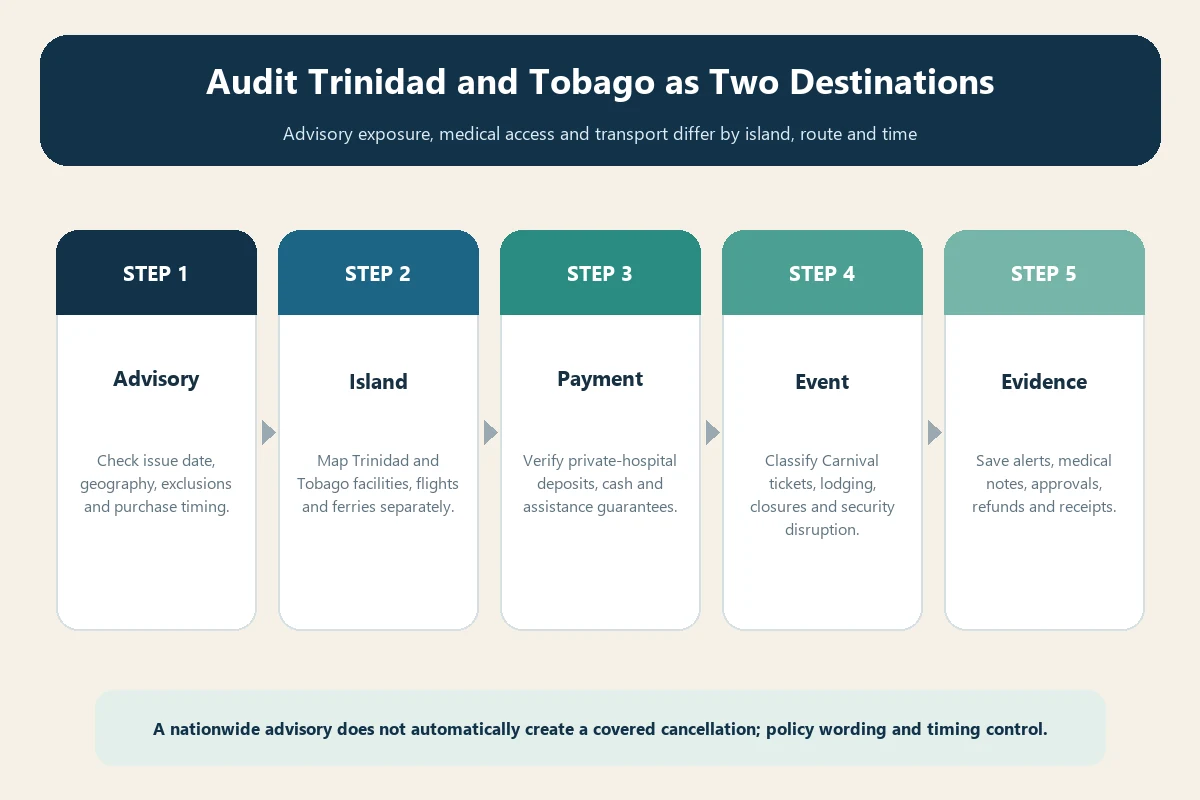
- Read the current advisory before paying and again before departure.
- Map Trinidad and Tobago facilities, flights and ferries separately.
- Verify private-hospital deposits, cash rules and transfer authority.
- Classify Carnival tickets, lodging and event disruption by contract.
- Preserve dated advisories, medical records, approvals and refunds.
Planning information reviewed August 16, 2026. Advisory levels, state-of-emergency rules, providers, inter-island schedules, event operations and policy terms can change. Recheck official and supplier information for the exact dates.
Read the advisory as a dated document
The current U.S. Department of State Trinidad and Tobago travel guidance is Level 3, Reconsider Travel, citing crime, health and terrorism. It also reports a nationwide state of emergency and identifies areas and times with increased risk. Travelers should review the entire current page, not rely on a remembered level or an old search snippet.
Save the advisory version on the policy purchase date and recheck it before departure. Record the issue date, risk indicators, geographic detail and any government restriction that affects the booked route. An advisory can inform a decision without automatically creating a covered cancellation.
The country exclusions and advisories guide explains the contract questions: Does the policy exclude destinations or events known at purchase? Does a later advisory change create a defined benefit? Does the wording apply nationwide or to a listed area? Obtain the insurer’s written answer for the exact itinerary.
Decide what a later advisory change would mean
Ask the insurer to distinguish three situations: the current advisory remains unchanged, its level rises, or the government adds a restriction affecting a booked location. Determine whether any of those facts is a listed cancellation reason. Avoid assuming that “reconsider travel” or “do not travel” has a universal insurance meaning.
If optional cancel-for-any-reason coverage is available, confirm the purchase deadline, requirement to insure trip costs, cancellation cutoff and reimbursement percentage. It can provide broader discretion but rarely reimburses the full trip. Save the endorsement, not just a quote-page label.
A voluntary route change may reduce risk without being reimbursable. Ask airlines, hotels and event suppliers about changes and credits before canceling. Keep the insurer’s answer and every supplier option so the final claim reflects the least unreimbursed eligible loss.
Build two island plans, not one label
List every overnight, airport, ferry terminal, event venue and road transfer on Trinidad. Create a separate list for Tobago. Add the legal carrier, check-in cutoff, last departure and refund rule for every inter-island segment.
The State Department notes limited health care in rural areas on both islands. Identify the first realistic facility for each overnight and the higher-level destination a clinician might use. Record hours, travel time, after-hours access and a licensed transport option.
A canceled flight or ferry can strand the traveler on the opposite island from a prepaid hotel or U.S.-bound flight. Ask whether separate tickets qualify for missed-connection or delay benefits and whether the policy requires a scheduled common carrier. The ferry insurance guide provides a useful schedule-and-contract audit for the inter-island route.
Protect separate bookings and event equipment
Record which supplier controls each connection. An inter-island carrier may not protect a separate international ticket when its service is late. Note the minimum connection, final departure, change fee and backup overnight cost. Keep the original and revised schedules.
Carnival costumes, instruments or specialty equipment can exceed ordinary baggage per-item limits. Ask whether checked, shipped or event-specific items are excluded and whether business or professional use changes eligibility. Photograph the item, retain its receipt and record custody at every handoff.
If an event supplier retains a payment for future credit, preserve the credit’s expiry and transfer rules. A credit with real value may reduce the covered loss even when the traveler prefers cash. Ask the insurer how it wants that value documented.
Audit public and private medical care separately
The official guidance states that public care is free but may involve long waits, overcrowding and limited staff or supplies. Private care is not free, and private hospitals may require payment upfront or proof of good insurance before treatment or admission. Some providers primarily accept cash.
Ask likely private facilities about deposits, accepted currency, cards, written estimates and insurance guarantees. Ask the insurer whether assistance can issue a guarantee of payment and how the traveler should proceed if urgent care cannot wait. Keep financial flexibility without carrying conspicuous cash.
The health insurance abroad guide helps test the U.S. plan for overseas reimbursement and claim forms. Even if it offers some coverage, the local provider may still require the traveler to pay first.
Plan for ambulance and hospital transfer limits
The State Department says public ambulance availability can be limited and response slow, while private ambulance service requires payment at the time of service. Public ambulances can transport only to public hospitals. Those operational rules make the first destination and payment method part of the insurance plan.
Separate local response, first hospital, transfer to another facility, inter-island movement and international evacuation. Ask who selects the receiving hospital, confirms acceptance, determines medical necessity and approves each stage. Preserve the sending clinician’s note and receiving physician’s acceptance.
The medical evacuation guide explains insurer-controlled transport and adequate-facility language. A traveler’s preferred flight home is not necessarily the same as a medically necessary evacuation.
Test assistance with a Tobago case
Give each insurer the same scenario: a U.S. traveler becomes seriously ill in rural Tobago, needs private assessment, faces a deposit and may require transfer to Trinidad or another regional destination. Ask what assistance can arrange and which steps need advance approval.
Then ask what happens when ordinary inter-island service is suspended or the receiving hospital has no capacity. Does the medical team choose a different facility? Can a companion travel? Are added lodging and dependent-return expenses separate benefits?
Use the assistance line versus claims guide to distinguish coordination from later claim review. Record every case number, name, instruction and time.
Price Carnival and other event risk correctly
A Carnival itinerary can include nonrefundable lodging, flights, costume or band payments, event tickets and local transport. Put every payment in a table with supplier, cancellation term, transferability and refund deadline. Do not insure refundable or replaceable amounts as though they are permanent losses.
Ask whether event cancellation itself is a covered reason. Many policies protect trip cancellation for listed events such as illness or severe weather, not because a parade, concert or party changes. Security concerns, a government restriction and a supplier cancellation also require different evidence.
Purchase timing is especially important when an advisory or state of emergency already exists. A policy bought after the relevant circumstance is known may exclude that circumstance while still covering unrelated future events. Request a specific answer rather than assuming “cancel for any reason”; that optional benefit has deadlines, percentage limits and eligibility rules.
Connect storm alerts to the booked route
Trinidad and Tobago’s official Office of Disaster Preparedness and Management storm page explains tropical-storm and hurricane watches and warnings, including the 48-hour watch and 36-hour warning concepts. The National Hurricane Center preparedness hub provides regional hazard information.
Record the policy purchase, first trip payment, forecast development, official watch or warning, airport or ferry action, event notice, lodging closure and traveler decision. Weather on one island can affect a carrier or venue without closing the entire itinerary.
The weather-delay guide shows how official evidence must connect to policy thresholds. Ask about severe weather, natural disaster, common-carrier delay, mandatory evacuation and destination uninhabitability.
Separate cancellation, interruption and delay
A covered event before the U.S. departure may fall under cancellation. After arrival, unused lodging or event arrangements and an added return flight may fall under interruption. Waiting overnight for a replacement inter-island service may be delay after a defined threshold.
The delay, interruption and cancellation guide maps each expense to its timing. Keep original and revised itineraries, written carrier reasons, event notices and supplier refund decisions.
Protect medication and the overnight handoff
The State Department warns about counterfeit medication and recommends original packaging with a prescription. Carry an adequate supply and generic names. Ask the insurer how prescription replacement works and which receipts or clinician notes are needed.
For an overnight hospital stay, give a companion access to consent, the medical summary, policy, assistance number and payment method. Ask about bedside travel, companion lodging, dependent return and a private nurse. These benefits require their own conditions and medical certification.
Compare policies with one two-island scenario
Hold ages, dates, costs and route constant. Include a Level 3 advisory already in effect, Trinidad and Tobago overnights, inter-island transport, Carnival payments, rural illness, private-hospital deposit and possible evacuation.
- How does the existing advisory affect eligibility and exclusions?
- Which inter-island carriers meet policy definitions?
- How does assistance handle cash or a private-hospital deposit?
- Who selects the transfer or evacuation destination?
- Which event or storm disruption can trigger a trip benefit?
- What dated evidence and notification deadlines apply?
Build the evidence chronology
Save the advisory version, itinerary, supplier contracts, medical summary, provider estimate, diagnosis, itemized bill, payment proof, transport approval, receiving-facility acceptance, official alert, carrier notice, event decision and refund.
The travel insurance claim guide supplies a step-by-step chronology. Disclose every supplier or health-plan reimbursement and claim only the eligible balance.
For medical expenses, include the U.S. plan’s explanation of benefits or written noncoverage decision when required. For advisory or event losses, label the exact trigger, date and supplier response. Keeping these evidence tracks separate reduces confusion between safety decisions, medical necessity and commercial refunds.
Bottom line
The strongest Trinidad and Tobago plan treats the advisory as a dated contract fact and the islands as separate medical and transport routes. Verify private payment, transfer authority, event terms and storm triggers before purchase, then preserve the records that show exactly what changed.
