
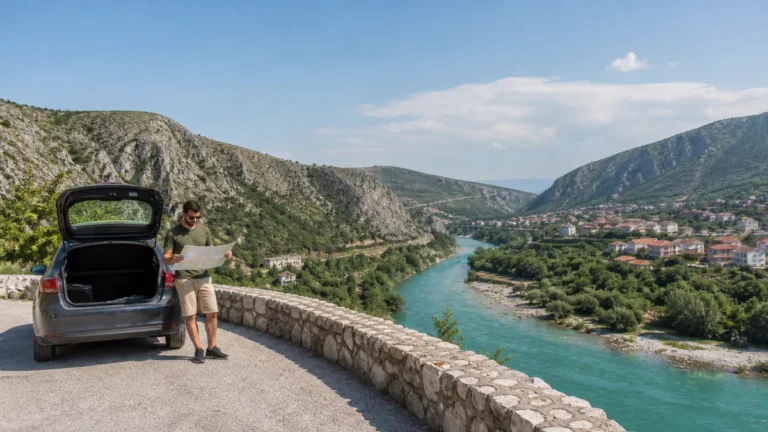
Travel insurance for Bosnia and Herzegovina from USA trips should connect rural medical access, mountain activities and the full Balkan road route. Sarajevo, Mostar, a rafting base and a remote mountain guesthouse create different provider, transport and safety questions. The useful policy is the one that answers those differences before the traveler leaves a marked road or crosses a border.
Key takeaways
- Map treatment options outside Sarajevo and plan how a patient reaches higher-level care.
- Keep hiking and roadside stops on verified routes because mine risk remains in some areas.
- Separate travel medical, rescue, roadside assistance and rental-car protection.
- Check landslide, snow, border and vehicle-permission issues for the exact road itinerary.
- Save coordinates, official notices, assistance approvals, bills, reports and refunds.
Planning information reviewed August 16, 2026. Medical access, mine-safety information, roads, borders, activities and policy wording can change. Recheck official sources for the exact route and dates.
Turn the itinerary into a response map
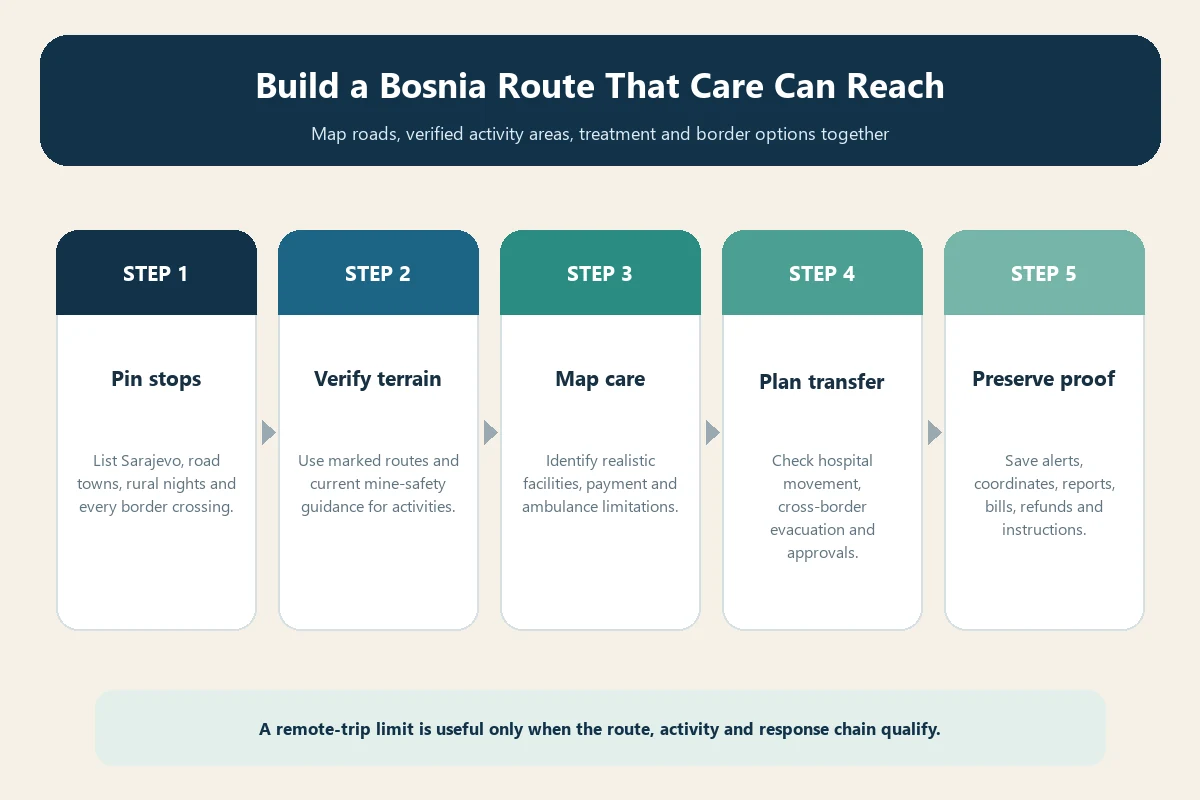
List every airport, overnight town, rental pickup, road segment, border, trailhead, river operator and prepaid activity. Add the first nonrefundable payment and the latest safe time to reach each overnight. This turns a country-level purchase into a route-level test.
A loop through Croatia, Montenegro or Serbia needs every country and transit date inside the policy territory. Use the multi-country Europe insurance guide to record borders and self-booked connections instead of relying on a broad “Europe” label.
Plan care outside Sarajevo
The U.S. Department of State’s current Bosnia and Herzegovina country information says adequate medical facilities may not be available outside Sarajevo and may not meet U.S. standards. It also notes that English-speaking providers may be unavailable and that major surgery is performed in public hospitals.
Ask the assistance company which facilities it can coordinate with in Sarajevo, Mostar and the closest town to each rural overnight. Verify whether the traveler may need to pay first, which documents are required and whether direct billing is realistic. A U.S. insurance card is not proof that a local provider will accept the plan.
The health insurance abroad guide shows how network, reimbursement, authorization and service gaps can change after leaving the United States.
Separate ambulance, transfer and evacuation
Dial 124 for ambulance, 122 for police and 123 for fire. The State Department reports that ambulances are available but responder training, availability and equipment may fall below U.S. standards. Protect life first, then contact the insurer’s assistance service as soon as reasonably possible.
Ask who authorizes movement from a rural clinic to Sarajevo, whether ground transport has a separate limit and when a cross-border hospital becomes the nearest appropriate facility. Medical evacuation may end at suitable regional care rather than at a U.S. hospital. Repatriation is a later and different decision.
Use the remote medical evacuation guide to test decision authority, receiving-facility rules and transport documentation.
Keep outdoor routes inside verified areas
Landmines and unexploded ordnance remain a serious route-planning issue. The State Department advises travelers to stay on hard-surfaced areas, avoid abandoned buildings and unmarked trails, observe warnings and consult the Bosnia and Herzegovina Mine Action Center. Review the current BHMAC information before hiking, cycling, roadside photography or approaching ruins.
Insurance cannot make an unsafe route acceptable. A covered hiking activity does not cancel government warnings, illegal-entry exclusions or a requirement to use marked trails. Give an operator the exact planned route and ask how it verifies the area. Preserve the guide’s identity, booking, route description and any official clearance information.
Do not improvise a detour around a road closure across open land. Turn around or use an officially identified alternative. Record the coordinates and notice that caused the change.
Audit hiking, rafting and canyon activities
| Activity | Clause to locate | Evidence to keep |
|---|---|---|
| Marked-trail hiking | Altitude, route, guide and search-and-rescue terms | Trail, operator, forecast and coordinates |
| Commercial rafting | River grade, licensed operator and equipment conditions | Booking, briefing, waiver and incident report |
| Canyoning or climbing | Rope, technical equipment and named-activity exclusion | Route grade and guide credentials |
| Mountain biking | Off-road, competition and protective-equipment rules | Route, rental terms and helmet record |
| Skiing | Piste, off-piste, resort boundary and rescue sublimit | Lift pass, patrol report and location |
Check each pursuit by name with the adventure-activity exclusion guide. Ask separately about treatment, local rescue, helicopter movement and damaged rented equipment.
Build a defensible road plan
The State Department describes narrow, curving two-lane roads, limited guardrails and poor lighting outside cities. Fog, snow and ice can make winter travel hazardous, while landslides, gatherings and accidents can block roads. BIHAMK publishes current Bosnia and Herzegovina road conditions.
Save the notice for the affected road and time. Record a safe alternative, fuel stops and the last practical turnaround. Do not schedule a tight international flight after a long mountain drive.
The Europe road-trip insurance guide separates medical expense, vehicle damage, roadside service and unused trip bookings.
Keep the rental contract separate
Confirm additional drivers, license documents, territorial permission, required motor liability, collision terms, towing and replacement-car rules. Get written approval before taking the vehicle into Croatia, Montenegro or Serbia. A border document may satisfy vehicle law without expanding travel-insurance territory.
Photograph the vehicle and supplied safety equipment at pickup. After a collision, protect people, contact local authorities and follow the rental company’s reporting instructions. Do not promise a private settlement that conflicts with the contract.
The rental car abroad guide shows where motor liability, a rental waiver, a credit-card benefit and travel insurance stop and start.
Record every border crossing
BIHAMK maintains current border-crossing reports that can show queues and operating restrictions. Record the actual crossing, operating hours, vehicle permissions and return route. A predictable queue is not automatically a covered travel delay.
For each border, identify whether the next ticket is connected or separately booked. Add a realistic buffer and keep the carrier’s check-in cutoff. If a crossing closes, obtain an official notice and the rental company’s instruction before incurring a major rerouting cost.
Classify landslide, snow and fog disruption
A road closure can affect extra lodging, a missed flight or an unused prepaid stay, but the same closure does not automatically trigger every benefit. Find the covered cause, minimum delay, per-day cap and reasonable-alternative language. Timing also matters if the condition was known before purchase.
Use the weather-delay insurance guide to compare closure evidence, delay thresholds and known-event rules.
Request supplier refunds first. Keep the original booking, cancellation terms, official closure, alternative booking and refund statement. A claim should show the remaining loss rather than the total initial price.
Run one rural-route comparison
Give every insurer the same case: U.S. flights, Sarajevo and Mostar lodging, a rental-car loop, a rural guesthouse, a guided rafting day and a border crossing. Add a landslide closure and an injury requiring transfer from a small facility.
- Are all countries, dates, roads and activities inside the territory?
- How would the assistance team identify and contact appropriate care?
- Who pays for ambulance and inter-hospital movement?
- When does movement outside the country qualify as evacuation?
- Are search and rescue and the exact activity separately covered?
- Which road or border event can trigger delay or interruption?
- What notice deadlines and original records apply?
The delay, interruption and cancellation guide helps place each expense under the correct trigger.
Create a claim-ready route file
Carry the policy, assistance number, route, rental agreement, activity booking, medical summary and emergency numbers offline. During an incident, record the time, coordinates, road or trail status, assistance case number, provider decision and safe alternative considered.
Collect itemized medical bills, payment proof, police or rescue reports, operator notices, unused booking terms, refunds and replacement receipts. The claim filing guide turns those records into a single chronology.
Set a three-stage route recheck
Review the itinerary when the policy is purchased, before the final cancellation deadline and again within 48 hours of each rural leg. At the first review, confirm insured trip cost, dates, countries and activity names. At the second, update any added lodging, tour or vehicle cost through the insurer’s stated process and retain its confirmation.
At the final review, check the official road report, border status, weather, operator message and current mine-safety information. Record the source and time rather than saving an unexplained screenshot. If a route changes, tell the accommodation, guide and trusted contact which alternative will be used. Do not substitute an unmarked path or informal roadside shortcut.
Give the assistance company the same updated route that the traveler carries offline. Confirm that the emergency contact can locate the policy number and itinerary without having access to unnecessary medical or passport data. A staged recheck cannot prevent every disruption, but it creates a clear record of what was planned, what changed and why the traveler chose a safer alternative.
Also record the last fuel stop, daylight cutoff and staffed accommodation on isolated road days. Those practical checkpoints make a safe retreat possible before a delayed arrival becomes an avoidable emergency.
Bottom line
The strongest Bosnia and Herzegovina policy follows the traveler from a verified route to realistic care. Test rural treatment, transfer authority, mine-safe activities, mountain roads, border driving and documentation. A high limit is useful only when the location, activity and response chain remain inside the contract.
