

One travel insurance policy can usually cover a multi-country Europe trip, but only if every stop, travel date, activity, traveler and prepaid cost fits the same certificate. “Europe” is not a universal insurance territory, and a Schengen-compliant document is not proof that the rest of the policy fits your trip. The safest way to compare plans is to test the actual itinerary against the policy definitions before you pay.
Key takeaways
- You normally do not need a separate policy for every European country.
- Check the certificate’s geographic definition rather than relying on the word “Europe” in a product name.
- Include non-Schengen stops, overnight travel dates, side trips and planned activities in the review.
- Travel medical, medical evacuation and trip cancellation are different benefits with different triggers.
- Update insured trip cost and travel dates when the itinerary changes.
Do you need one policy or several?
For an ordinary vacation that starts and ends in the United States, one policy is generally easier to administer than several overlapping policies. You have one assistance number, one certificate and one claim process. That does not make one policy automatically sufficient. It works only when its territory, duration, benefits and exclusions cover the complete itinerary.
Separate or specialist coverage may be needed when part of the trip falls outside the main policy. Common examples include a high-altitude trek, off-piste skiing, a long cruise segment, paid work, a stay that exceeds the maximum trip length, or travel to a destination excluded by an advisory or sanctions clause. In those cases, buying two ordinary policies can create more confusion; a specialist policy or endorsement that covers the whole risk may be the cleaner solution.
Start with the broader question in our guide to travel medical insurance for US citizens in Europe, then use the itinerary test below to decide whether a particular certificate fits your route.
Build an itinerary coverage matrix
Write down every country where you will sleep, connect, drive, board a ship or take a separately booked tour. Then match each part of the journey to the document that would respond if something went wrong.
| Itinerary element | What could create a gap | What to verify |
|---|---|---|
| United Kingdom stop before the EU | A plan or visa certificate defined only by the Schengen area | The policy territory includes the UK for all relevant benefits |
| Rail travel on separate tickets | No missed-connection benefit for independently booked transport | Common-carrier and missed-connection definitions |
| Ferry or island stay | Weather disruption or limited local medical facilities | Trip delay, interruption and evacuation terms |
| Hiking, cycling or skiing | An activity, altitude or rescue exclusion | Covered-activity list, add-on and search-and-rescue wording |
| Vacation rental and prepaid tour | Refundable costs mistakenly included in insured trip cost | Trip-cost definition and supplier refund rules |
This exercise is more useful than comparing headline benefit limits alone. Our country overview explains why Europe travel insurance can differ by destination, especially when medical access, ferries, mountains or long transfer distances change the exposure.
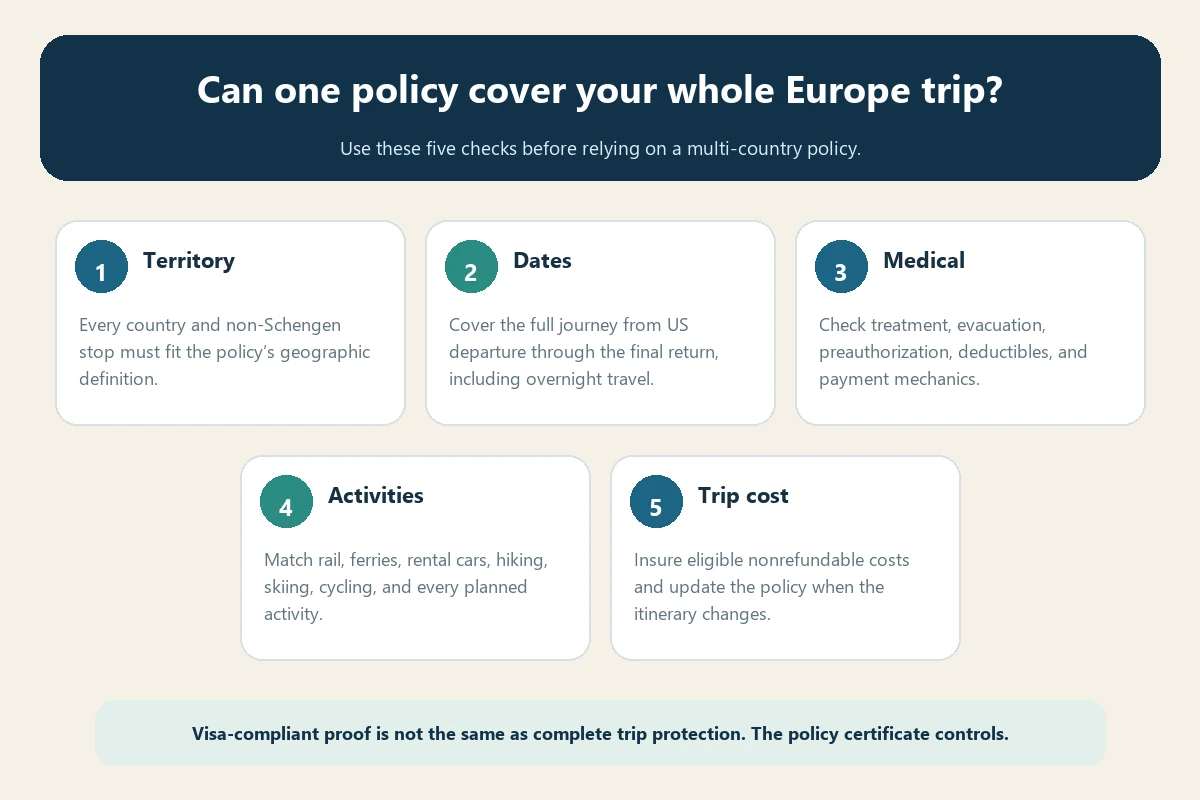
Five checks that decide whether one policy is enough
1. Confirm the exact geographic territory
Look in the certificate for definitions such as “Europe,” “Schengen area,” “worldwide excluding the United States,” or a list of included and excluded destinations. A marketing page is not enough. The policy certificate and any state-specific endorsements control the claim.
Europe, the European Union and the Schengen area are not interchangeable. The European Commission states that the Schengen area currently contains 29 countries, including four that are not EU members. Ireland remains outside Schengen, and Cyprus has not yet had its internal border controls abolished. A route can therefore cross several legal groupings without feeling like it crossed a meaningful border.
Also inspect restrictions linked to government advisories, war, civil unrest and sanctions. A worldwide label may still contain country-level exclusions. Check the US State Department’s destination page shortly before purchase and again before departure, but remember that an advisory change triggers coverage only if the certificate says it does.
2. Cover the whole travel period
The insured dates should normally begin when you leave the United States and end after your scheduled return. Include overnight flights, pre-tour hotel nights and post-cruise stays. If the final flight departs Europe late on June 20 and lands in the United States on June 21, a policy ending on June 20 may create an avoidable dispute.
Benefits can also start at different times. Trip cancellation may begin after purchase, while medical, baggage and trip-delay benefits generally relate to the covered trip period. Read the effective-date and termination sections rather than assuming every benefit begins the day you pay. The timing guides on when to buy travel insurance and buying Europe cover in the right order explain why deposit dates matter.
3. Separate medical treatment from medical evacuation
The US Department of State says the US government does not pay overseas medical costs for American travelers. It also notes that Medicare and Medicaid do not pay for care outside the United States, while private US plans vary. The CDC advises travelers to check their domestic plan and be prepared for providers abroad to request payment up front.
For every destination, verify:
- the emergency medical limit and deductible;
- whether the benefit is primary or secondary;
- preauthorization requirements;
- how pre-existing conditions are defined or waived;
- whether the assistance provider can arrange a guarantee of payment;
- the medical evacuation limit and the destination of an approved evacuation; and
- repatriation and return-of-remains benefits.
Medical evacuation does not necessarily mean a flight home. The CDC explains that the insurer generally decides whether evacuation is medically necessary and where the traveler should be moved. Read our guide to what Europe travel health insurance should include before treating a large evacuation number as complete protection.
4. Match transport and activities to the certificate
A multi-country itinerary often depends on trains, ferries, rental cars and separate reservations. Check how the policy defines a common carrier and whether a delay must last a minimum number of hours. A missed rail connection may not qualify just because a late train made the next ticket unusable. The event must meet the applicable delay or missed-connection wording.
Do the same for activities. “Hiking covered” may still be subject to altitude, marked-trail or guide requirements. Skiing can require a winter-sports add-on, and rental-car damage is not the same as third-party liability. If an activity is central to the trip, ask for written confirmation and save the policy version you reviewed.
For disruption terminology, see our plain-English comparison of trip delay, interruption and cancellation. These benefits solve different problems and cannot be treated as substitutes.
5. Insure the right trip cost and keep it current
Trip cancellation usually responds to eligible prepaid, nonrefundable cost—not the total value of everything on the itinerary. Record the amount you would actually lose after supplier refunds. Add later tour payments, rail passes or nonrefundable lodging when the policy requires trip-cost updates.
Points bookings need special attention. A policy may cover taxes, redeposit fees or a cash replacement ticket, but it may not assign the same value to miles that you do. Credit-card benefits also depend on how the trip was paid. Use the current guide to benefits and compare it with our credit-card versus standalone travel insurance guide.
Schengen proof is not a complete coverage test
A traveler who needs a Schengen visa may have to present a travel medical insurance certificate that meets visa requirements. US citizens traveling on a US passport for an ordinary short tourist visit generally have a different entry position, but nationality, residence, trip purpose and duration can change the rule. Check the relevant consulate rather than using an insurance article as immigration advice.
Even when a certificate satisfies a visa file, it may say little about cancellation, delays, baggage, rental cars or expensive activities. It may also cover Schengen territory but not an added stay in Ireland, the United Kingdom or another destination. Our Schengen travel insurance requirements guide deals with the document requirement; this article deals with the wider trip.
Worked example: Boston, London, Paris, Zurich and Rome
Assume two travelers fly from Boston to London, take the train to Paris, continue to Zurich, rent a car for a mountain stay and fly home from Rome. They have prepaid flights, rail tickets, several hotels and a guided hike.
One policy may cover the itinerary if its territory includes the United Kingdom, France, Switzerland and Italy; its dates include the overnight return; the guided hike fits the activity wording; the rental-car expectations are handled separately; and all eligible nonrefundable costs are declared. The travelers should also confirm that a medical evacuation goes to the nearest suitable facility unless the plan expressly offers something broader.
The same policy may be insufficient if it covers Schengen countries only, excludes the hike’s altitude, ends before the aircraft lands in Boston or omits a pre-existing condition that affects one traveler. The answer comes from the certificate, not the number of countries.
Common mistakes on multi-country trips
- Assuming “Europe” has one fixed definition. Check the territorial wording and exclusions.
- Listing only overnight destinations. Connections, ferries and separately booked day tours can matter.
- Using a visa certificate as the entire policy review. Entry compliance and broad trip protection are different tests.
- Ignoring payment mechanics. Even insured travelers may need to pay a provider and seek reimbursement.
- Failing to update trip cost. New nonrefundable bookings can affect both benefits and waiver eligibility.
- Relying on a card’s marketing page. Save the current guide to benefits and confirm the charge that activates coverage.
- Arranging an evacuation independently. Unless an immediate emergency makes contact impossible, call the assistance service before committing to transport.
Before you buy: a document-first checklist
- Download the full certificate for your state of residence.
- List every country, connection, transport type and planned activity.
- Confirm the start and end dates, including overnight travel.
- Call your US health plan and record what it covers abroad.
- Compare emergency medical, evacuation, deductible and pre-existing-condition terms.
- Calculate eligible nonrefundable trip cost after supplier refund rights.
- Check delay, missed-connection and interruption definitions for rail, air and ferry travel.
- Save the quote, certificate, endorsements, receipts and written answers together.
- Recheck the policy after adding destinations, activities or major trip payments.
If you need help during the trip
Save the assistance number in your phone and offline with the policy number. For a medical event, seek urgent care first when delay would be unsafe, then contact the assistance provider as soon as practical. Ask the provider for itemized bills, clinical notes and proof of payment. For a transport delay, request a written reason from the carrier and keep every receipt.
Insurance normally pays the covered net loss after refunds and other responsible parties. Our guide to filing a travel insurance claim with complete documentation shows how to build the record before details disappear.
Sources and methodology
This guide was checked against the CDC Yellow Book chapter on travel, health and evacuation insurance, the US Department of State travel insurance guidance, the European Commission’s current Schengen overview, and the NAIC consumer guide. These sources describe general risks and regulatory context; the traveler’s state-specific policy certificate determines coverage.
Editorial note: This article provides general educational information for US travelers. It is not a recommendation of a particular insurer and is not medical, legal or immigration advice.
Choosing coverage amounts? Use the Europe travel insurance coverage limits guide to build medical, evacuation, cancellation, delay and baggage limits from the actual itinerary.
Crossing several borders? Review the Europe country exclusions and travel advisories guide to check territory, event timing, war and unrest wording, sanctions, and assistance limits.
Traveling without a daily guide? The self-guided Europe tour insurance guide covers prepaid stages, independent navigation, luggage transfers and route interruption.
Does the route extend beyond one country? Use the Schengen insurance territorial-coverage guide to compare the current 29-country area with every non-Schengen stop on the itinerary.
Adding Austria to the route? Use the Austria travel insurance guide for U.S. travelers to check Alpine rescue, activity exclusions, medical payment and cross-border connections.
Planning Croatian island stops? Use the Croatia travel insurance guide for U.S. travelers to check ferries, private-boat exclusions, island medical access and mainland evacuation.
Routing through Belgium? Use the Belgium travel insurance guide for U.S. travelers to plan for medical payment, international rail delays, strikes and missed connections.
Building a Czech rail itinerary? Use the Czech Republic travel insurance guide for U.S. visitors to check medical payment, train connections, entry proof and prepaid city bookings.
Driving into Finnish Lapland? Read the Finland travel insurance guide for U.S. visitors to check winter vehicles, remote medical transport, activities and route buffers.
Adding Denmark to the route? Read the Denmark travel insurance guide for U.S. travelers to audit medical access, cycling, ferries and Nordic connections.
Adding Budapest or a Danube sailing? Use the Hungary travel insurance guide for U.S. visitors to check medical payment, river disruption, thermal activities and rail links.
Using Luxembourg as a cross-border base? Read the Luxembourg travel insurance guide for U.S. visitors to align rail fares, neighboring-country care and disruption claims.
Driving into the Romanian Carpathians? Use the Romania travel insurance guide for U.S. visitors to separate rental protection, road disruption, mountain rescue and medical care.
Planning a Cyprus road trip? The Cyprus travel insurance guide for U.S. visitors separates travel-policy territory from rental-car insurance, medical care, diving and evacuation.
Driving through Serbia? Read the Serbia travel insurance guide for U.S. visitors for entry proof, medical payment, Balkan borders, road documentation and evacuation checks.
