
A travel insurance claim phishing scam involving bank details or payment can look convincing because a real claim already involves policy numbers, medical records, passports, invoices, beneficiaries, and expected deposits. A criminal can imitate an insurer, administrator, assistance company, hospital, travel agent, courier, or recovery vendor and ask the traveler to click a link, reveal a code, change ACH instructions, or pay a fee.
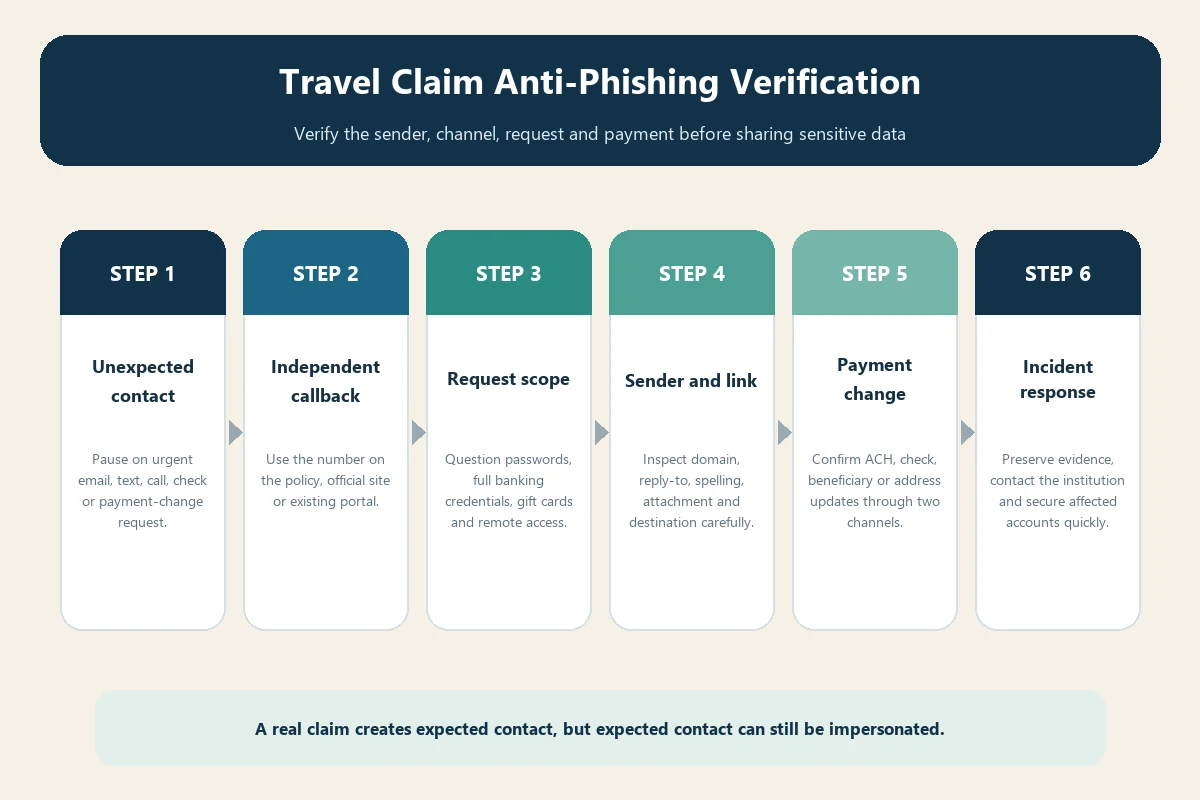
Verify every sensitive request through a known channel from the policy certificate or official website. Do not reply, click, or call the contact information in a suspicious message. A real-looking claim number, logo, signature, or document does not prove the sender is legitimate.
Key takeaways
- Use the authenticated claim portal and official published number to verify requests.
- Never share passwords, one-time codes, or remote-device access.
- Confirm any change to bank, payee, address, or provider instructions independently.
- Separate a real claim delay from a demand to pay a release or processing fee.
- Report suspected fraud quickly to the insurer, bank, and appropriate authorities.
Why claimants are attractive targets
A claimant may be traveling, stressed, sick, grieving, using unfamiliar networks, waiting for money, or coordinating family members. The file can contain identity, medical, financial, and itinerary details. Urgency makes an unexpected “payment failed” or “document missing” message more persuasive.
Scammers can use public travel posts, compromised email, stolen invoices, data breaches, or simple guessing. Do not assume a message is authentic merely because it knows the destination or provider.
Common impersonation scenarios
- a fake adjuster asks for bank credentials by email;
- a fake hospital changes wire instructions after direct billing begins;
- a message says a claim payment is held until a tax or release fee is paid;
- a fake courier requests identity documents to deliver a check;
- a caller asks for a one-time code to “verify” the portal;
- a fake recovery team demands repayment by gift card, crypto, or urgent wire;
- a beneficiary notice asks for a fee before releasing a death benefit; or
- a link leads to a cloned claim login page.
Verify the sender outside the message
Open the insurer’s site from a saved bookmark or type the known address. Call the number on the certificate or official site. Sign in to the portal independently and check whether the same request appears. Ask the verified representative to confirm the sender, subject, and requested document.
Do not use a phone number from the suspicious email, a sponsored search ad, or an unverified social media profile. Search results can contain fraudulent ads and look-alike domains.
Inspect the domain carefully
Look for misspellings, added words, different country domains, unusual subdomains, URL shorteners, and display names that hide the real address. Hovering over a link can help, but it is not a substitute for navigating independently.
A secure padlock only means the connection is encrypted; it does not prove the website belongs to the insurer. Never bypass a browser warning.
Never share authentication secrets
A legitimate representative should not need your password, one-time authentication code, recovery phrase, or remote control of your phone or computer. One-time codes can authorize login or transfer even when the caller says they are only verifying identity.
Do not install remote-support software at an unsolicited caller’s request. End the contact and call the official claims team.
Bank detail requests
Insurers can offer ACH or electronic payment, but enrollment should occur through a verified process. Confirm the legal payer, portal, bank-data fields, payment vendor, privacy notice, and how changes are authenticated. Never send full online-banking credentials.
If bank instructions change after approval, verify through a second channel. A compromised email thread can contain a convincing reply from a criminal.
Provider wire fraud
Foreign hospitals and assistance companies can exchange guarantees and international payment instructions. Criminals can impersonate either side and substitute a bank account. Confirm beneficiary name, bank, country, invoice, amount, and reference using known contacts.
Do not assume a PDF invoice is safe because it matches earlier formatting. Compare the final provider ledger and payment confirmation. Use our assignment and direct-payment guide to distinguish authorized payees.
Claim checks
A paper check can be stolen, altered, duplicated, or sent to an old address. Verify any request to endorse it to a third party. For a joint-payee check, follow legitimate endorsement and deposit rules; do not sign another person’s name.
If a check is missing, contact the insurer through official channels for trace, stop-payment, and reissue. Do not pay a stranger to “unlock” or replace it.
Fake overpayment and recovery demand
A scammer can send a counterfeit check, claim it was too large, and demand an immediate return before the bank discovers the check is bad. Another may impersonate an insurer seeking subrogation or refund. Do not send money based on urgency.
Verify the original claim payment, policy provision, written calculation, legal entity, and secure repayment method. Use the later refund and recovery guide.
Beneficiary and deceased-traveler scams
Families handling a death can receive fake beneficiary notices, funeral invoices, transport requests, or “estate release” fees. Verify the policy, insurer, funeral home, consulate, and assistance case independently. Do not publish death certificates or claim numbers in public messages.
Our claim after a traveler dies guide explains legitimate benefit and authority paths. A named beneficiary is not required to pay an unknown intermediary to discover the insurer’s official claim form.
Medical record phishing
A fake message can request records, portal credentials, or a medical authorization. Confirm the vendor and exact request with the insurer. Review recipients and scope before signing. Use the medical authorization guide.
Send health information through the approved secure channel. Ordinary email forwarding can expose files and metadata to unintended recipients.
Fake claim status messages
Messages such as “final notice,” “claim closed today,” or “payment expires in two hours” create pressure. Check the portal and call the verified claims number. Real deadlines can exist, so do not ignore the subject; verify it.
Keep the status log in our claim follow-up guide. A documented genuine representative can clarify status without asking for a password.
Protect uploaded documents
Before uploading, verify the portal domain and TLS warning state. Use strong unique passwords and multifactor authentication. Log out on shared devices. Avoid public computers and insecure networks for sensitive files.
Maintain a manifest of what was sent. Our original document guide explains custody, copies, and secure physical delivery.
Redaction without damaging evidence
Ask which fields are required. When redaction is permitted, keep the claimant name, transaction, date, merchant, amount, last account digits, and document context needed for verification. Redact only unrelated information and retain the unredacted original securely.
Do not flatten or edit medical, supplier, or financial records so the claim content becomes ambiguous. Label redacted working copies.
Coordinate family access safely
Seniors may ask an adult child, caregiver, travel companion, executor, or beneficiary to help. Tell the insurer which representative is authorized and what proof it needs. Do not share one portal password among several people or forward one-time codes.
Use separate authorized access where available and keep a record of who submitted each change. Remove access when the role ends. A helper can organize records without becoming the insured, payee, beneficiary, or estate representative.
Mail and address-change fraud
A criminal can redirect checks or claim correspondence by changing the mailing address. Confirm any address update through the official portal, ask for written confirmation, and review the payee and destination before payment. Use secure mail handling for certified death records, checks, and identity documents.
If mail disappears, contact the insurer and postal service promptly. Ask whether a check was issued, cashed, or returned and whether a stop-payment is required. Do not assume the insurer knows that the claimant moved.
If you clicked or shared information
- Disconnect from the suspicious session and stop communication.
- Contact the bank or card issuer through a known number.
- Change compromised passwords from a trusted device and enable multifactor authentication.
- Tell the real insurer and ask it to flag the claim and payment instructions.
- Preserve messages, headers, URLs, phone numbers, receipts, and timestamps.
- Report phishing and identity theft to appropriate official channels.
- Monitor accounts, credit, claim status, and address changes.
Speed matters for unauthorized transfers. Do not wait for the insurer to investigate before contacting the financial institution.
If payment details changed fraudulently
Ask the insurer to freeze or recall an unissued payment, trace any transfer, restore verified payee data, and require stronger authentication for changes. Contact the receiving and sending banks where appropriate. Record case numbers and actions.
Do not submit new banking information in the same compromised email thread. Use a clean, verified channel.
Report and preserve
The FTC provides phishing and identity-theft reporting resources, and the FBI Internet Crime Complaint Center accepts cybercrime reports. CISA publishes phishing guidance. The insurer and state insurance department can also receive relevant fraud or complaint information.
A report does not guarantee recovery. Preserve all contractual appeal and claim deadlines independently.
FAQ
Will an insurer ask for bank details?
It may use verified ACH enrollment, but it should not need your banking password or one-time code. Confirm the process independently.
Is a claim fee always a scam?
Do not pay an unexpected release, tax, or processing demand. Verify the contract and insurer through official channels.
Can a real email thread be compromised?
Yes. Independently verify changed bank, payee, or wire instructions even inside an existing conversation.
What if the deadline message is real?
Verify it promptly through the portal or official number and meet the genuine requirement through the approved channel.
Bottom line
Travel claims combine sensitive data with expected payments, making them ideal impersonation targets. Navigate independently, verify every sender and change through known channels, never share authentication secrets, and protect document custody. If compromise occurs, contact the bank and real insurer immediately, preserve evidence, and report it.
Sources
- FTC — Recognize and Avoid Phishing Scams
- FTC — IdentityTheft.gov
- FBI — Internet Crime Complaint Center
- CISA — Recognize and Report Phishing
- NAIC — Insurance Fraud
- CFPB — Fraud and Scams
Reviewed August 16, 2026. This article is general educational information, not cybersecurity, banking, identity-theft, or legal advice.
