
If a travel insurance claim check was cashed by someone else, ask the payer for the paid check image before deciding what happened. The front, back, endorsements, deposit markings, amount, and dates can distinguish an unauthorized endorsement from a joint-payee issue, authorized agent, prior deposit, or altered check.
Report the problem promptly through verified insurer and bank channels. Do not confront or publicly accuse a suspected person, and do not submit a false forgery affidavit. This U.S.-focused guide is general information, not legal, banking, law-enforcement, identity-theft, tax, or insurance advice.
Confirm the original payment record
Obtain the written claim decision, calculation, check number, amount, currency, issue date, payee line, mailing address, mail date, and date the issuer says the check cleared. Ask whether the payment system shows a deposited, cashed, returned, replaced, stopped, or adjusted item.
A claim portal’s “paid” status may refer to issuance or final bank settlement. Ask the payment or treasury team to state which. If the check was supposedly mailed but never received, preserve the separate lost claim check mail timeline.
| Possible issue | Key evidence | Why classification matters |
|---|---|---|
| Forged endorsement | Signature was not made or authorized by payee | Triggers endorsement-claim process |
| Altered payee | Front of check differs from issuer record | May involve alteration and bank warranties |
| Joint payee | Multiple names and connector on front | Another payee may or may not act alone |
| Authorized representative | Assignment, POA, entity, or agency record | Signature may be authorized in capacity |
| Prior endorsement | Payee signed before loss or theft | Facts differ from a forged signature |
| Duplicate or mobile deposit | Earlier account credit and later reversal | May be a posting or redeposit issue |
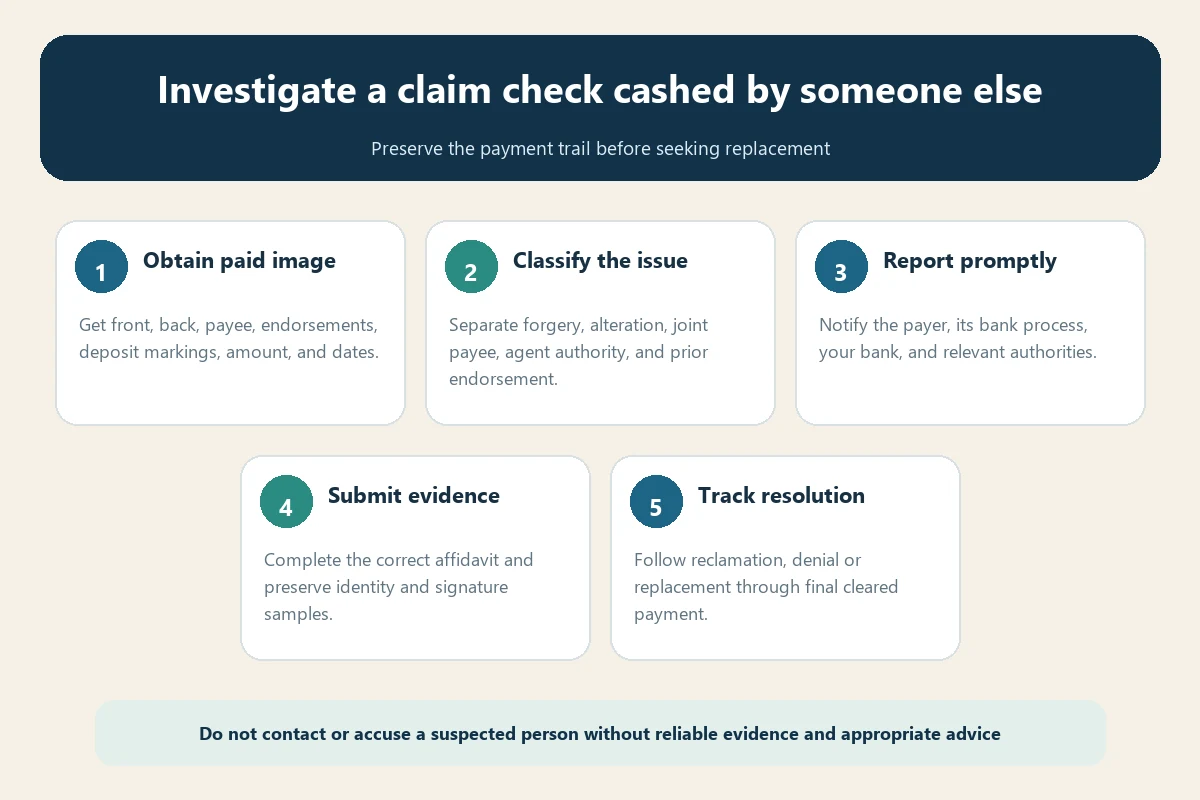
Request both sides of the paid check
Ask the insurer or its issuing bank process for a legible front-and-back image. The copy should show the original payee line, amount, issuer signature or data, check number, endorsement, deposit channel markings, processing stamps, and payment date. Request any available substitute-check or electronic presentment record.
Do not edit or annotate the master image. Create a separate working copy for notes. Store it securely because it can contain addresses, signatures, account fragments, claim numbers, and bank identifiers.
Compare the signature without overclaiming
Record factual differences between the endorsement and known genuine signatures, but do not present yourself as a handwriting expert. The endorsement may be a handwritten name, mobile-deposit notation, restrictive endorsement, business stamp, representative signature, or account credit without a visible traditional signature.
Ask whether the named payee ever possessed, signed, photographed, mailed, assigned, or authorized deposit of the check. A check genuinely signed before it was stolen presents different facts from one bearing a signature the payee never made.
Review every payee and connector
If the check names two people or entities, copy whether it uses “and,” “or,” another connector, or ambiguous punctuation. Another named payee’s deposit is not automatically authorized as to every payee.
The two-payee claim check guide explains joint and alternative payees, bank procedures, estates, providers, and reissue. Do not allege forgery solely because one co-payee negotiated a check that was actually payable in the alternative.
Notify the check issuer immediately
Contact the insurer, administrator, or payment vendor through the issued policy or official portal. State that you dispute the endorsement or negotiation and request preservation of the payment records. Obtain a case number, assigned fraud or payment unit, submission channel, deadline, and required form.
The Texas Department of Banking’s consumer FAQ says an intended payee whose check was fraudulently endorsed should notify the check writer and ask it to pursue the issue and replacement. That answer describes Texas law and banking allocation; other states and facts can differ. See the official Texas Department of Banking FAQ.
Understand which bank relationship applies
The insurer wrote the check from its account. A bank or check-cashing business accepted the item for deposit or cash, and the issuing bank paid it. The intended payee may not be a customer of either institution. Ask the insurer which party must initiate the endorsement claim and which forms the payee must complete.
The CFPB advises a check writer to contact its bank or credit union quickly after learning of a forged endorsement and notes that protections and reporting periods can depend on state law and whether the item was processed electronically. Review the official CFPB forged-endorsement answer. As the payee rather than account owner, coordinate through the issuer unless qualified advice directs otherwise.
Complete the correct affidavit
The payer or bank may require an affidavit of forged or missing endorsement, declaration of nonreceipt, indemnity agreement, signature specimen, identity copy, or notarization. Read every statement and use the form matching the facts.
State accurately whether you received the check, endorsed it, authorized anyone, obtained any proceeds, know the person or account shown, or previously reported loss. Do not sign a broad statement you cannot verify. Keep the completed copy, delivery evidence, and submission date.
Preserve relevant signature and authority records
Retain genuine signatures from reliable dated records, identity documents as requested securely, assignments, powers of attorney, provider authorizations, estate papers, guardian documents, and communications about payment. Do not circulate unnecessary identity documents to every participant.
If a provider, attorney, family member, travel companion, employer, or agent appears in the payment chain, collect the actual authorization. The assignment of benefits guide distinguishes assignment, direct payment, reimbursement, and information authorization.
Report mail theft or identity misuse through proper channels
If evidence suggests the envelope was stolen from U.S. mail, use the U.S. Postal Inspection Service’s official reporting page. If local theft, forgery, or identity misuse is suspected, ask the payer, bank, qualified counsel, and appropriate law-enforcement agency what report is needed.
A police or postal report documents notice; it does not by itself decide bank liability or guarantee replacement. Preserve the report number and avoid publishing check images or a suspect’s personal information.
Secure the claim account and payment channels
Change compromised claim-portal and email passwords, enable multifactor authentication, review forwarding rules and logged-in devices, and verify whether the mailing address or payment method changed. Do not reuse a compromised password.
The claim payment scam guide covers fake support, altered banking instructions, urgent verification messages, and recovery-fee scams. A person promising to recover the check in exchange for gift cards, cryptocurrency, remote access, or a login code is not following a legitimate bank process.
Track reclamation separately from replacement
The check writer’s bank may seek recovery from the institution that accepted the item. That bank-to-bank process is often called a warranty claim or reclamation, but names and procedures vary. Ask for the claim date, reference, responsible unit, response deadline, and current status.
Separately ask whether the insurer will issue replacement before recovery, after recovery, or only after a liability decision. Do not assume one universal sequence. Request the policy or legal basis for any prolonged hold.
Treasury check rules are only an example
The U.S. Treasury maintains a formal process for federal checks negotiated over forged endorsements, including claimant evidence and reclamation. Its Payment Issue Resolution guidance shows why nonreceipt, endorsement, proceeds, timing, and bank evidence are evaluated separately.
A private travel-insurance claim check is not a U.S. Treasury check and does not use the federal Check Forgery Insurance Fund. Do not cite Treasury replacement procedures as a right against a private insurer; use the private payer’s bank process and applicable state law.
Handle a denial with the evidence behind it
If the endorsement claim is denied, request the written decision, factual findings, check images, authority relied on, investigation documents available, and appeal or reconsideration process. Determine whether the denial says the signature was genuine, authorized, ratified, untimely, already compensated, or outside that institution’s responsibility.
Do not submit the same affidavit repeatedly without addressing the denial reason. Obtain qualified legal advice promptly because contractual, UCC, bank, insurance, and civil deadlines may apply.
Prevent duplicate negotiation after replacement
If a replacement is issued and the original later appears, do not deposit it. Follow the payer’s destruction or return instructions. If any original proceeds are recovered or credited after replacement, notify the payer and bank to avoid duplicate payment.
Verify the replacement payee, address, method, amount, and trace. The claim payment method guide can help choose a more secure delivery route. Reconcile final receipt to the written claim decision.
Escalate to the correct regulator
An insurance complaint can address the insurer’s claim and replacement handling; a banking complaint can address a regulated institution’s conduct; law enforcement handles alleged crime. One agency may not control all three.
The NAIC state insurance department directory links to official regulators. Include the policy, decision, check images, mailing record, first notice, affidavit, bank claim reference, responses, replacement status, and timeline. Protect full financial identifiers.
Bottom line
When someone else cashes a travel insurance claim check, obtain the paid image and classify the issue before demanding a remedy. Notify the payer promptly, complete the correct endorsement affidavit, preserve signature and authority evidence, secure compromised channels, and track bank recovery separately from replacement. Final resolution requires a documented decision and a replacement that reaches the intended payee without duplicate payment.
