
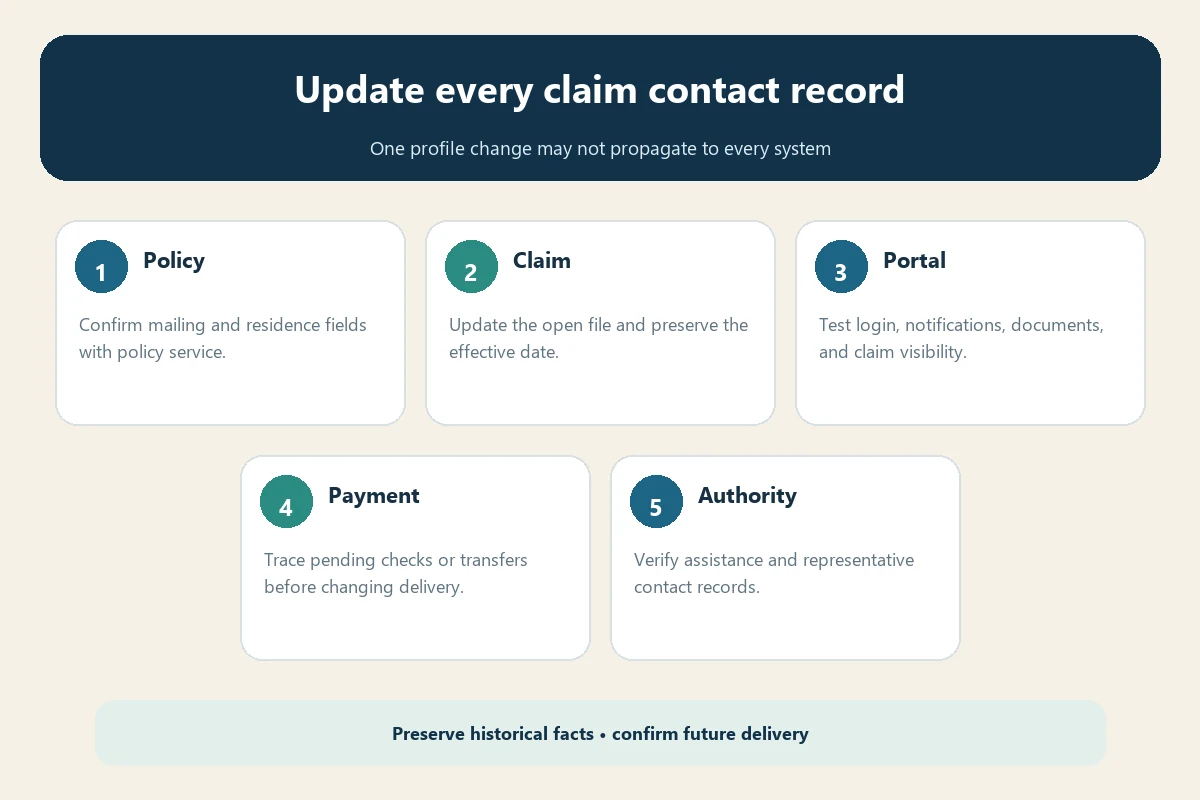
To change address during a travel insurance claim, update more than one screen. The policy account, claim file, portal login, mailing system, payment record, assistance case, and authorized-representative record may be separate. A change in one system does not prove that every future letter or check will use it.
This U.S.-focused guide explains how to update a mailing address, residence address, email, or telephone number without rewriting historical facts, losing deadlines, or exposing identity and payment data.
Separate the records that may need updating
| Record | Why it matters | Confirmation to obtain |
|---|---|---|
| Policy account | Contract and customer-service record | Fields changed and effective date |
| Open claim | Letters, requests, decisions, and examiner contact | Claim number and new delivery details |
| Portal login | Authentication and notifications | Verified email, phone, and access test |
| Payment | Check delivery or electronic verification | Payee, destination, issue status, and method |
| Assistance case | Ongoing medical or travel coordination | Case number and emergency contact |
| Representative | Who may receive or discuss records | Current authority and correspondence choice |
Distinguish mailing address from residence
A mailing address tells the administrator where to send correspondence. A residence address can be a policy eligibility, rating, or regulatory fact. A temporary hotel, family member’s home, postal box, or mail-forwarding address is not automatically the traveler’s legal residence.
State the change accurately: old mailing address, new mailing address, whether residence changed, move date, temporary or permanent status, and preferred delivery method. Ask whether the policy-service team needs a separate request.
Do not backdate a move or alter the address that correctly described the traveler when the policy was purchased or the loss occurred. Preserve historical facts and add the later change with its real effective date.
Use the administrator’s verified update process
Travel Insured International’s claims center says a claimant can provide a statement by the listed channels to have claim payment sent to a new address. That is one administrator’s procedure, not a universal form. Obtain current instructions from the exact administrator handling the policy.
Verify the portal, email, fax, postal address, or phone number independently from the issued policy or official website. Include the claim number and only the identity information requested through that channel.
Allianz’s online claim guide notes that a submitted claim cannot simply be edited, while additional documents can be added. This illustrates why a profile edit may not alter the filed claim record; follow the actual administrator’s correction process.
Build a contact-change ledger
Record one row for each system:
- system or organization;
- policy, claim, case, or account number;
- old field and new field;
- actual effective date;
- request date, time, and channel;
- representative or confirmation ID;
- documents supplied;
- date the change was confirmed;
- future letters or payments affected;
- follow-up owner and deadline.
Do not put a full Social Security number, bank account, passport number, or diagnosis in the ledger. Keep sensitive verification records in a protected folder.
Send one precise change statement
Re: Claim [number], policy [number]. Effective [date], my [mailing/residence] address changed from [old address] to [new address]. My preferred verified email and telephone are [details]. Please update the open claim and confirm which other policy, portal, payment, assistance, or representative records require a separate change. Please state whether any correspondence or payment has already been issued, its destination, and the effective date for future delivery.
If only email or phone changed, say so. Do not imply a residence move that did not happen.
Protect pending decision letters and deadlines
Ask whether any document was mailed or posted before the update, including requests for information, completeness notices, decision letters, appeal instructions, or closure notices. Request a secure duplicate and preserve both the original send date and the redelivery date.
The written claim decision guide explains how to request the status, reasons, calculation, payment, and appeal route when a letter is missing. Do not assume redelivery resets a policy or legal deadline; obtain guidance for the actual rule.
Handle a check already mailed to the old address
Ask whether the check was printed, mailed, delivered, returned, deposited, or still unissued. Request check number, issue date, payee, amount, destination, and trace status. If necessary, ask about stop-payment, void, and reissue procedures.
Do not merely submit a second payment request. A replacement check without a documented stop can create duplicate-payment risk. The claim payment method guide covers checks, electronic transfers, traces, rejections, and reissue records.
Postal forwarding may help with ordinary mail but should not replace direct confirmation from the administrator. Some financial mail can be restricted, returned, or delivered too late for a response deadline.
Verify electronic payment separately
A mailing-address change does not necessarily change the bank account or approved payee. Do not send new banking instructions unless the administrator requests them through a verified secure channel. Confirm whether any pending ACH or digital payment is affected.
If an unexpected message links the address change to an urgent bank update, pause and verify independently. The travel claim payment scam guide explains how to check domains, telephone numbers, changed instructions, and identity requests.
Update portal access without losing evidence
Before changing the login email or phone, download the policy, submitted forms, upload receipts, correspondence, and status history. Ask whether changing the credential creates a new profile or leaves the claim tied to the old account.
After the update, test login, multifactor authentication, claim visibility, document download, and notification delivery. Do not create a second claim because the first disappears from a new profile. Contact support and ask it to link access to the existing number.
Preserve proof of every delivery path
Keep the submitted change statement, portal receipt, email message ID, fax report, postal tracking, call reference, and written confirmation. If mail is returned, preserve the envelope and return notation because they show which address and delivery attempt were used. Download screenshots as files with dates rather than relying on a portal history that may later disappear.
Maintain a list of correspondence expected but not yet received: document request, completeness notice, decision, payment notice, tax record if applicable, and closure confirmation. Follow up by claim number and ask whether the item can be delivered securely through another approved channel.
The claim record-retention guide explains how to retain policy, correspondence, payment, appeal, and recovery records after the move. Keep address-change evidence until every affected claim, payment, appeal, and delivery issue is resolved.
Separate claimant contact from representative contact
A spouse, parent, estate representative, caregiver, attorney, or authorized agent may receive copies or speak with claims. Changing the claimant’s address does not automatically revoke or update that authority.
Ask who is the primary correspondence recipient, who receives copies, and whether the authorization has an expiration or scope. A change of address should not silently redirect sensitive medical records to a person without current authority.
Work through a move-and-payment example
A claimant moves on August 1 while a cancellation claim is under review. The online customer profile is updated that day. On August 4, the claims team mails a partial decision and check to the old address because the open claim retained the original contact record.
The claimant should preserve the August 1 profile confirmation, notify the claim team directly, and ask when the check and letter were issued. The ledger should show separate updates for the account and claim. If the check has not been deposited, the administrator can explain trace, stop, and reissue steps. The claimant should also obtain the decision securely so an appeal deadline is visible.
The update does not justify changing the address recorded on booking invoices, medical records, or the original claim form. Those documents remain historical. The new mailing address governs future delivery after confirmed processing.
Correct an address-related identity mismatch
A bank statement, ID, policy, and medical bill can display different addresses because they were created at different times. Explain the chronology and supply only the requested bridge evidence. Do not edit an original record.
The claim identity mismatch guide provides a record-owner method that also works for address history: identify who created each record, when it was valid, and which organization can correct or explain it.
Escalate when the update does not propagate
If letters continue to go to the old address, ask a supervisor to audit the claim, policy, payment, and portal systems. Provide the ledger and confirmations. Request written confirmation of the current address in each affected record.
If internal correction fails or a missed notice materially affects the claim, use the policy complaint procedure and contact the appropriate regulator. The NAIC directory links to state insurance departments. Rules and jurisdiction vary; provide the issued policy, update receipts, misdirected records, and resulting claim impact.
Contact-change checklist
- Label mailing, residence, email, phone, and payment fields separately.
- Preserve the old values and actual effective date.
- Verify the administrator’s official update channel.
- Update policy, claim, portal, assistance, payment, and representative records as needed.
- Obtain confirmation for each system.
- Trace letters or checks already issued.
- Protect response and appeal deadlines.
- Test portal access and future notifications.
- Escalate with the contact-change ledger if delivery remains wrong.
A contact change is complete only when every system that can send a claim request, decision, or payment reflects the correct future destination. Preserve historical addresses, document the change date, and verify delivery instead of assuming one profile edit propagated everywhere.
