
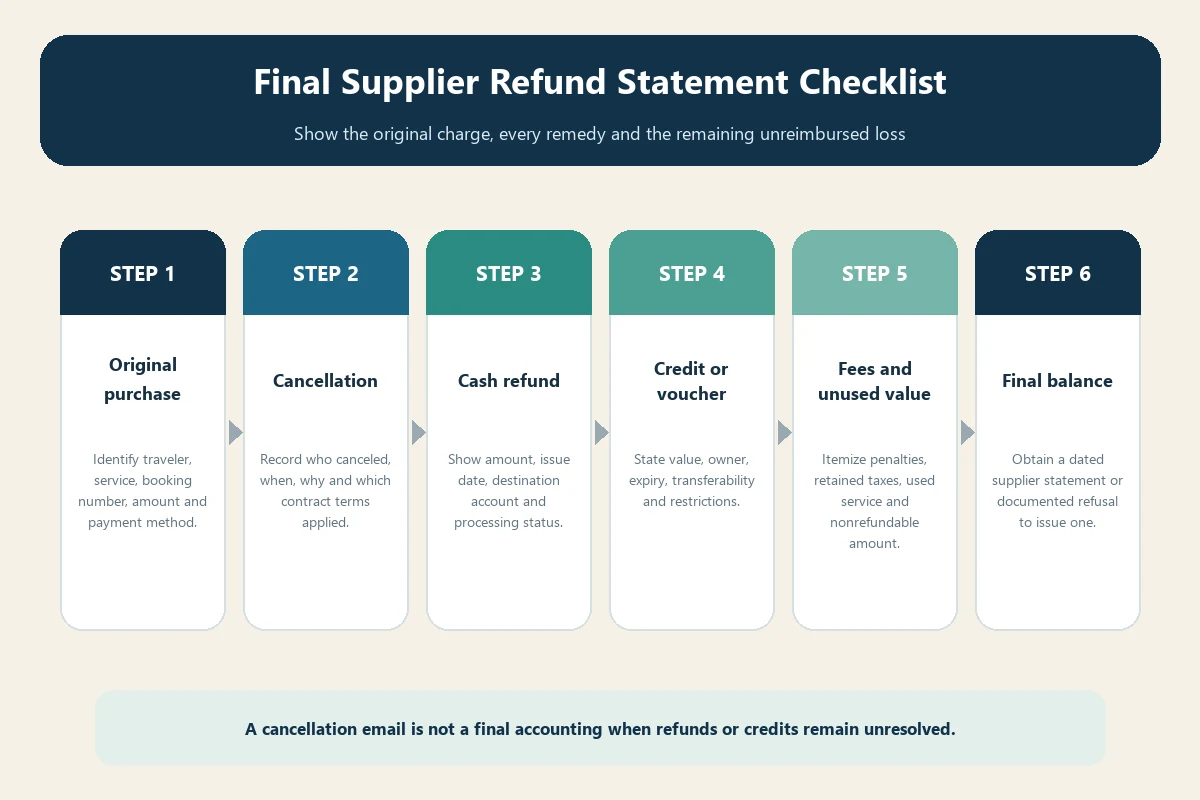
A travel insurance claim supplier refund letter or no-refund statement should answer more than “the booking was canceled.” The adjuster needs a final accounting of the original cost, traveler, service, cancellation date, cash refund, taxes, fees, voucher or credit, used portion, and remaining nonrefundable amount.
Airlines, hotels, cruise lines, vacation rentals, tour operators, and travel agents use different systems and names. Ask for a final refund statement, cancellation invoice, zero-refund letter, folio, ticket status, or account ledger—whichever official record contains the facts. Preserve the original terms and every later change.
Key takeaways
- A cancellation confirmation does not necessarily show the financial loss.
- Request a line-by-line accounting for each traveler and service.
- Cash refunds, vouchers, credits, taxes, fees, and pending amounts must be separated.
- A supplier’s “nonrefundable” label does not itself prove an insured covered reason.
- Open the insurance claim on time while the supplier accounting is pending.
Why the insurer requests it
Trip cancellation and interruption benefits generally evaluate an eligible prepaid loss after refunds, credits, and other recoveries under the policy. The insurer must distinguish money never at risk from money truly lost. It also needs to avoid paying an amount later returned by the supplier or card issuer.
The supplier statement does not decide coverage. It proves the financial side. Medical evidence, carrier disruption, weather, death, jury duty, or another covered reason must be documented separately.
Cancellation notice versus refund statement
A cancellation email can show when a reservation was canceled. It may omit the amount paid, refund method, fee, credit, or balance. A booking confirmation shows original plans but not final disposition. A card statement shows money movement but not supplier policy or allocation.
A complete packet commonly includes all three: original invoice, cancellation record, and final refund accounting, plus payment evidence. If one document combines those facts, confirm every traveler and service is included.
What the statement should include
- supplier legal or trading name and contact information;
- traveler or guest names;
- booking, ticket, reservation, cabin, or invoice number;
- service dates and description;
- original charge by traveler and component;
- payment dates and methods;
- cancellation or interruption date;
- used and unused portions;
- cash refund, taxes returned, fee retained, and refund date;
- voucher or credit amount, restrictions, expiration, and transferability;
- pending refund or dispute status; and
- final nonrefundable balance and reason.
Ask for the currency on every figure. If the supplier issues separate documents, create an index rather than editing them into one unofficial statement.
Airline ticket accounting
An airline record can involve base fare, taxes, seat, baggage, lounge, upgrade, and change fees. Request the e-ticket receipt, coupon or segment status, cancellation or rebooking history, and refund confirmation. Identify whether each segment was flown, exchanged, open, voided, or refunded.
U.S. DOT rules can require refunds in certain cancellation or significant-change situations when the passenger does not accept the alternative, subject to current law and facts. Check the current DOT refund page rather than relying on an old summary. Insurance coverage remains a separate contractual question.
Hotel and vacation-rental statements
Ask the hotel for the original confirmation, rate and cancellation terms in effect at booking, final cancellation number, deposit ledger, no-show charge, taxes, refund, and remaining balance. A reservation platform and the property can each hold different pieces.
For vacation rentals, distinguish rent, cleaning fee, taxes, service fee, damage deposit, host refund, platform refund, and credit. Ask which entity retained each amount. A host saying “I issued everything I received” may not resolve the platform fee.
Cruise and tour accounting
Cruise invoices can include fare, port charges, taxes, gratuities, excursions, air programs, transfers, packages, and future cruise credits. Request the final passenger ledger and cancellation-penalty schedule applied on the cancellation date. Identify travel-agent commissions or fees separately when relevant.
Tour operators may issue one group invoice. Ask for each insured traveler’s allocation, used services, supplier refunds, and retained amount. If only the group organizer receives the refund, document how it will be distributed.
Package bookings with several suppliers
A package price may combine air, lodging, transfers, activities, and an agency margin without showing component values. Ask the package provider to allocate original cost, used value, refunds, and retained amounts by component. If it refuses to reveal contracted wholesale rates, request at least an official statement of the traveler’s total nonrefundable loss and every credit.
Do not assign arbitrary retail values to make the total reconcile. Identify what the supplier confirms and what remains unallocated. The insurer may apply the package terms, benefit limits, or another reasonable allocation method. For multiple insured travelers, request each person’s share and explain child, single-supplement, or occupancy pricing.
Taxes and fees need their own lines
Some taxes and government charges can be refundable even when the fare or service is not, while certain supplier or agency fees may be retained. Ask the statement to separate them. A total labeled “penalty” without calculation can prompt another request.
When only part of a tax or fee returns, preserve the supplier explanation and posting. Do not treat all taxes as automatically refundable or all fees as insured; current law, supplier terms, and the policy determine their treatment.
Travel agent versus underlying supplier
The agent may collect funds and pass them to airlines, hotels, or tour operators. Request the agent’s invoice, payment allocation, cancellation action, service fee, and every supplier response. Ask whether the agent still holds funds or awaits a refund.
A statement that “the supplier has not paid us” is not final. Record it as pending, protect the insurance deadline, and submit updates. If the agent has closed, contact the underlying suppliers and preserve failed contact attempts.
Cash refund versus travel credit
A cash refund restores money. A credit or voucher can have expiration, blackout, traveler, destination, transferability, or fare restrictions. The policy determines how the credit affects the insured loss. Provide the full terms and state whether it was accepted, declined, used, or expired.
Do not describe an inconvenient credit as “no refund” without disclosing it. Conversely, do not assume the insurer will value a restricted credit at face value. Request a written claim calculation.
Partial use and trip interruption
When travel began, the supplier must separate used from unused arrangements. For a cruise, that can mean sailed nights, unused nights, excursions, and early-disembarkation charges. For a tour, identify completed hotels and activities. For a round trip, show flown and unused ticket coupons.
Keep new return transportation separate from unused prepaid cost. Our trip interruption guide explains the benefit lanes.
How to request the statement
Write a short, factual message with the booking and traveler details. Ask the supplier to confirm original cost, cancellation date, every refund or credit, used value, retained fees, pending amounts, and final nonrefundable balance. Request the reply on an official invoice, letter, account export, or email from the supplier domain.
Give a response deadline tied to the insurance claim without demanding a coverage conclusion. The supplier should document its accounting, not state whether travel insurance must pay.
Sample request structure
Please provide a final account statement for booking [number] for [traveler names], service dates [dates]. Show the original cost and currency, payment received, cancellation date, services used, cash refunds with dates, credits or vouchers with terms, fees retained, pending amounts, and final nonrefundable balance. Please identify each amount by traveler and component.
Adapt the request to the supplier. Do not ask it to backdate a letter or use words that are inaccurate.
If the supplier will not issue a letter
Combine authentic system records: booking confirmation, terms, cancellation screen, chat transcript, ticket status, card refund, account ledger, and written refusal. Preserve complete timestamps and agent names. Explain the remaining gap to the adjuster and ask which substitute evidence it will accept.
Follow the evidence hierarchy in our claim without receipts guide. A self-created spreadsheet is an index, not a supplier statement.
Chargebacks and disputed transactions
Disclose any card dispute. A provisional credit is not a final refund, and a reversed chargeback changes the loss again. Provide the dispute opening, provisional credit, merchant response, and final issuer decision. Avoid inconsistent statements between the insurance and card cases.
When a later credit posts after insurance pays, use our subrogation and later-refunds guide.
Currency conversion
Keep the supplier’s original currency and the card’s U.S.-dollar posting. A refund can convert at a different rate from the purchase. Do not hide the difference or use today’s rate. Our currency claim guide provides a line-by-line method.
Submit a supplier reconciliation
Create one row per booking component with original cost, paid amount, used value, cash refund, credit, fee, other recovery, and remaining claim. Link each number to the supplier page or card statement. If the figures do not add up, identify the pending item instead of forcing a balance.
Include this with the indexed packet in our claim documentation guide. An Explanation of Benefits belongs in a medical payer lane, not as a substitute for a travel supplier statement.
Protect deadlines while waiting
Give the insurer prompt notice and submit the original booking, cancellation request, current refund status, and proof that a final statement was requested. Use our notice and proof-of-loss guide. Ask to supplement the file when the supplier responds.
FAQ
Does “nonrefundable” prove the claim?
It supports the amount at risk but does not prove that the cancellation reason is covered.
What if the refund is pending?
Disclose the amount and request date, submit available proof on time, and update the insurer when it resolves.
Does a voucher count?
Policy treatment varies. Provide its full terms, value, restrictions, and status.
Can a card statement replace the supplier letter?
It proves money movement but may not show services, cancellation terms, allocation, or final nonrefund. Combine records.
Bottom line
A useful supplier refund statement follows the money from original booking to final loss. Obtain the booking, cancellation, itemized refunds, credits, fees, used value, and pending amounts for each traveler and service. Submit on time, disclose later changes, and leave the coverage decision to the insurer.
Sources
- U.S. DOT — Airline Refunds
- U.S. DOT — File an Air Travel Complaint
- CFPB — Disputing a Credit Card Charge
- NAIC — What to Know About Travel Insurance
- New York DFS — Travel Insurance
- California Department of Insurance — Travel Insurance Guide
Reviewed August 16, 2026. This article is educational information. Supplier rights, refunds, credits, and insurance treatment depend on current law, contract terms, and claim facts.
